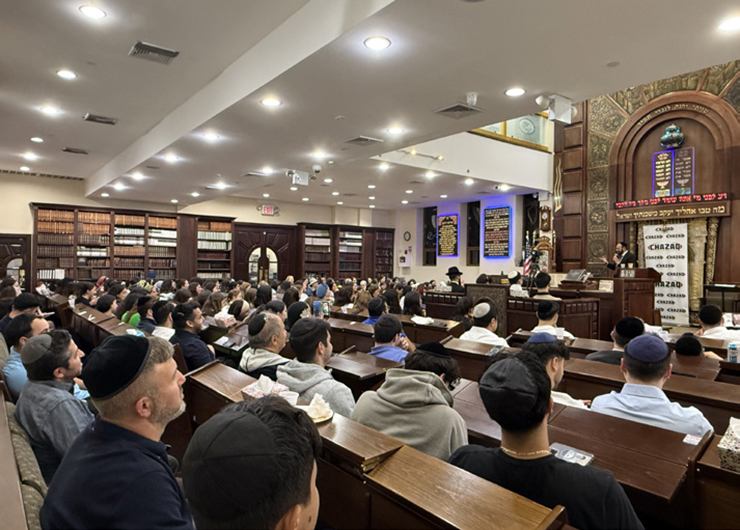

On Thursday night, June 25, the community gathered at the Young Israel of Hillcrest for a special shiur hosted by Chazaq on the topic of finding one’s match. Robbie Aboff welcomed the crowd and introduced the evening’s speaker, Rabbi Yisrael Yakubov, a well-known lecturer who traveled from Toronto to Queens to share valuable ideas on how to find one’s zivug.
Rabbi Yakubov began by explaining that physical effort is, of course, necessary when looking for a match. A person must call people and ask if they know someone appropriate; they must prepare a résumé and may even post that résumé on various dating sites. Normal effort is required. He compared this to earning a living. A person cannot simply stay home and say, “G-d will send me the money.” Hashem wants a person to do something, and then He sends the blessing. A person must create a vessel for the blessing, and that vessel can be created through both physical effort and spiritual effort.
Rabbi Yakubov then addressed the following question: How does one make spiritual efforts to find a match? He noted that spiritual effort can be even more powerful than physical effort. People often refer to these spiritual efforts as segulos. A segulah, he explained, is something a person does to connect to the Source of abundance. When a person wants a particular blessing, that blessing comes from Hashem. The segulah may be a prayer, an intention, or a physical action that connects a person to the root of blessing and helps open something that is blocked. “It’s locked,” he said, “and you need to open it.”
He compared this to the area of health. A person who wants to be healthy can make physical efforts, such as eating healthful foods and exercising. At the same time, a person can also make spiritual efforts. Spiritual effort means doing something that connects a person to the root of blessing, allowing Hashem to send that blessing. It requires a person to change something within himself or herself in order to bring down the desired blessing.
Rabbi Yakubov explained that a segulah is beyond the physical world. “I can’t explain how it works,” he said. However, he cautioned that not every practice called a segulah is legitimate. There are segulos that do not have a source, and if something does not have a source, he said, it does not work. If it comes from a tzadik, however, it can serve as a remedy to help bring about a particular result. He noted that the Talmud teaches the concept of tzadik gozeir – that a tzadik decrees and Hashem fulfills the decree. “That is why we are comfortable with segulos,” he said. “I saw so many people following certain segulos, and they got what they wanted.”
Still, Rabbi Yakubov emphasized that a segulah cannot be the entire focus. If a person’s main effort to get married is only through segulos, that is not what Hashem wants. Spiritual efforts must come in addition to physical efforts. A person must also be connected to Hashem. The key idea, he explained, is that the more connected a person is to Hashem, the more effective the segulos become.
Rabbi Yakubov then shared a list of spiritual acts, all rooted in Torah sources, that can help a person find a spouse more quickly. He began with segulos for women, explaining that certain actions are especially connected to women, while others are more focused on men.
He related that one of the difficult mitzvos for women can be hosting guests. One reason, he said, is that women often want the attention of their husbands. In many homes, the woman also carries much of the responsibility for caring for the guests. In addition, women may be more perfectionist by nature. In general, he said, men often enjoy hosting more than women do. Women also tend to value privacy more. Hosting has three levels: providing food, drink, and a place to sleep. When a guest sleeps in one’s home, that is the highest level of hospitality, but it also means giving up some privacy.
Rabbi Yakubov explained that when a person does something above his or her nature, Hashem responds midah k’neged midah, measure for measure. When a person goes beyond nature for Hashem, Hashem can do something beyond nature for that person. Finding one’s zivug, he said, is also beyond nature.
He shared that a great tzadik taught a segulah for women who want to get married. A woman should say to Hashem that she accepts upon herself that, when she gets married, she will have a room or bed available for guests for Shabbos. Accepting such a commitment, he said, is a segulah that opens something spiritually. It can remove blockages and help bring her zivug more quickly. Rabbi Yakubov said that many women who accepted this upon themselves saw a salvation that same year.
For men, Rabbi Yakubov spoke about the importance of Kiddush Levanah, the blessing recited over the new moon. When a man performs Kiddush Levanah, he said, he strengthens the moon. Rabbi Chaim Vital taught that if this mitzvah is performed without happiness, it does not fully accomplish what it is meant to accomplish. A person must bless the moon with simchah. If a man accepts upon himself to perform Kiddush Levanah with joy, Rabbi Yakubov said, it is a segulah to find his match more quickly. If he continues to perform this mitzvah with joy, he receives more brachah, because blessing the moon is, in a certain sense, like blessing one’s wife. Women are associated with the moon, while men are associated with the sun.
For women, he added, a daughter can ask her father to perform Kiddush Levanah with happiness. After he recites Kiddush Levanah with joy, he should ask Hashem to bring his daughter her zivug. This, Rabbi Yakubov said, is another powerful segulah.
If possible, Rabbi Yakubov said, a man should add a meditation after reciting the blessing, which makes the practice even stronger. He should say one of the Names of Hashem that opens the blessing of finding a match: yud, hei, vav, and hei.
Another segulah for women, Rabbi Yakubov continued, is to perform a mitzvah even before one has the thing one is praying for. For example, a person may buy mezuzos before owning a house. Similarly, a woman can go to a Judaica store and buy beautiful tzitzis for her future husband to wear under the chupah. She can then come home and say, “Hashem, I bought the tzitzis for the chupah, but I have one problem: I do not yet have the husband.” Rabbi Yakubov explained that such an act creates a spiritual opening. “Hashem says, ‘I have to pay you back.’” He advised taking the tallis and using it as a way to pray to Hashem.
Rabbi Yakubov then shared a teaching from Rebbe Nachman of Breslov, which applies to men and can also be used by women. If a person sees that he or she is making efforts and Hashem has delayed the match, the person can do something spiritual to remove the blockage. Rebbe Nachman taught that a person should recite Tehillim 100, Mizmor L’Sodah, a song of thanks. Rabbi Yakubov explained that when a person thanks Hashem, Hashem grants that person’s wishes more quickly. The more thankful a person is to Hashem, and the less he or she complains, the more this serves as a segulah.
He added that if a man learns halachah every day, it is a segulah to get married more quickly. Rabbi Yakubov suggested that a man accept upon himself to learn a minimum of two halachos each day. “Read two a day,” he said, “and you will get the kallah faster. And say Tehillim 100. It helps.”
Rabbi Yakubov then shared a unique segulah brought down by the Ben Ish Chai. The Torah, he explained, is the Book of Life, and all blessing is found in it. For finding one’s zivug, a person should recite six chapters of Tehillim every day: 32, 38, 70, 71, 127, and 124. One can also add Shiras HaYam. After reciting these chapters, the person should take an apple, which represents love and shalom bayis. The apple should be cut into five pieces. The person should then recite the blessing over the apple slowly, eat it, and then ask Hashem for his or her match.
He noted that eating apples together is also a segulah for shalom bayis. A husband and wife should eat apples together, and Rabbi Yakubov suggested having apples on the Shabbos table. Apples, he explained, symbolize a certain energy in the higher world and awaken an energy of blessing.
Rabbi Yakubov also spoke about the Magen David, which is made of two triangles. The first triangle represents the Jewish people in this world reaching upward toward Hashem. The second triangle represents Hashem’s energy descending to us. The Magen David, he said, is the symbol of the Jewish people.
He pointed out that most segulos are not fully explained. A segulah, he said, is spiritual medicine.
Rabbi Yakubov also noted that certain times of the year offer a stronger opportunity to pray for one’s zivug. For example, when it rains, prayers are stronger. At such times, a person should pray in his or her own words and ask Hashem: “Please give me my soulmate.”
Sometimes, he added, helping others get married can help a person get married as well. This can include giving money to help someone get married or participating in the chupah, such as holding up the tallis over the chasan and kallah.
Rabbi Yakubov then spoke about the power of stories. Rebbe Shlomo of Bobov taught that there is a certain story that, if a person hears it or tells it to someone else, can help that person get married. He also noted that stories can bring healing. Rebbe Nachman of Breslov once told three stories to his daughter when she was very ill, and she got better. There are certain stories of righteous people, Rabbi Yakubov explained, that bring blessing simply by being heard.
Rebbe Shlomo of Bobov said that one should hear this story or say it over to someone else, and it is a segulah to get married more quickly. The story can be heard at the end of Rabbi Yakubov’s speech on TorahAnytime.
Rabbi Yakubov concluded his shiur by offering a blessing to the listeners. He blessed them that they should have chein, that they should have success in all that they do, that their words should be heard, and that they should find their zivug hagun – the right match – and live peaceful, beautiful lives together.
By Susie Garber