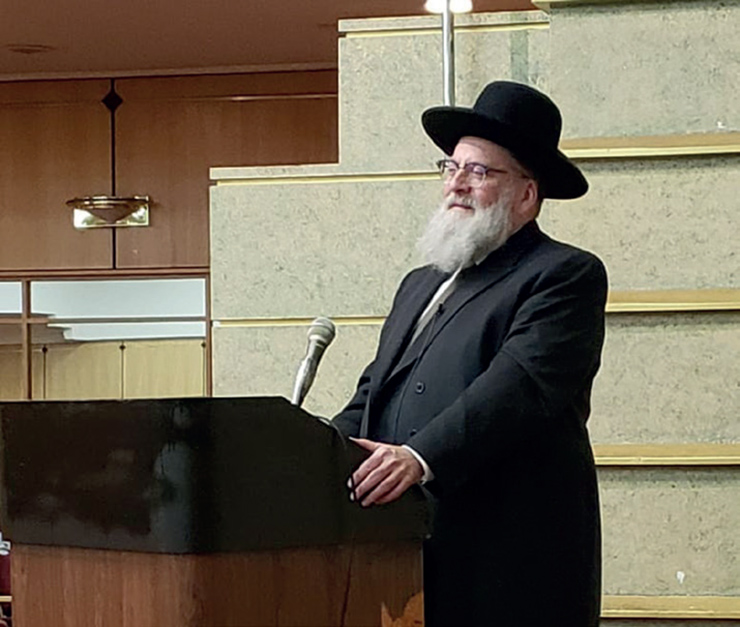

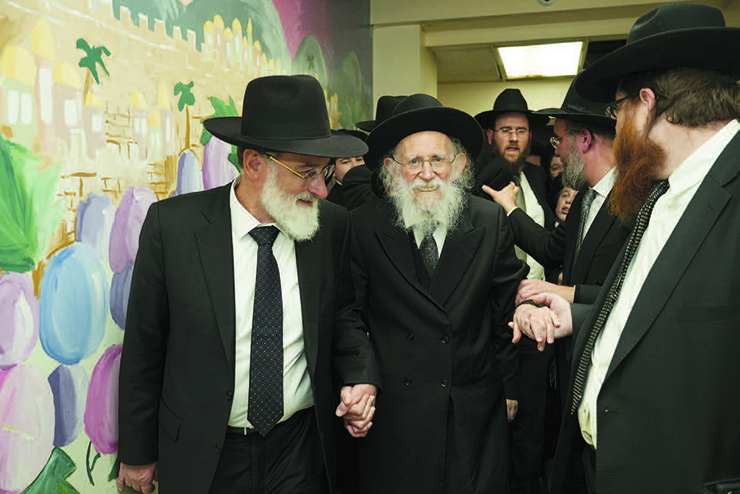
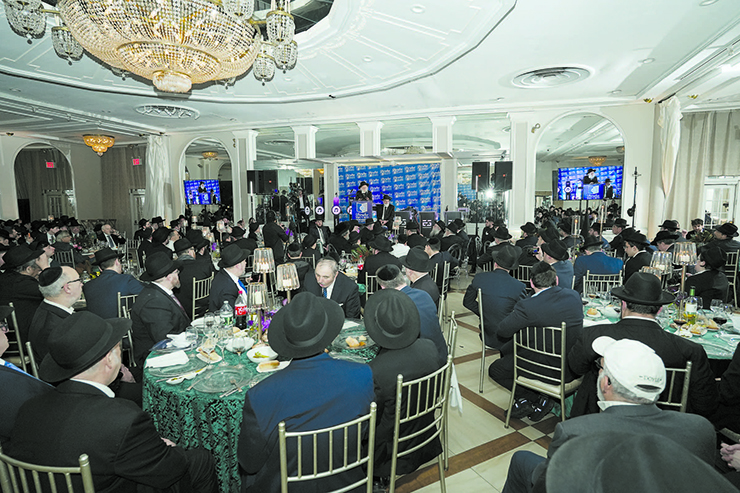
Emotion gripped the assemblage. Wide-eyed with awe, everyone watched the Gaon and Tzaddik, HaGaon HaRav Shimon Galei, shlita, walk into the hall of the White Shul in Far Rockaway, arm-in-arm with the Nasi of Dirshu Rav Dovid Hofstedter, shlita. It was just a harbinger of what was to come in a night full of spiritual and emotional highlights that brought together some five hundred members of the Far Rockaway-Five Towns communities.
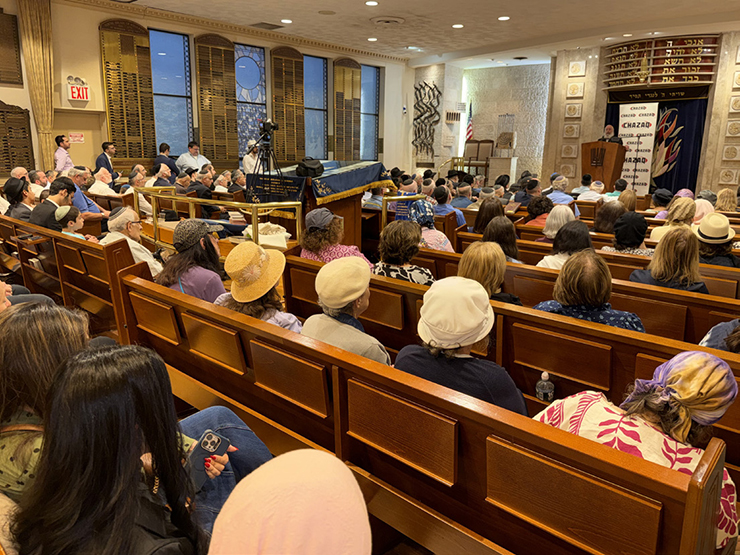
Ostensibly a siyum on Chelek Gimmel of Mishnah Berurah that was recently completed in Dirshu’s Daf HaYomi B’Halacha daily halacha program, the event was really much more! Held on Sunday, January 4, the gala siyum marked a renaissance of Dirshu learning and programing in the community, bringing a tremendous enthusiasm and outpouring of interest in joining one of Dirshu’s programs of accountable kevius ittim l’Torah such as the Amud HaYomi and the Daf HaYomi B’Halacha.
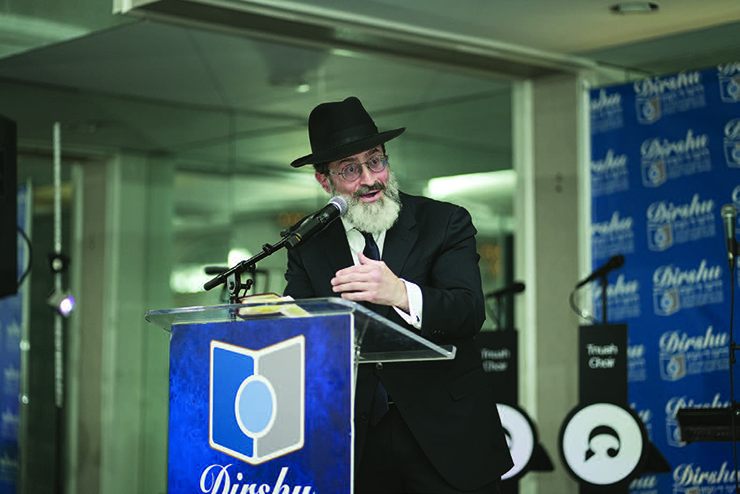
In addition to Rav Galei’s powerful words of chizuk, riveting drashos were given by HaGaon HaRav Shlomo Avigdor Altusky, shlita, Rosh Yeshiva of Yeshiva Darchei Torah, Rav Eytan Feiner, shlita, Rav of the White Shul, Rav Dovid Hofstedter, shlita, Nasi Dirshu, and Rav Moshe Tuvia Leiff, shlita, Rav of the Agudas Yisrael Beis Binyomin Shul in Flatbush. The event also featured deeply uplifting music with Baruch Levine, and the Tnuah choir, added an elevated dimension, creating a particularly festive atmosphere.
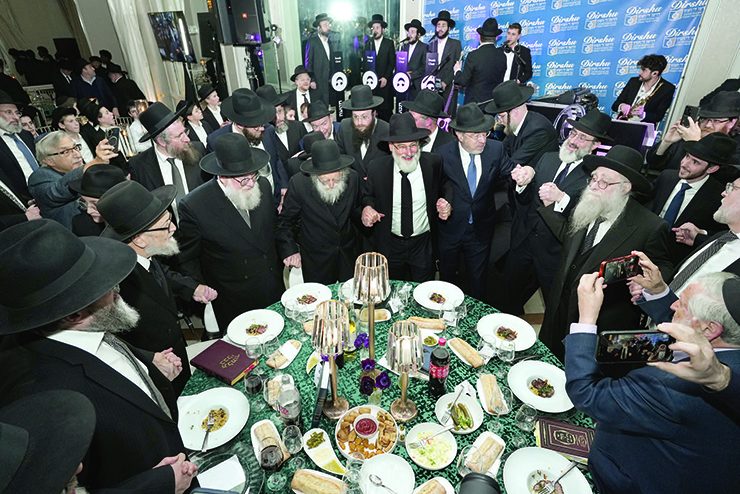
There were so many highlights. There was Rav Dovid Hofstedter’s deeply personal story of what brought him to the maamad, there was Rav Shimon Galei’s spontaneous singing that fired up the entire assemblage, there was the spirited dancing after Rav Altusky made the siyum and the Gedolim on the dais danced with each other setting the tone for the unique simchas haTorah that permeated the atmosphere, and there were the passionate words of Rav Moshe Tuvia Lieff quoting Rav Shach on how a person should approach the upcoming perek of Arvei Pesachim in the Amud HaYomi program…
“I Came to Acknowledge Dirshu… I Left Burning with Passion!”
One resident from Cedarhurst remarked, “I came because I felt it was important to acknowledge the work of Dirshu in making Torah accessible to all segments of Klal Ysrael, but I left a different person! I left with a burning desire to join the Amud HaYomi, to learn, complete and take tests on Arvei Pesachim so that when I sit down to the seder this year, I will do so with a clarity in all aspects of the seder.”
The evening began before the actual siyum did.
When word got out that Rav Shimon Galei would be available, in advance of the event, to personally meet with people to advise them and give them brachos, throngs came. Some two hundred Yidden lined up more than an hour before the event was slated to begin, waiting for their turn to speak with the Gadol and Tzaddik. People came to ask him to daven for shidduchim for themselves or their children, others came to ask him to daven for their children who were struggling with Yiddishkeit, yet others came to ask him to daven for sick family members… Through it all, Rav Shimon, with his unique, deep way of feeling the pain of another, took all their burdens onto his own shoulders.
The event itself began with a bang. It wasn’t long before the tables were full and people were still coming, standing all around with the overflow crowd participating in a nearby room where a live-feed was being shown.
Even the organizers were surprised at the massive crowd, which was a testament to the impact Dirshu has had on the community.
Setting the Tone of Ashreichem Talmidei Chachomim
As the participants washed for Hamotzi and sat down, Rav Shimon Galaei was invited up to address the assemblage. Rather than begin speaking, Rav Shimon, in his inimitable way, began singing! The words “Shaarei shomayim pesach” - a song where we beg Hashem to open the gates of heaven and shower us with bracha from His infinite otzar, treasure house of bracha – filled the cavernous hall. The tangible emotion and feeling of Rav Shimon reverberated throughout and the crowd joined in, raising their voices in song. Soon, everyone was on their feet singing, davening. The emotion reached a crescendo and it was clear to everyone there that they were indeed tapping into a unique eis ratzon. The emotion, the tefillos, the tears that were shed, defy description.
Rav Shimon then began explaining that a siyum on Chelek Gimmel of Mishnah Berurah and the fact that so many have now started Chelek Daled which contains the more obscure halachos of eiruvin which so many used to skip is a tremendous simcha. “There is great simcha in shomayim and it is therefore an eis ratzon, an opportune time to access Hashem’s bracha!”
At the conclusion of his drasha, Rav Shimon once again began to sing. This time it was the enthusiastic tune of “Ashreichem talmidei chachomim.” Indeed, he set the tone for the evening, an evening that was a declaration of the concept of ashreichem talmidei chachomim, praiseworthy are talmidei chachomim who devote time every day with a kevius of limud haTorah!
The Importance of Kevius, Especially Global Kevius!
Originally, HaGaon HaRav Reuven Feinstein, shlita, was scheduled to make the siyum, but unfortunately, he was hospitalized last week and was unable to attend.
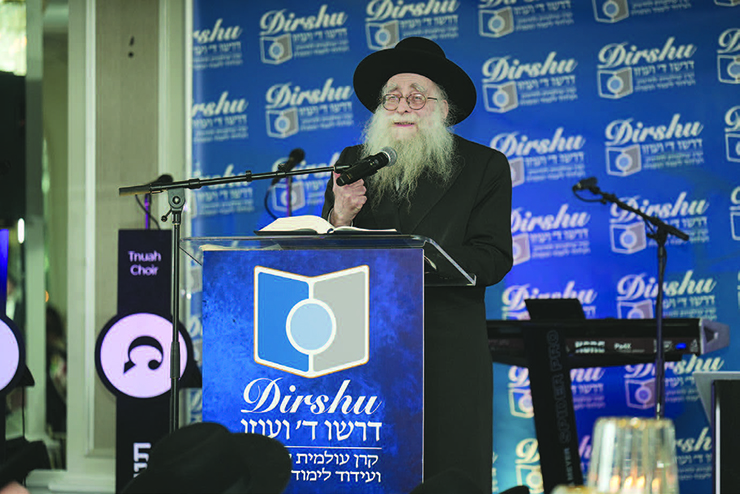
The community had the great fortune of having the siyum made by Rav Shlomo Avigdor Altusky, beloved Rosh Yeshiva of Yeshiva Darchei Torah.
Rav Altusky first gave a beautiful, comprehensive shiur on the last se’if in Chelek Gimmel, and then before he made the hadran, he addressed the assemblage.
In his very important, very practical message, he conveyed the importance of making a kevius, a set time to learn every day. “Whether you are able to learn a lot or a little, it is critical that the learning should be kavua, day after day.” He explained from the Chassid Yaavetz that the kevius is the most important part of the day and everything one does during the day is in essence a preparation for his kevius. Thus, even if a person spends most of his day engaged in earning a parnassah, if his daily kevius in learning is the center of his day, the most important thing in his day, then even the time he spends earning a living is also a mitzvah! Why? Because it is the preparation for his learning! He said that this is especially relevant with a program such as Dirshu where you are joining so many Yidden across the globe in this very same kevius.
After Rav Altusky completed the Kaddish it seemed as if a spark had been ignited! Such a contagious outpouring of unmitigated simcha was felt throughout the hall as the assemblage jumped up in dance and song. Young and old danced with unrestrained simcha shel mitzva in a way that that one rarely sees!
The Double Prerequisite to Acquiring Torah
Rav Eytan Feiner, one of the people most integral in making the evening a success, was then called on by the Chairman of the event, Rabbi Meir Avracen, Dirshu’s Far Rockaway, Five Towns coordinator to address the event.
Rav Feiner pointed out that he and Dirshu’s Nasi, Rav Dovid Hofstedter, share a name, the name Dovid.
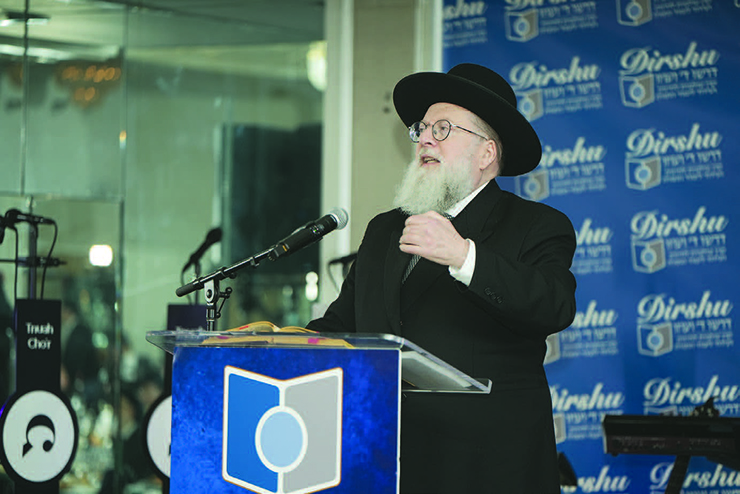
“There is a minhag,” Rabbi Feiner said, “that before completing the Shemoneh Esrai, one recites a passuk that starts with the first letter of one’s name and ends with the last letter of one’s name. The passuk that both I (my middle name is Dovid) and Rav Dovid say, is ‘Dirshu Hashem v’uzo, bakshu panav tamid.’ What do the words ‘dirshu’ and ‘bakshu’ mean? The Vilna Gaon in his commentary on Mishlei says, ‘In order to acquire Torah, one needs two things: constant drisha, constant learning and toiling, investing tremendous mental energy in Torah, but that is not enough. Coupled with the drisha, a person needs, ‘bakshu’, he needs to beg Hashem, daven to Hashem from the bottom of his heart that he should merit to understand and acquire Torah. That,” Rabbi Feiner exclaimed, “is what Rav Dovid Hofstedter has done! He has invested so much into the ‘drisha’, into facilitating learning thereby earning the siyatta d’Shmaya so necessary for success in learning.”
The Two Levels of Zechuyos Needed for Geulah
Rav Dovid began his drasha by praising the wonderful Far Rockaway and Five Towns communities for their outpouring of enthusiasm and support for Dirshu’s mission. “I see that this community is no different than Yerushalayim, Lakewood, or London, in the way they have embraced Dirshu’s mission.”
Rav Hofstedter continued by teaching a relevant lesson from the parshiyos of Sefer Shemos. “We are now in Sefer Shemos, the sefer of geulah. The Gemara teaches us that the time for the geulah [from Mitzrayim] had come but Am Yisrael had no mitzvos with which to occupy themselves - Hashem therefore gave them two mitzvos: The blood of Pesach and the blood of milah... (Rashi 12:6)
“The Kli Yakar asks a profound question. ‘How can the Medrash say that they did not have mitzvos? The Gemara (Sotah 11) states, “In the merit of the nashim tzidkanios in that generation the Bnei Yisrael were redeemed from Egypt.’ The Gemara explains that in a time of great peril, when Pharaoh had decreed that every male baby must be thrown in the river, the women displayed heroic self-sacrifice and, despite the government decree, brought children into the world.
“Furthermore, we are all familiar with the Medrash (Emor 32) that states, ‘In the merit of four things, the Bnei Yisrael were redeemed from Egypt. They didn’t change their names or their language, they didn’t speak lashon hara, and they were not guilty of arayos.
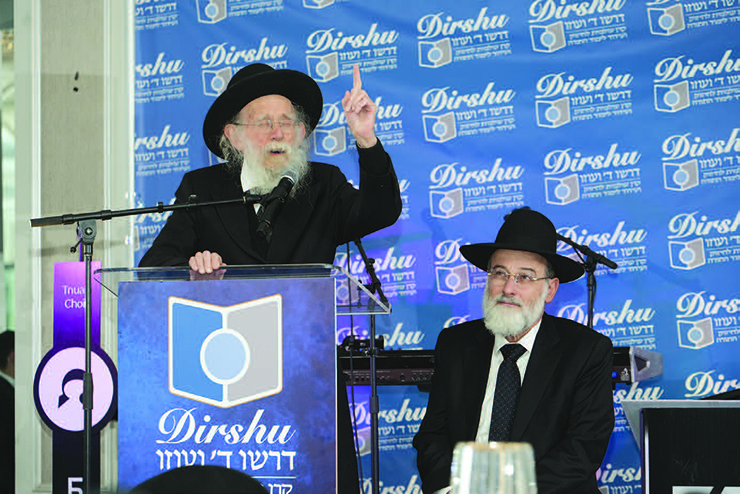
“Not only that, but the Gemara says that even in Mitzrayim there was a yeshiva where Torah was learned! Why then did they need the merit of the blood of the korban Pesach and the blood of bris milah? They already possessed the above-mentioned merits which, according to the Medrash were, on their own, sufficient reason to merit being freed from Egypt? How can we say that they had no mitzvos?”
Rav Dovid explained, “To answer that question, we must define the concept of ‘geulah’. The Ramban explains that the geulah was only complete when the Yidden came to Har Sinai and subsequently built the Mishkan. Only then did the Shechinah rest among them. Getting out of Mitzrayim, leaving slavery, was only the first step. Not changing their language, nashim tzidkaniyos and even learning Torah in Mitzrayim was enough for that first step. It was not enough, however, to make them worthy of being ‘Hashem’s’ nation and receiving the Torah. To reach that level they needed to show true mesiras nefesh. They had to show that they were ready to put their lives in danger by slaughtering the avodah zarah of Mitzrayim, thus completely severing their ties with avodah zarah – dam Pesach. They also had to show mesiras nefesh by undergoing a bris milah which symbolizes the severing of the ties with the immorality and lust of Mitzrayim – dam milah. Only with such mesiras nefesh, could they truly be worthy of being Hashem’s nation. That is real geulah!
The Chinuch that CAN Transform Klal Yisroel Into a Mamleches Kohanim V’Goy Kadosh
“Yes,” Rav Dovid continued, “we live in a wonderful era. There has perhaps never been more learning in Klal Yisrael than we have today. There is an explosion of Torah, of yeshivos. That is wonderful!
“On the other hand, however, there are dark clouds on the horizon, r”l. Kefirah, existential threats from within and without. Perhaps in this time of ikvesa d’Mashicha, Hashem is demanding that our Torah learning be more elevated, more transformational. When we learn in a program that demands chazarah, constant review and even taking a test, that is Torah that can transform us. Hashem doesn’t just want our zechusim! He wants us to be transformed as a mamleches kohanim v’goy kadosh!”
Rav Hofstedter then concluded his drasha with a personal story that illustrated this very point about how Torah and halacha can have a transformational impact on a person. The crowd was sitting at the edge of their seats as Rav Hofstedter recounted the story experienced by his mother in Hitler’s torturous concentration camps.
“My mother, a”h, was just a teen of sixteen when the war broke out. She grew up in a small village where there was no Bais Yaakov school, no Day School, no summer camps and no Bnos groups. The chinuch she received was what she learned from her mother, her father, her grandmother, and her uncles. The town was so small that in order to have a minyan on Shabbos, they would have to bring in bachurim from a nearby town. In our world, we would say that she had no chinuch...
“When the war broke out, she was taken to Auschwitz, and from there, to a brutal slave labor camp called Allendorf. Then Pesach came, Pesach, 1945. She knew that it was simply impossible for a Jewish girl to eat chometz on Pesach. But not eating chometz meant starving. Nothing less. Still the chinuch she had received at home was so real, so sincere, so ehrlich, that she felt that come what may, she would not eat bread on Pesach. If the Nazis saw that the prisoners didn’t take the bread, they would beat them to death, so she had to take the bread. What did she do? She took the bread and buried the pieces in the ground.
“Not long after that fateful Pesach, the last Pesach of the war, the allies began to bomb Allendorf and the Nazis liquidated the camp, sending my mother with all the other prisoners on the infamous death march. They marched for days and days. People were falling and dying all around. There was no food and no water.
“One day, the Nazis disappeared. The allies were almost there! My mother and her friends were a short distance from a farmhouse when she collapsed. She simply couldn’t carry on. Her friends, however, brought her to the farmhouse and gave her water and some food that revived her and brought her back to life.
“What enabled her to last on the death march until that point even though so many others had died? Just before they were herded away to begin the death march, my mother remembered the hidden bread and retrieved it. It was that bread; bread that she had not eaten on Pesach in order to refrain from eating chometz; that bread saved her life, giving her sufficient nourishment to withstand the cruel march into Germany…! Until they were finally liberated.
“That chinuch is the type of chinuch that transforms and elevates. Hashem is demanding that we also learn that type of Torah. Torah that transforms us and elevates us.
Rav Hofstedter concluded with a heartfelt bracha, “May Hashem grant us the siyatta d’Shmaya to be able to learn Torah with full strength and full sincerity, and transform ourselves together with all of Klal Yisrael in a way that during our time, this time of chevlei Moshiach, we will have become the mamleches kohanim and goy kadosh that will be mikabel pnei Moshiach!”
The Song of Torah
A highlight of the evening was the powerful, inspiring drasha given by Rav Moshe Tuvia Lieff. Rav Lieff began with a bang. He said, “Dirshu is an organization of visionaries and the vision for Dirshu is that the Far Rockaway and Five Towns communities will join the Amud HaYomi program with the beginning of Perek Arvei Pesachim and complete the perek in time for Pesach this year!”
Rav Lieff then related a fascinating story that transpired with Rav Elazar Shach, the Rosh Yeshiva of Ponevezh. “Rav Shach had a talmid who was a maggid shiur. When Rav Shach asked him what he was learning, he answered, ‘Arvei Pesachim’ and implied that it was an easy perek that did not require much preparation, so he was ready to go…
“Rav Shach countered, ‘Pesachim?! When I learn Pesachim, I eat Pesachim, I sleep Pesachim, I dream about Pesachim, I breathe Pesachim! Pesachim is the only thing on my mind, and you are implying that you just say a shiur like that?!’”
Rav Lieff then related a fascinating incident that took place in London, England several years ago. In England, they periodically hold an event where the greatest actors come together to read poetry in a large hall. The person who reads the poetry in the most moving, passionate way receives an award. That year, a tall, handsome fellow chose to read Psalm 96. He did a magnificent job full of energy and pathos. He was given the award!
As the people began to leave, an elderly man shuffled towards the dais, took the microphone and said, “I will recite this psalm in the original Hebrew.” He then began to sing a niggun, “Shiru l’Hashem shir chodosh.” He sang the niggun with such deep feeling, such emotion, that the entire place stopped in their tracks to listen.
When he finished, everyone rose to their feet and there was a thunderous clapping that went on and on. The tall fellow who won the prize ran over to the old man and said, “Here, this prize really belongs to you. Here, you take the prize.”
He then asked him, “How were you able to recite that psalm with such inspiration?”
The man replied, “I am a descendant of King David who wrote this psalm.”
Then, he rolled up his shirt sleeve and showed the concentration camps numbers branded onto his arm and exclaimed, “I learned this song in Auschwitz. It isn’t my song! It is OUR song! It is the collective song of the Jewish people.”
“That,” Rav Lieff thundered, “is what Dirshu is. Dirshu is the rina of Torah, the song of Torah! It is a song that emanates from the deepest recesses of the soul when you are part of Dirshu!”
Rav Lieff explained that when one learns with Dirshu, the only way to truly be successful is by being consumed with the masechta one is learning, breathing the masechta, eating and sleeping the masechta.
“Years ago,” Rav Lieff concluded, “when I lived in Cleveland, I had a talmid who would learn with a Dirshu program and take monthly tests. You couldn’t talk to him before the test! He was so consumed with learning and chazarah. There was nothing else on his mind. That is the way to learn Torah! That is how, Torah becomes transformational as Rav Dovid said in his drasha!”
Indeed, as the event wound down with bentching, the night was really just starting.
Throngs stayed to join in the beautiful kumzitz led by Baruch Levin and the Tenua Choir as they sang inspiring songs, happy songs that were a testament to their inspiration and joy as the Far Rockaway and Five Towns communities truly joined the transformational movement that is Dirshu!