
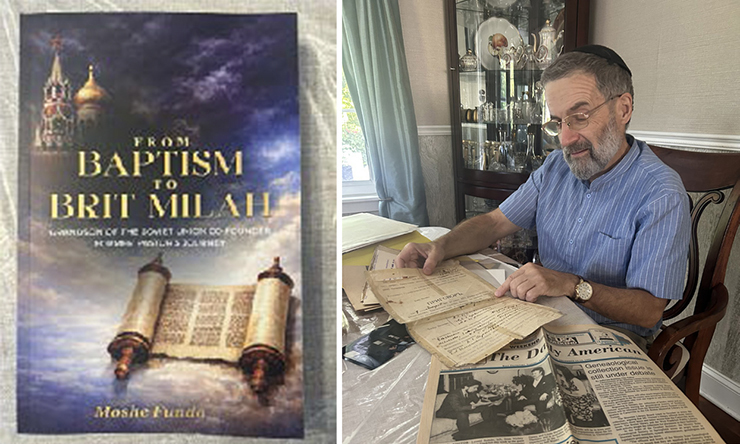
When my mother-in-law had her first Shabbos in West Hempstead, she understood that this wasn’t Brooklyn. There are only a handful of Russian speakers in the community. Among those who warmly welcomed her arrival here was Moshe Fundo.
He told us that he was a missionary before making teshuvah and living an observant lifestyle. I didn’t ask him about his years in the church, but recently he wrote a book about it. It is a story of self-realization, of recognizing that there is a higher power, and then realizing that his Jewish heritage and search for truth led him to conclude that his answers were in the Torah. He then led other wayward Jewish seekers on a trip to Crown Heights! As he recounts the events of his life, it was all hashgachah pratis.
“We came to West Hempstead in 1994. There were so many Jews in the park by the pond, and I thought that this is where I want to live. I did not know that they were gathering for Tashlich,” he said. With help from Shalom Lamm, he studied at Yeshiva University, while Paul Reinstein connected his two children with the Hebrew Academy of Nassau County. Fundo then had a bris milah and stood under the chupah for an authentic wedding with his wife Marina.
Moshe’s story begins with his grandfather, Lev Braginsky, who was raised in an observant home in Ukraine; but rather than wait for Mashiach to bring justice to the world, he became a communist. After suffering at the hands of tsarist police, he rose to power after the revolution as an assistant to Soviet secret police chief Felix Dzerzhinsky. His boss died as Joseph Stalin was consolidating power, and within the decade, the dictator was purging the government of old Bolsheviks.
“My grandfather saw his friends being arrested and executed. He suffered a stroke and lost his vision. That’s why Stalin did not view him as a threat. He lived until 1952.” Seven years later, his namesake grandson, Leonid, was born. From an early age, he had questions about religion, which shocked his mother, who feared the government that persecuted religious individuals. In college, he met Senya, who introduced him to the Adventists. Marina was also a seeker who loved to read and delve into questions about the meaning of life. They married and participated in the underground church.
At the same time, the missionaries did not have answers to some of their questions, and with their inescapable Jewish identities, they began expressing doubts about Christianity.
“I came with theological questions. I had discussions with theologians in Russia, and they asked me to pray more. In Moscow, I lived near a church and the shul on Arkhipova Street. It was 1981, and two elderly women told me to leave. On the way to the church once, I spoke to Rabbi Dovid Karpov. He helped me understand a lot. I went to preach at the church, quoting Rashi and Rambam.”
Today a Chabad chasid, Karpov was a graduate of Moscow State University, studying chemistry while developing his own interest in Judaism. As restrictions against religion loosened in the final years of the Soviet Union, the Adventists relied on Fundo to translate their literature from English to Russian. At a book fair in 1987, his church had a booth, and he struck up a conversation with Rabbi Hillel Zaltzman, a magazine publisher who had been teaching Judaism secretly with Chabad before moving to New York in 1973.
They discussed the ninth chapter of Daniel, which is among the sources quoted by missionaries in defense of their religion. “He asked me if I read it in the original language,” Fundo said. “He then gave me a copy of the Nachmanides disputation, in which he debated a church official.”
With the collapse of the Soviet Union, the Adventists were eager to win over souls and sent Fundo to America on a fundraising mission. He ended up staying and working with Russian-speaking Jews in Brooklyn.
“Some Russian Jews are intermarried; some find it more friendly than a shul,” he said of the missions targeting Jewish immigrants. “We spoke Russian. I was doing my own sermons, so I opened ArtScroll. I was searching. It was a breathtaking adventure.”
Fundo wore a talis and a kipah, to the extent that he was accused of “Judaizing” his Brooklyn congregation, which he named Lechaim.
“Hashem then expedited the whole thing. That’s when I got in touch with Rabbi Dov Haskelevich, who translated the disputation. I then spoke to my congregation. Some 20 of us then drove to Crown Heights, and we never came back to the church. We met at different shuls. We then initiated a class at the FREE shul in Brighton Beach. We also learned with Rabbi Algaze in Queens.” Fundo noted that a gentile member of his congregation also gave up Christianity, subsequently identifying as a ben Noach.
At the time, the Fundos lived in Floral Park, close to the Long Island chapter of the church. “My wife was locked out of the church school. I also lost my job as I made t’shuvah. I spoke point by point about the Tanach and waited for them to respond. I was not a brother anymore. They said I sold my soul.”
After moving to West Hempstead, Leonid, who was known in the church as Brother Leon, took the name Moshe for his example of leaving the spiritual wilderness and leading others on his path to Torah.
When my mother-in-law began spending Shabbos in West Hempstead, Fundo was happy to lend her books and newspapers on Yiddishkeit, and over time, her observance picked up. Fundo left the church at age 38, and his new friend began keeping Shabbos in her 60s. Although he does not have a pulpit, he noted that there are others who are working to bring Russian Jews back to observance.
“There are many wonderful rabbis in Brooklyn who work with Russian-speaking Jews. The main thing for Russian Jews is to feel they are around friends. Chabad is doing this. A sense of family, friendship. Churches immediately hug you. A Russian Jew needs love, friendship, and kindness,” he said.
Regarding his book, titled From Baptism to Brit Milah, Fundo tried to work with frum publishers but felt constrained by their standards. Self-publishing his memoir meant sharing his internal debate between Jewish and Christian sources, leading to his conclusion. “Frum publishers felt it would offend their readers, so it was better to self-publish.”
It is candid, personal, and written in a way that feels as if Fundo is speaking with the reader. It is available on Amazon and other online book retailers. Although I was reluctant to ask Fundo about his Christian past when I first met him, having his book on my table feels as if he is speaking to me in depth about his theological journey to Yiddishkeit.
By Sergey Kadinsky