

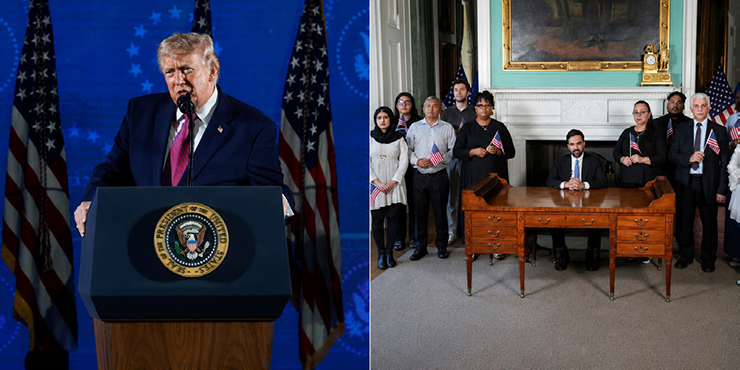
This July 4th weekend, as the nation marked its 250th birthday, two prominent speeches offered Americans a stark choice in how we understand our past and chart our future. One, delivered by New York City Mayor Zohran Mamdani, framed the American story as if we were currently undergoing systemic problems like slavery or Jim Crow, rewriting history to appeal to the victimhood mentality of the socialists. The other, given the next day by President Trump, celebrated America as the crowning achievement of human history, built by giants who secured unalienable rights and a people whose best days remain ahead. The contrast reveals more than a rhetorical differentiation; it’s a chasm between grievance and gratitude.
Mamdani’s address, delivered while seated at George Washington’s desk, began with poetic imagery of New York Harbor and waves of arrivals. But it quickly settled into a familiar progressive register: emphasis on oppression, nativism, and struggle rather than the miraculous achievements of 1776 and 1787. The narrative quickly turns to slavery—“men waiting at the docks to take them into bondage”—and waves of immigrants who “could not yet see the nativism they would face, the jobs they would be refused, the landlords who would not rent to them, and the abject labor and living conditions they would withstand.” Irish arrivals suffered a famine “manufactured by imperial cruelty.” Later groups faced “sweatshop fires that killed hundreds of women” and “riots aimed at their very existence.”
These are real chapters in our history, but in Mamdani’s telling, they become the dominant lens. No one goes to a birthday party and gives a speech listing the guest of honor’s faults and failings. The speech downplays the unprecedented system of ordered liberty the founders created—the Constitution, the Bill of Rights, the separation of powers, and the economic freedom that turned a fragile republic into the most prosperous and powerful nation on earth. It offers little on the philosophical roots of the American order or the astonishing speed with which the country abolished slavery, expanded the franchise, and absorbed millions into a common culture. Instead, America appears primarily as a place where successive groups arrived and had to fight against barriers erected by those already here.
This is not neutral history. It is a selective retelling that serves a political purpose. It trains listeners to see the American story as one of perpetual grievance and group competition rather than individual opportunity under equal laws. It subtly casts earlier Americans—largely European settlers and their descendants—as the sources of exclusion, while positioning newer arrivals and their advocates as the agents of progress. The line “the ideals our nation still strives to fulfill” is doing heavy lifting: It implies the founding was flawed in its essence or delivery, not that it established the framework that made correction and expansion possible.
This approach echoes an old Soviet tactic. As the joke went, “The past is always changing, but the future is never in doubt.” Communist regimes rewrote history textbooks with each shift in the party line, erasing inconvenient facts and elevating narratives of class or national oppression to justify present power. The goal was never truth; it was control. Mamdani, a democratic socialist aligned with the DSA, applies the same tactic here. By centering hardship and unfinished business, the speech prepares the ground for racial and class warfare. The solution? More government intervention in the form of higher taxes, more regulation, identity-conscious programs, and a politics of resentment dressed as compassion.
President Trump’s speech the next day offered the corrective. He spoke without apology or hedging.
“For two and a half centuries, our American republic has stood as the crowning achievement of human history. This country is the home of freedom. This is the land of liberty. And this is a flag. That’s the banner of the most extraordinary, most exceptional, most incredible nation ever to exist on the face of the earth.”
On the founders, he was direct: “Our founding fathers summoned the courage of giants and the wisdom of centuries to boldly proclaim these timeless truths. They declared that all men are created equal. That they are endowed with sacred unalienable rights by the hand of our Creator.”
He rejected the revisionist project outright: “America will never be a communist country. Won’t happen. Communism is a loser, and it always will be. The communist system is the opposite of the American system, and the communist system has never worked.”
And he looked forward with confidence: “At 250 years old. We may be the oldest constitutional republic on earth, but our country is just getting started because the best is yet to come. This is only the dawn of the golden age of America.”
One speech treats America as a problem to be managed through grievance and redistribution. The other treats it as a miracle to be defended and extended through confidence, unity, and the defense of founding principles. One reduces the founders to a “small group” who failed because they didn’t form a government that fixed everyone’s problems. The other calls them men of giant courage who formed the government only in order to secure the rights “endowed by the Creator.” One dwells on what immigrants endured upon arrival. The other celebrates what they and their descendants built together.
These are the competing messages that the electorate receives: grievance vs. gratitude, victimhood vs. victory, dependence vs. independence. The message of Mamdani is the false promise that if you give him power, your problems go away. The message of Trump is that America is the place where problems become opportunities for growth, expansion, and greatness. Whichever message resonates more with the American people will determine the next 250 years.
Moshe Hill is a political analyst and columnist. His work can be found at www.aHillwithaView.com and on X at @HillWithView.