

On Tuesday evening, May 19, the community members gathered at the Young Israel of Kew Gardens Hills for an inspiring program featuring the well-known speaker, Rabbi Joey Haber. Hosted by Chazaq, Ohel, and Project Inspire, the event was dedicated in memory of Mr. Jack Friedman z”l by his family. The evening also served as the official introduction to Ohel’s new clinic in the heart of Queens.
Robby Aboff, Events Director of Chazaq, welcomed the crowd and noted that the topic was especially meaningful as the community prepares for Shavuos, since derech eretz (proper character) is a necessary prerequisite for acquiring the Torah.
Next, Dr. Chesky Gewirtz, Clinic Director, shared that Ohel is dedicated to helping in every possible way. He noted that, while mental health challenges are a major concern in the secular world today, the Jewish community is not immune to these issues. He emphasized, “We are here for you!”
Opening in Kew Gardens Hills this week, the Ohel clinic is designed to be an accessible, affordable resource. It offers evidence-based counseling in a warm environment that is sensitive to the Jewish values of the community, and it accepts most insurances. Beyond mental health counseling, Ohel provides a vast array of services, including residential care and day programs for individuals with intellectual and developmental disabilities, care management, and trauma and bereavement services. Additionally, Ohel offers older adult care, shelters for survivors of domestic violence, foster care placement, addiction and substance use disorder treatment, parenting workshops, and medication management.
Dr. Gewirtz noted that the response from the Queens community has been overwhelmingly positive. He beautifully connected the launch to Jewish history, sharing that when the Jews stood together at Har Sinai in achdus (unity), all physical and mental health ailments were completely cured.
Following these introductions, Rabbi Joey Haber took the podium. He remarked that people who are afraid to address mental health challenges today are like people who are still using beepers. The world has changed, he argued, and mental health issues must be addressed head-on.
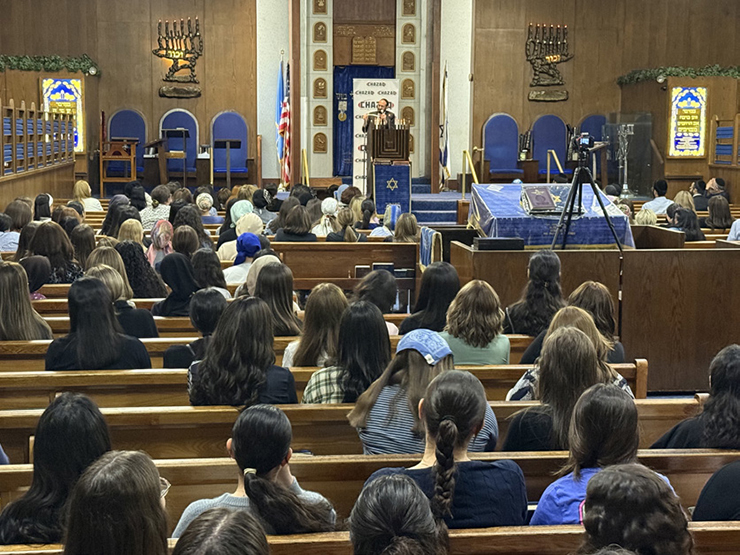
He shared that the defining midah (attribute) of Yaakov was emes (truth). But what makes emes so great? Yaakov’s greatness was not just that he spoke the truth, but that he lived it.
To illustrate this point, Rabbi Haber shared a pasuk in Shir HaShirim: “Do not look at me because I am dark, because the sun has tanned me. My mother’s sons were angry with me; they made me a keeper of the vineyards, but my own vineyard I have not kept.”
He taught that too many of us are overly consumed by what the world expects us to be and do, constantly trying to conform. He stated powerfully, “There is nothing you are good at other than being you and accepting who you are meant to be.”
In this pasuk, we are essentially telling Hashem not to judge us based on external pressures. When we succumb to the expectations of others, we end up watching over their fields and their lives instead of cultivating our own. As a result, we cannot achieve our true neshamah’s potential. “Be yourself,” Rabbi Haber urged. “Be your own truth.”
Yaakov lived this way. Even though his father-in-law constantly tried to undermine him and Yaakov faced countless trials, he remained anchored to his personal truth. Torah is entirely about living authentically. In fact, for the 49 days of the counting of the Omer, we celebrate this path of truth.
Rabbi Haber highlighted four great historical figures who embodied this standard, beginning with Rabbi Akiva, who was disowned by his father-in-law, yet spent 24 years dedicated to learning and became the Gadol HaDor (leader of the generation) because he lived his truth. Similarly, Rabbi Shimon bar Yochai chose to hide in a cave for 12 years rather than compromise on his reality. Ruth was the daughter of a king and had married into a highly prestigious family, yet she lost her husband and was reduced to utter poverty. Any ordinary person would have abandoned the path, but she stayed loyal to the truth. Finally, Boaz could have easily dismissed his obligation to marry Ruth, just as Ploni Almoni did. Instead, Boaz chose to marry her.
Against all odds, Ruth and Boaz lived a life of ultimate truth, and from their union descended the monarchy of the Jewish nation. Conversely, Ploni Almoni is left without a real name in the text because he failed to follow his true calling.
In closing, Rabbi Haber left the audience with a powerful, soul-searching question: “Are you living your truth?”
By Susie Garber