

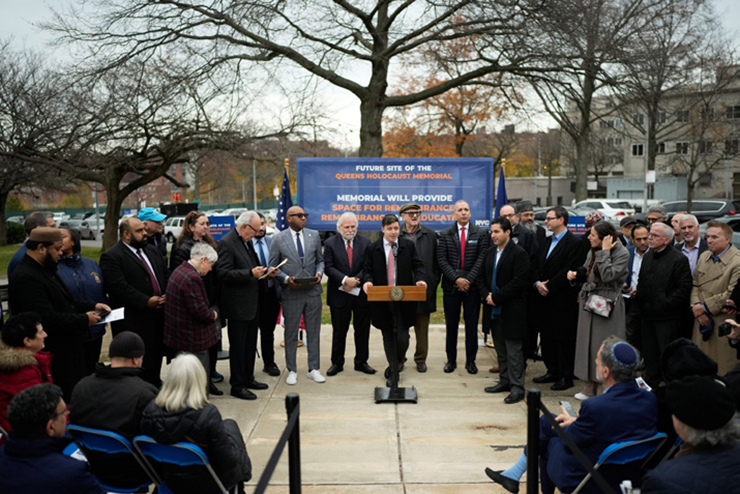
The announcement of the new Queens Holocaust Memorial—held on Tuesday, November 25 after being rescheduled from Monday to accommodate key officials—marked an emotional and historic day for the borough. What began nearly three years ago as a quiet meeting between Holocaust survivor Vladimir Epshteyn and QJCC Board Member Judith Rosen has now become a fully funded memorial initiative supported by city leadership, state legislators, and Jewish communities across Queens.
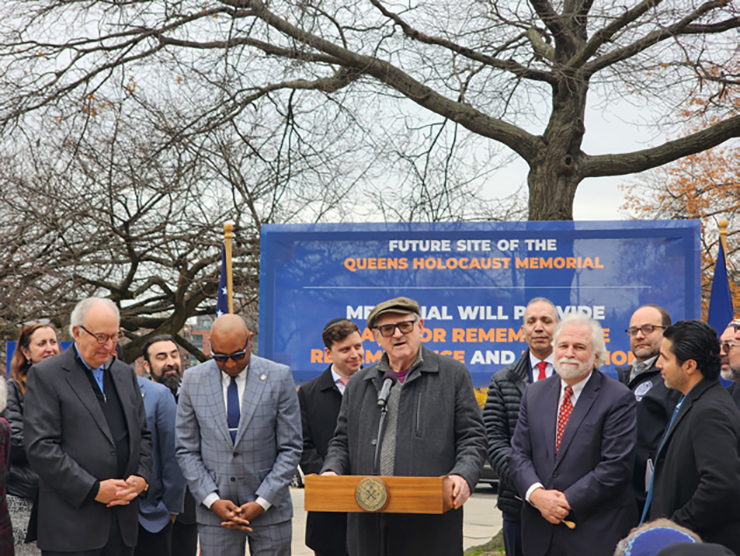
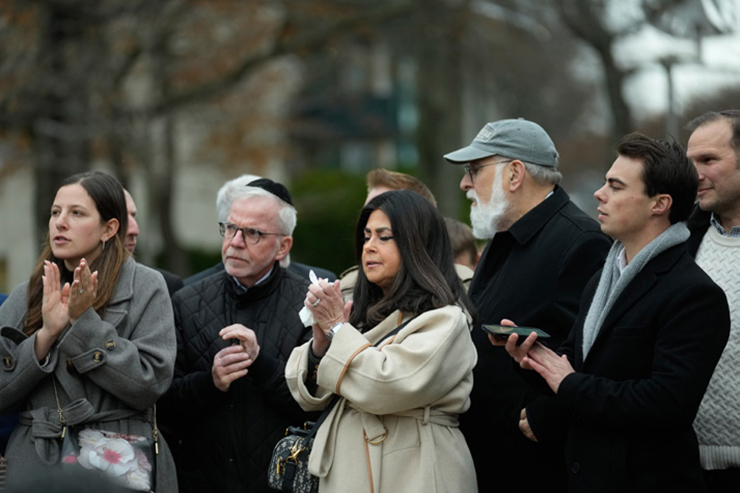
Dozens of elected officials, community leaders, survivors, and clergy gathered outside Queens Borough Hall, where an unmistakable sense of gravity filled the air. Senior members of the Adams administration stood alongside local leadership, including Menashe Shapiro, Deputy Chief of Staff & Senior Advisor to the Mayor, Fred Kreizman, Commissioner of the Mayor’s Community Affairs Unit, Deputy Mayor Fabien Levy, Commissioner Louis Molina, and Moshe Davis, Executive Director of the NYC Mayor’s Office to Combat Antisemitism, the first municipal office of its kind in the nation. Representing Mayor-elect Zohran Mamdani’s incoming administration was community leader Ali Najmi, signaling broad support from both the current and future city governments. The event was secured with the help of Queens Shmira volunteers, who provided additional safety throughout the gathering.
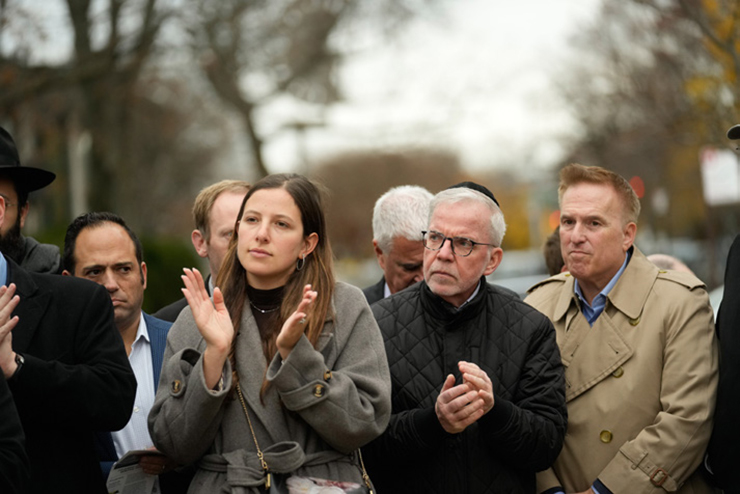
First Deputy Mayor Randy Mastro opened the ceremony by recalling a pivotal meeting this past June inside City Hall. At that meeting, he pledged—on behalf of Mayor Eric Adams—that the long-discussed memorial would finally move forward. On this day, he announced the fulfillment of that commitment: the city’s allocation of $2 million for the memorial’s creation. Mastro emphasized the widespread coalition behind the effort and noted the significance of having so many leaders across political lines present—a reflection of the shared moral responsibility to preserve Jewish memory and confront the city’s rising tide of antisemitism.
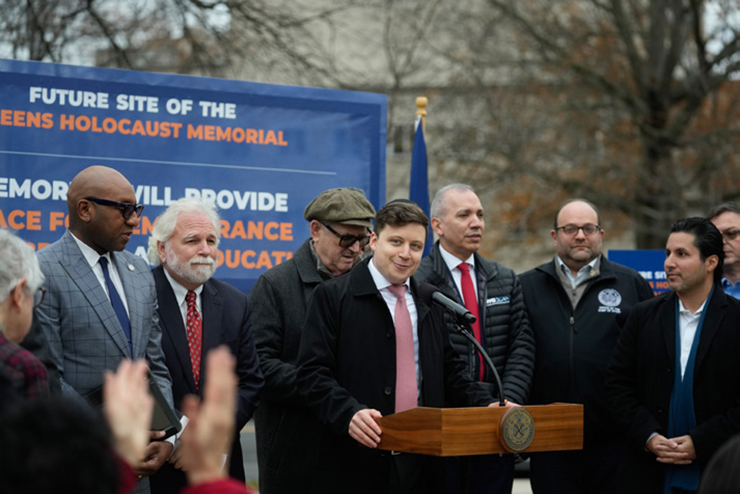
He then introduced Queens Borough President Donovan Richards, who has been central to the project since its inception. Richards spoke with clear emotion, describing the day as deeply personal for the many families in Queens whose loved ones perished in the Holocaust. He reminded the crowd that Queens is home to one of the largest populations of Holocaust survivors in the world, and that their stories, scars, and strength form part of the very fabric of the “World’s Borough.” Richards reaffirmed his office’s $1 million investment, a commitment he said he made the moment he first heard the proposal three years ago, when he walked Nussbaum, Rosen, and others outside and pointed to the exact spot where the memorial should stand.
Longtime civic leader Michael Nussbaum then delivered a moving and personal account of his own family history. He spoke of his father’s siblings in Eastern Europe and how one brother—born in 1900—refused to board the cattle car when the Nazis rounded up Jews from his town. He was shot on the tracks, a fact that was confirmed only recently through a Yad Vashem document uncovered by a cousin. Nussbaum dedicated this memorial to his memory and to all those whose lives were cut short, expressing hope that the new garden will serve as a place of reflection, healing, and education.
Holocaust survivor Vladimir Epshteyn then stepped to the microphone, offering one of the most powerful testimonies of the day. Introducing himself as a survivor from Bessarabia, he said plainly that sixty-eight members of his family—grandparents, aunts, uncles, and nephews—were murdered solely because they were Jewish. He described his later imprisonment by the KGB for fighting Soviet antisemitism and credited the United States government for helping secure his release following the fall of the USSR. Epshteyn emphasized that antisemitism is rising around the globe, including in New York, and that the Holocaust Memorial Garden carries a message that extends far beyond Queens. He thanked those who helped advance the project, including Judy Rosen, Michael Nussbaum, Leonid Bard, Borough President Donovan Richards, Mayor Eric Adams, and Moshe Davis, and he expressed hope that Mayor-elect Mamdani would support the memorial’s next stages.
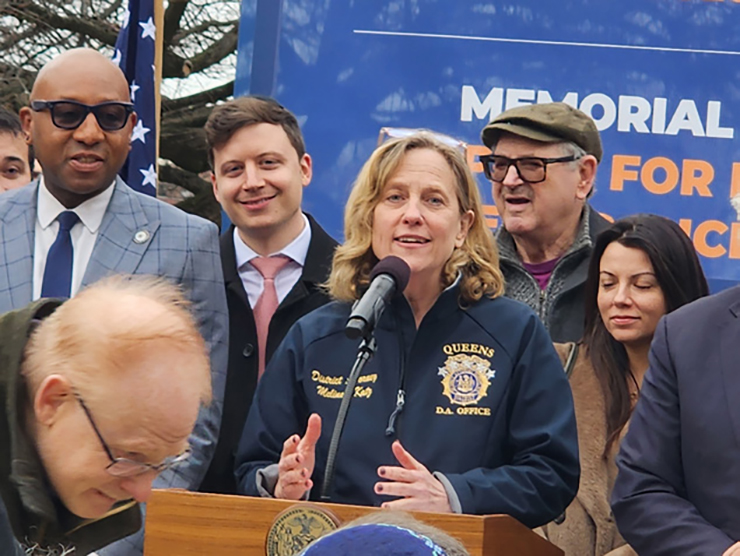
Queens District Attorney Melinda Katz addressed the crowd next, highlighting the surge in antisemitic crimes in New York City, particularly since October 7. As the only Jewish district attorney in the state, Katz spoke of her responsibility to ensure that Holocaust memory remains alive for younger generations—especially those who did not grow up hearing survivor testimonies at their kitchen tables. She noted how essential it is for students from all backgrounds to visit a site like this, learn the history, and understand the consequences of unchecked hatred.
State Senator Toby Stavisky, drawing on her background as a social studies teacher, reinforced the centrality of education in combating hate. She announced that she had allocated $1 million toward the memorial from the State Senate. Assemblymember Nily Rozic, Assemblymember Alicia Hyndman, Senator Leroy Comrie, and Assemblymember Ed Braunstein were among the officials present who expressed their support.
A particularly moving speech came from Assemblymember Sam Berger, who spoke through the lens of his family’s Holocaust survival narrative. He recounted his grandparents’ journey from wartime devastation in Europe to rebuilding their lives in Forest Hills—working humble jobs, opening small businesses, raising a family, and becoming part of the borough’s rich Jewish landscape. Berger recalled how survivors gathered each Shabbat at the Queens Jewish Center for Kiddush, where men with numbers tattooed on their arms would share stories of loss, cry together, laugh together, and celebrate life. He then announced that he and the Queens Assembly Delegation would fight for $1.5 million in the upcoming state budget. The moment drew a powerful reaction, prompting Borough President Richards—moved by Berger’s words—to pledge an additional $1 million from his own office, a spontaneous commitment that brought the crowd to applause.
Assemblymember David Weprin also delivered remarks, reflecting on his longstanding involvement in Holocaust education efforts, including at Queensborough Community College. He too committed to supporting the memorial through his capital budget.
The ceremony concluded with a heartfelt prayer from Rabbi Shlomo Nisanov of Kehilat Sephardim of Kew Gardens Hills. Still recovering from a recent tragedy in his own family, Rabbi Nisanov thanked the Borough President, the Mayor’s Office, his colleagues in the clergy, and the Queens community for their support. He read a reflection sent to him—“Those we love don’t go away; they walk beside us every day”—a message that resonated deeply. He spoke of arriving in America as a Soviet Jew seeking religious freedom, and of finding a home in Queens where he could proudly wear a kippah and live openly as a Jew. Rabbi Nisanov honored Aaron Aronov, a leading figure in preserving Bukharian Jewish history, and reminded the crowd that all people are descendants of Avraham—Ibrahim, Abraham—and must stand together in love and unity.
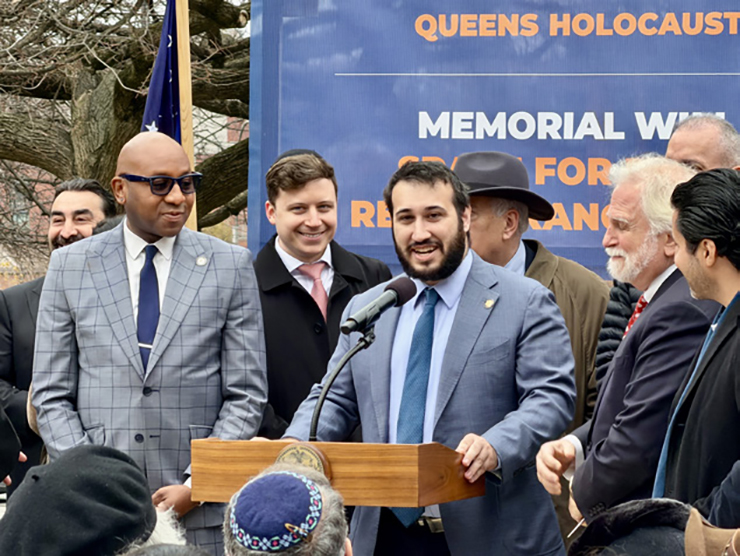
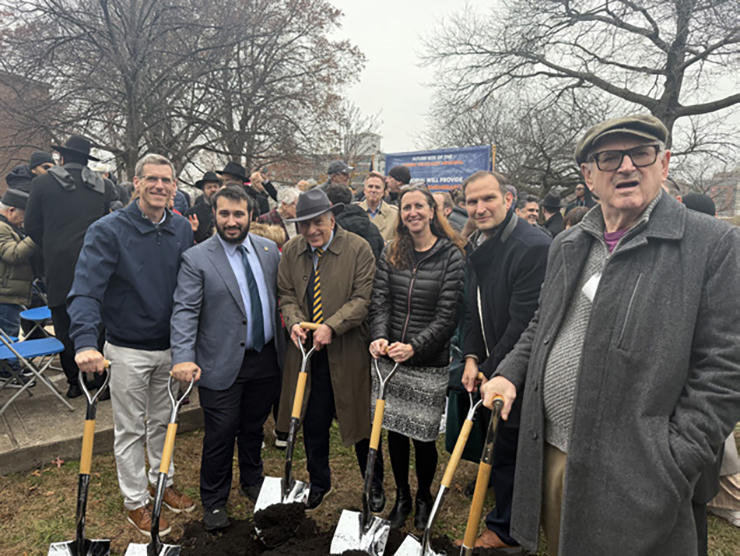
As the program came to a close, survivors, officials, QJCC leaders including Barry Grodenchik and Rabbi Mayer Waxman, and community members gathered for the first ceremonial groundbreaking of the Queens Holocaust Memorial Garden. A modest reception followed inside Borough Hall, where participants reflected on how far the project had come—and how much it will mean for future generations.
Three years ago, a survivor placed a call with a simple idea. Today, that idea has become the foundation of a permanent memorial that will stand in the heart of Queens, ensuring that the stories of those who perished, and those who rebuilt their lives here, will never be forgotten. In a time of rising hate and deepening division, Queens delivered a message of clarity: we will remember, we will teach, and we will never again be silent.
By Shabsie Saphirstein