

Throughout recorded history, humankind has lived in near-constant warfare. The Old Testament records a “world war” between five kings and four kings in the time of Abraham. Land was not scarce at that time, and the population of Canaan, Mesopotamia, and Egypt was perhaps a few million. Yet the desire for conquest was great, and a succession of empires fought over the lands which are now Israel and many Arab countries. At those times there was scant diplomacy. Relationships between monarchs were determined by force and cemented by marriage.
Wars were often fought over long periods of time and sometimes lasted for centuries. As technology, transportation, and military power grew, time frames constricted while the level of destruction and devastation grew. The development of nuclear bombs caused world leaders to realize that the survival of mankind required peaceful, diplomatic solutions to conflicts.
The search for peaceful solutions to disputes dates to antiquity and can be found in Indian, Chinese, Greek, and early Christian thought. The need to prevent anarchy led to the development of laws either imposed by authoritarians or legislated. In the twentieth century, international bodies (League of Nations, United Nations, International Court of Justice) were created to maintain world peace and to rule on legal principles of conduct between sovereign nations.
The success of these diplomatic efforts has been spotty. Wars continue to rage in many regions of the world. The United Nations has either been powerless or lacked the will to prevent or stop these conflicts. At the core of these failures is an unwillingness to confront violators and to provide objective analysis of responsibility.
The UN did not intervene meaningfully in the Rwanda genocide, leading to the killing of more than 500,000 Tutsi members by Hutu militias. The West stood by idly when the end to the violence could have been achieved by a relatively small Western force, with little long-term cost for the intervention. Focusing on the Middle East, although expressing concern about human rights violations, the UN has never taken effective action to rein in terrorist organizations or belligerent states. Starting in 1948, wars were fought between Israel and nearly every neighbor. After nearly eighty years of conflict these wars still rage. The latest battle involves a terrorist state that is repressive and led by leaders with extreme apocalyptic ideologies.
The propaganda emanating from the Islamic Republic of Iran is smoke talk. This state is among the most constant oppressors of human rights. It denies freedom of the press, freedom of movement, freedom of speech, and gender equality, and is ruthless in its response to attempts to obtain any of these freedoms. Women are abused and sometimes killed for the way they choose to dress. This brutal despotic regime recently murdered more than 30,000 of its own citizens. Most European nations and the media stood by and watched.
Iran has also been the most aggressive opponent of Western liberal democracies. From the beginning, the Islamic Republic of Iran, under Ayatollah Ruhollah Khomeini, was virulently anti-Zionist and anti-American. Ayatollah Ali Khamenei, the Iranian supreme leader for 35 years, followed and expanded Khomeini’s lead. He called for the elimination of the Zionist entity repeatedly and labeled Israel a cancerous tumor.
Using Iran’s oil revenues, Khamenei exported the Islamic revolution and spent billions of dollars strengthening its proxies. Iran is responsible for killing hundreds of Americans and thousands of Israelis. It remains a chief supporter of Hezbollah and provided or funded thousands of missiles that were launched at Israel. It financed Hamas to the tune of hundreds of millions of dollars.
Independently, the Khamenei-run Islamic state was developing ballistic missile and nuclear weapons programs to threaten Western civilization. The response of the democracies to these flagrantly aggressive actions was to develop diplomatic approaches to curtail the Ayatollah. This path of appeasement was not successful.
The record of the West in dealing with despots has been one of catastrophic failure. Hitler was appeased when he violated the Treaty of Versailles and remilitarized the Rhineland in 1936. Mussolini and Franco were similarly allowed to strengthen their fascist governments with no intervention by the world powers at that time. Finally, lack of opposition to the annexation of the Sudetenland and Austria led to World War II and the loss of more than 60 million lives. If Britain and France had confronted Germany in 1936, these lives may have been spared.
The United States, led by President Barack Obama, signed a Joint Comprehensive Plan of Action (JCPOA) with Khamenei. It is true that this diplomatic agreement led to a delay in the breakout time for Iran to make a nuclear weapon. However, by reducing sanctions, restoring billions of dollars to Iran, and not addressing ballistic missiles, the JCPOA allowed Iran to build thousands of medium-range missiles and to continue to fund proxies to eliminate Israel and kill Americans.
For years Iran’s provocations were not acted against by the U.S., Europe, and Israel. Instead, many democratic nations and the Western media demonized Israel for any action it took to defend its citizens from the nearly continuous rocket attacks by Hamas and Hezbollah. The failure to act definitively against Iran’s machinations led to the Israel–Hamas war in 2023–2025. Diplomatic appeasement had once again failed.
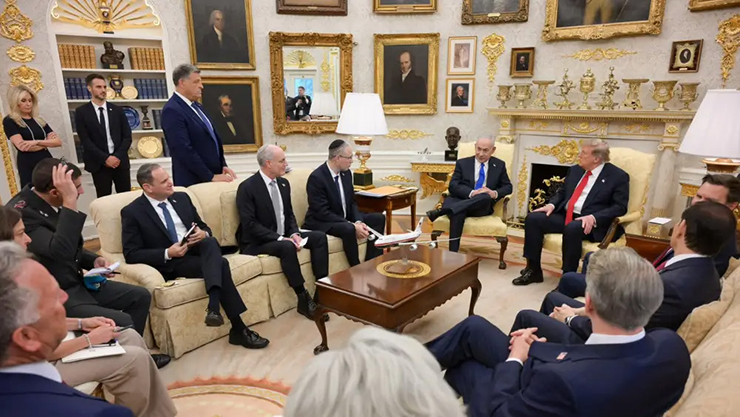
President Trump and Prime Minister Netanyahu realized that diplomacy was not leading to peace with Iran and its allies. They launched a major campaign to eliminate current and future threats emanating from a fundamentalist Islamic state whose ideological goal is opposed to the existence of Western values. The price of the previous diplomatic appeasement of the Iranian Islamic Republic is the current battle that will take time and enormous resources. Not confronting Iran now would have led to much greater costs in the future. All free people should applaud and support the action to bring down the leaders of this rogue state.
Dr. Naider is a former Provost and Senior Vice President for Academic Affairs at the College of Staten Island and Distinguished Emeritus Professor of Biochemistry and Chemistry at the City University of New York. He lives in Rehovot. The opinions in this article are his own.