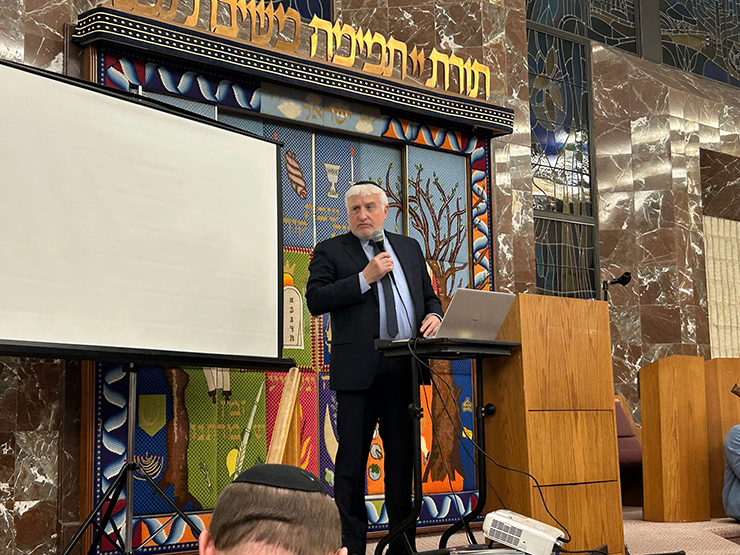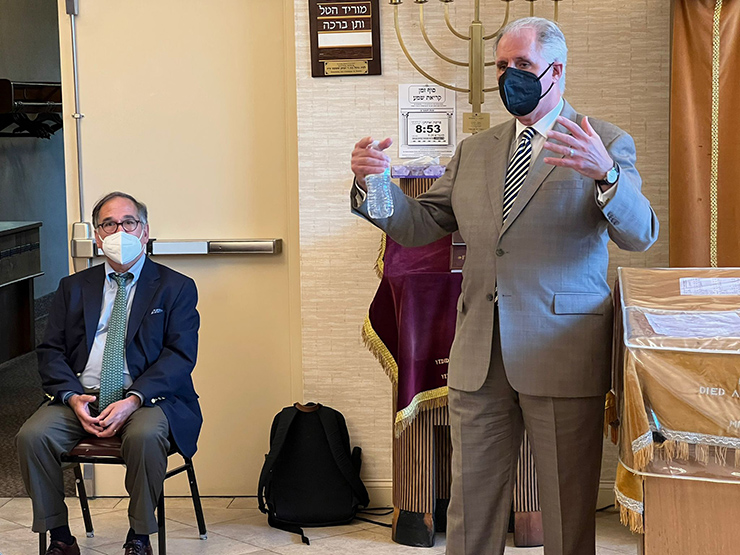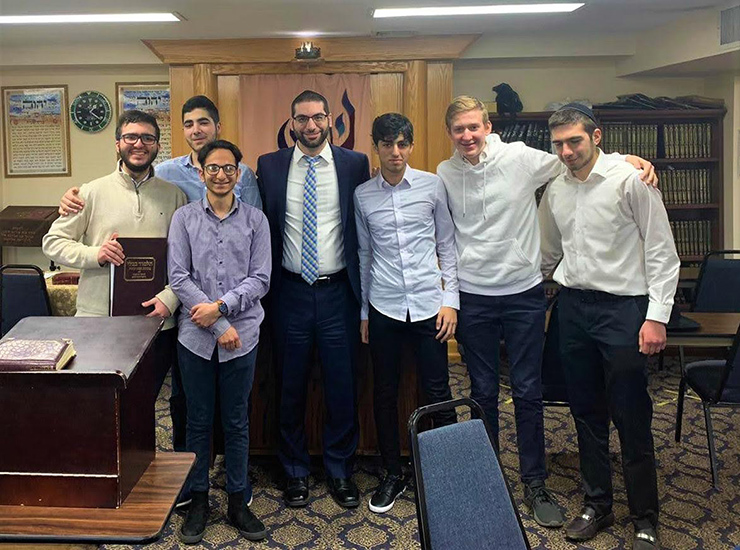

On Thursday night, July 2, Charlie Harary, a well-known speaker, shared an inspiring shiur at Shaare Emunah, the Sephardic Congregation of the Five Towns, in Cedarhurst. The shiur was hosted by Chazaq and Zichron Naftali. Zichron Naftali provides food and healthcare for thousands in Israel, and Chazaq is responsible for many amazing programs, including hosting thousands of shiurim and helping transfer more than 2,000 Jewish children from public school to yeshivah.
Mr. Harary shared that many of the ideas he would be teaching came from a conversation with his rav, Rav Moshe Levy.
He began by saying that we are living in an incredible period of time. It affords us the opportunity to draw very close to Hashem. He shared the famous mashal of the man who was drowning in heavy floods, so he climbed to his rooftop and kept asking Hashem to save him, while Hashem repeatedly sent first boats and then helicopters. The man ignored these means of salvation and kept saying, “Hashem, save me!” He did not realize that all of these opportunities had been sent by Hashem.
Many times, we say to Hashem, “Save me.” Hashem says, “I gave you the Three Weeks, Tish’ah B’Av, and Elul.” Every second, things are changing behind the scenes. We need to be cognizant that certain periods of time carry specific spiritual energies, and we must tap into those energies at the right time.
We have the ability to go beyond our teva. We should slow down and realize that Hashem is opening channels of connection, and if we put in effort specific to the time we are in, we can change. He offered the analogy of looking for a plug; once you find the outlet, you receive the energy.
“We’re entering a time period that most of us simply want to get through,” he said. “Shiv’ah Asar B’Tamuz is the beginning.” Hashem is saying, “I hope you realize I’m sending you a speedboat.” If you can capture these three weeks and emerge from Tish’ah B’Av transformed, you may be able to touch G’ulah.
This is a period when we are trying to fix a fundamental problem. If you walk around and do not feel that Hashem is always with you, that is a major problem. Hashem is with us all the time; but if we do not feel that way, then we are in Galus. If you do not feel the pain of this season, you are in Galus, and the darkness of this world overwhelms you.
“The goal of the Three Weeks is to bring more of the Sh’chinah into our lives and into the world,” he explained. “The Three Weeks are a speedboat for this. So dig in. Don’t pull out after you break your fast. Don’t lose three weeks of greatness.”
The Maggid of Kozhnitz taught that during this period we should run to bring the light of Hashem into our lives. This is the time to do it.
Most holidays come with a story. Shiv’ah Asar B’Tamuz is not merely about Tish’ah B’Av. It sets the stage for the entire period leading up to Tish’ah B’Av. Hashem is telling us, “I’m launching this time with a fast and ending it with a fast.” The spies and the destruction of the Beis HaMikdash are not the whole story. The fact that there is a fast at the beginning tells us there is more to this day and this period. What happened on Shiv’ah Asar B’Tamuz was the first step toward what eventually culminated on Tish’ah B’Av.
He then reviewed how klal Yisrael received the gift of the Torah on the sixth of Sivan. Moshe went up to receive the Torah and told the people he would return in 40 days. Moshe meant 40 full days, but they did not realize that. He had also told them that Aharon would be there if they needed guidance.
On the last day, klal Yisrael panicked because they thought Moshe was late. The Eiruv Rav said, “Make for us a god that will go before us.” Mr. Harary noted, “Logic is the beginning of leaving Hashem.”
Why are we still in Galus? One camp explains that it is because of sin’as chinam. Another says it is because of the Spies. The Spies were together except for two men. There was no fighting among them.
Charlie Harary taught that it is actually both. There is something deeper taking place beneath the surface. What causes Hashem to leave anywhere? We push out the Sh’chinah. The only way Hashem leaves us is if we say goodbye.
How do you push out Hashem?
We need to believe at our core that Hashem is in everything. However, when I believe that I am at the center of everything, Hashem says, “I cannot be with you there.” Hashem despises a haughty spirit because such a person is saying, in effect, that he does not want Hashem. Charlie Harary pointed out that even a Jewish king, despite his prestigious position, is meant to be a conduit for Hashem.
“If you live life with zero ani, you’ll shine,” he said. “Check your ani meter. Is it too high?” Lowering your ani meter is something to work on during the next three weeks.
Hashem never left us; we pushed Him out. In essence, Hashem says, “You think this house or city is yours? Then I’m leaving. Good luck with the laws of nature.”
The M’raglim (Spies) and sin’as chinam are connected, and that connection is gaavah. Both stem from relying on human logic rather than Hashem.
Sin’as chinam stems from a feeling of “I don’t like you.” It comes from not believing that we are in this world for a mission. I feel threatened by another Jew’s success. I feel diminished if you are here. I don’t like how you look because I only care how I look. It is all about me.
Galus is about our relationship with the Sh’chinah.
He pointed out that a person can be living in Galus in the Old City of Jerusalem, while someone in an alley in India can be living in G’ulah. Our wars are based on faith, not armies.
We are living in the Greco-Roman Galus. The Galus of the West is focused on self and on leaving Hashem out. So many advertisements proclaim, “You deserve a...” This concept is foreign to Torah and is not a Jewish idea. We do not deserve anything. Everything in life is a gift from Hashem.
He advised those in the audience to spend five minutes asking themselves where they score in humility. There were no valedictorians at Har Sinai and no sports teams at Har Sinai. We need to come from a place where there is no “I.” There is only Hashem.
As we lower our ani percentage, the Sh’chinah enters. The Sh’chinah is waiting for us. We are the ones who need to bring G’ulah.
In the story of Shiv’ah Asar B’Tamuz, the Jews were not asking for a leader. They did not ask Aharon to take over. They wanted an entirely different system. They were not asking for another Moshe; they were asking for a plural replacement.
This means that I care most about my own opinion. That is the yeitzer ha’ra playing checkmate. They could have asked for Chur or the Z’keinim. Instead, they asked for multiple gods. They were saying, “I want a different system with many gods because I do not want to bow my head to One.” The first step in pushing away Hashem was rejecting Moshe.
Hashem created a Torah system unlike any other. The way Hashem gave us Torah is not the way the world receives information. In the secular world, information is packaged for the ani. It has to feel personally relevant to a self-oriented individual.
Torah is not about the self. For Torah to flow properly, the midos must be developed first. The midos are the kli. The goal of Torah is to connect to Hashem. Torah should make a person more humble.
“You have to work on your midos while learning Torah,” he said. “Torah is Hashem’s greatness. Moshe received Torah from Sinai. Torah is a mesorah. It is passed down. You don’t just pick it up off the shelf. Torah is a mechanism to bring us to Hashem. You have to learn how to put your head down.”
Your midos must continue to grow. Whom do you turn to for advice?
It matters when you allow someone else to guide you. When that person is a rav, rebbetzin, or someone connected to the mesorah, you connect yourself to Hashem. He exhorted everyone to use this time to strengthen mesorah in their lives.
Thank you to Chazaq and Zichron Naftali for such an inspiring and beautiful shiur by Charlie Harary.
By Susie Garber