

When I was at the beginning of my career as a researcher/teacher at the university level, I had a relationship with Dr. Leonard D. Kurtz. Dr. Kurtz was a very unusual fellow. He was a board-certified radiologist but practiced medicine for only a short time. Instead, he ran a company that produced surgical needles and sutures. By nature, Dr. Kurtz was an inventor at heart, and he invented an improved polyester surgical suture by coating it with Teflon. This combination led to improved tissue compatibility and low friction, reducing tissue damage. The invention made Kurtz a wealthy man and allowed him to dedicate the latter part of his life to supporting biomedical research and researchers.
I was privileged to spend significant time with Dr. Kurtz, and while discussing the use of antibiotics, he once told me that all drugs, no matter how useful they might be, should be viewed as poisons. In fact, he argued that almost anything ingested had the potential to cause harm. It was simply a question of dosage, duration of use, and the idiosyncrasies of the patient.
This lesson has stayed with me throughout my career. It has made me very drug-averse and conservative. I remember a friend who suffered from migraine headaches. Such headaches are quite debilitating. The acute treatment is to take a painkiller, among which is acetaminophen. This friend went through a period when the migraines were very frequent. Accordingly, my friend took increasingly high doses of acetaminophen. Unfortunately, this drug, when taken chronically at elevated doses, can damage one’s liver. The result was drug-induced hepatitis, which resulted in hospitalization. Luckily, my friend recovered fully. Continued use of this drug could have resulted in liver failure.
I was born in 1945. Many of my friends and acquaintances are septuagenarians or octogenarians. We, as a group, take a growing number of drugs. Some have been shown to have highly beneficial effects on the quality and longevity of our lives. However, as we age, the way we metabolize drugs changes. Some drugs that are innocuous when used by young or middle-aged adults become dangerous for the geriatric population. It is essential that we be aware of this problem. Sleep disorders are not uncommon in the elderly, and physicians often recommend drugs to help us get necessary rest. There are many such drugs available over the counter.
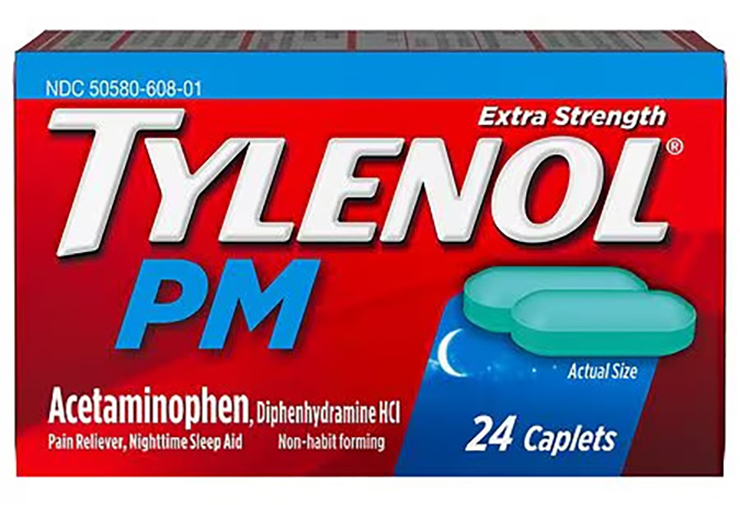
Among these nonprescription drugs are combinations of acetaminophen and diphenhydramine or acetaminophen, aspirin, and diphenhydramine. These combine common pain medications with a sedative, diphenhydramine. Acting together, these facilitate sleep. One of my wife’s friends, a septuagenarian who had undergone extensive chemotherapy, was having problems falling asleep. She took acetaminophen/diphenhydramine and woke up confused, unstable, and unable to walk by herself. She wound up in the emergency room. Extensive tests revealed no liver or other organ damage. She was advised to avoid any drugs containing diphenhydramine.
Today, virtually all drugs contain warnings. In the case of Tylenol PM and Excedrin PM, it would be valuable if the warning panel explicitly informed elderly patients that they might be highly prone to side effects from the diphenhydramine component of these drugs. Dizziness and confusion in the elderly increase the likelihood of falls. Falls in the elderly can lead to morbidity and even death. People over 60 should speak to their doctors and should beware of the medicines they take.
The writer is a distinguished emeritus professor of biochemistry and chemistry at the City University of New York. He is not a medical doctor. The opinions in this article are his own.