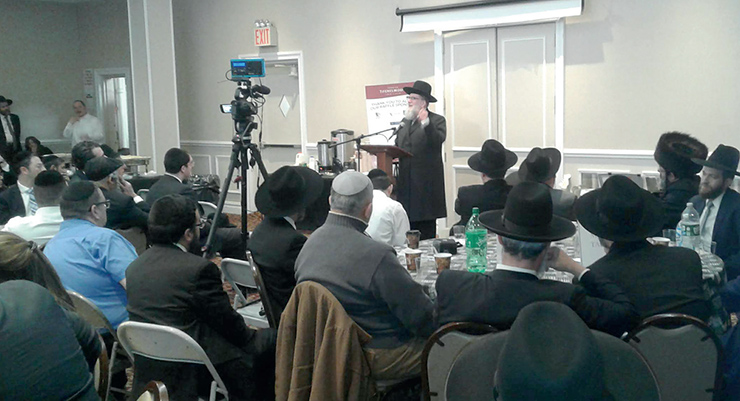

I arrived at the Javits Center last Tuesday afternoon, March 17, for a session that, on paper, probably wouldn’t have drawn much attention. It took place in a smaller room, with just a few dozen people — many of them familiar faces.
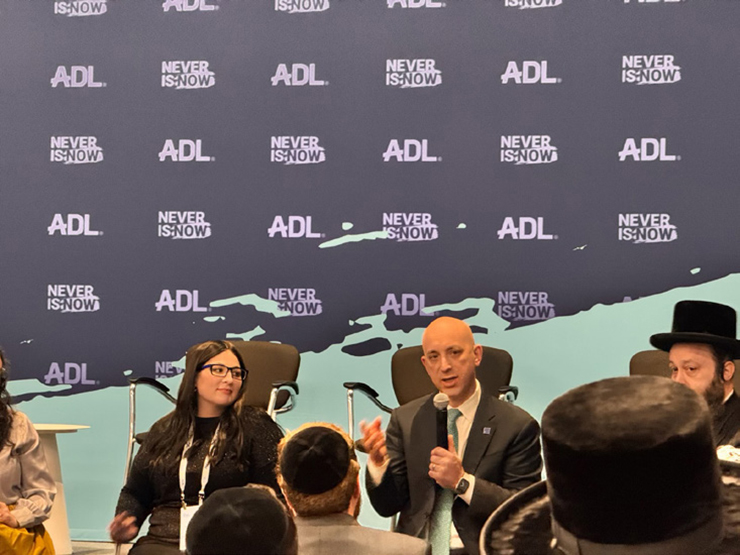
At the center of it was Jonathan Greenblatt, CEO of the Anti-Defamation League, who stepped away from the larger spotlight of the summit to sit with us.
Rows of black hats, yarmulkes, sheitels, and modestly dressed women filled the space alongside rabbanim, askanim, and community leaders. We were there because the conversation felt necessary.
Queens was well represented at the forum. Among those in attendance were Rabbi Avrohom Hecht, Executive Director of Project LEAD; Jay Hershenson, Vice President for Communications and Marketing and Senior Advisor to the President of Queens College; Alan Sherman, a longtime community advisor; Moshe Spern, who continues to advocate for Jewish educators and students facing antisemitism in public schools; Rabbi Mayer Waxman, Executive Director of the Queens Jewish Community Council; and Daniel Winchester of Queens Shmira.
This session, part of the Never Is Now Summit, was dedicated to the Orthodox community. It felt like a conversation — people standing up, introducing themselves, asking what was actually on their minds.
Greenblatt opened simply. “Our core purpose is not being in the headlines,” he said. “Our core purpose is to protect the Jewish people… all the Jewish people.”
Greenblatt doesn’t come from the Orthodox world. His background is in business, government, and advocacy. But over time, he’s made an effort — not just organizationally, but personally — to understand this community. He spoke about people who influenced him along the way, including Rabbi Moti Zeligson of Chabad.org and Rabbi Moshe Hauer zt”l, with whom he had been in touch shortly before his passing.
He addressed what everyone in the room already knew. “The most targeted Jews in this country are observant Jews.” “No one has the right to tell us how we should show up as Jews in America, ” he added. He mentioned ADL’s Brooklyn office, opened in 2022, and said plainly that it should have happened sooner. “We have to go where the problems are.” Because most of what people deal with never becomes public. “Most of these things don’t get tweeted,” he said. “They just happen.”
He acknowledged the work of groups like Shmira and their coordination with the NYPD, but emphasized that it can’t be occasional. It has to be constant. Rabbi Yisroel Kahan of Monsey, who serves as ADL’s liaison to the Orthodox community in the New York/New Jersey region, plays a central role in building that connection on the ground. And locally, Scott Richman has been a consistent presence, showing up again and again in Queens — not just when something happens, but as part of the ongoing relationship.
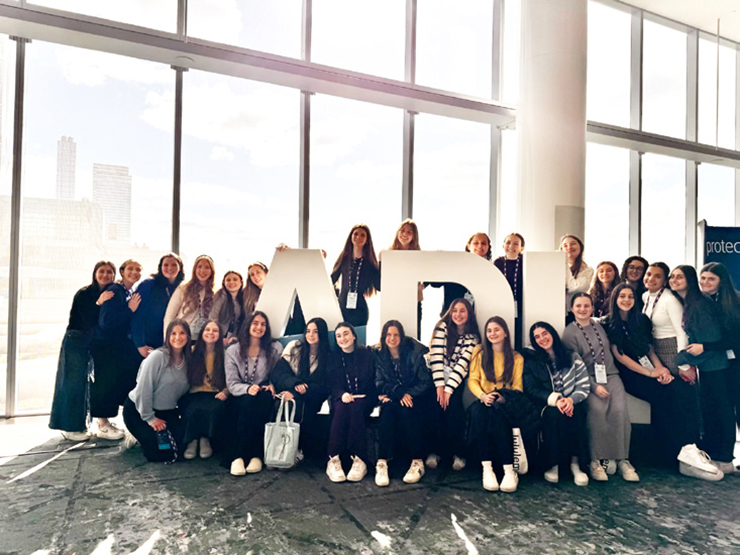
Outside the session itself, there were moments that said just as much. Chabad shluchim were walking around helping men put on t’filin. The Great Neck crowd showed up strong too — especially younger faces, high school and college students who already seem to understand what’s at stake.
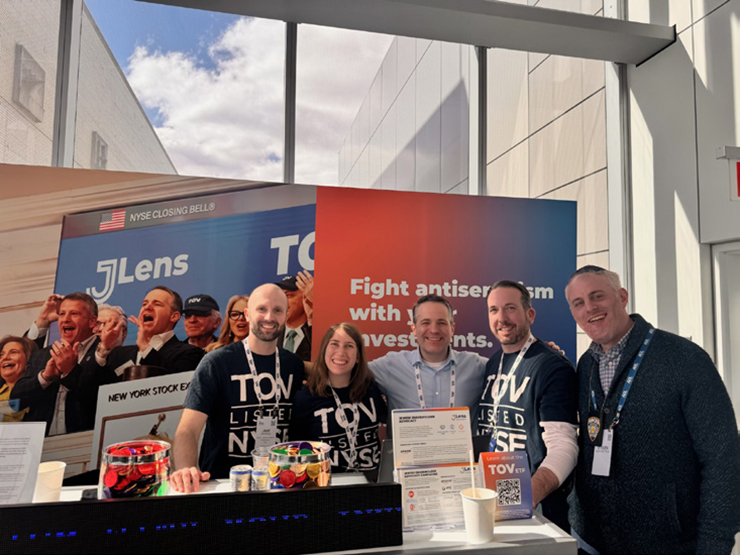
On the floor, the booth of JLENS stood out. Their work operates in a different arena — using investment power and shareholder advocacy to push back against antisemitism at the corporate level. It’s a reminder that this isn’t being fought in just one place anymore.
There was also a moment of recognition for Robert Kraft, whose efforts through the “Stand Up to Jewish Hate” campaign have brought visibility to the issue in a broader way. Attendees received the now-familiar blue square pin — simple, but increasingly recognizable.
Greenblatt also said something you don’t often hear in settings like this. “We make mistakes. But we’re going to keep trying — every single time.” Then he returned to something he clearly sees as critical: reporting. “We can’t change what we don’t count.” If incidents aren’t reported, they disappear. He described a system that reviews tens of thousands of submissions, including a Legal Action Network made up of more than 50 major law firms that can take on cases when needed.
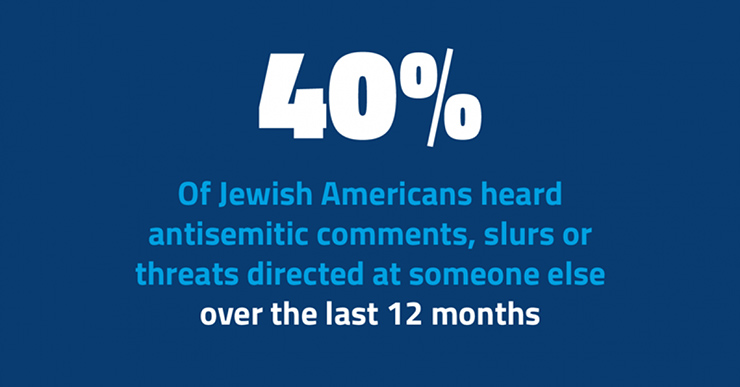
But none of that matters if people don’t come forward. Then came the number. When he started, there were 942 recorded incidents in a year. Last year, there were 9,354.
Local activist Chaskel Bennett stood up. “Any Jew that’s under attack — anywhere — is part of our community. Today it’s them. Tomorrow it’s us.” Then he added: “It has never felt worse than this.”
Then the conversation turned to what happens when the hostility comes from within. The issue of the protests surrounding Council Speaker Julie Menin’s buffer zone hearing was raised— where those of us who spoke in favor were met with open hostility, including from individuals identifying as Jewish.
Greenblatt didn’t avoid it. “I don’t work for Jews I agree with,” he said. “I work to protect all Jews.” “I struggle with this,” he added.
He spoke about the difference between long-standing ideological disagreements and more recent activism that, in his view, works against the broader community. He referenced the 2019 Monsey stabbing, where someone who helped stop the attacker refused a reward from ADL because of ideological differences.
At Brown University, he described walking into a room of Jewish students wearing keffiyehs aligned with anti-Israel activism. His security guard leaned over and asked, “Is this the right room?” It was.
“I don’t know how to square that,” he said. But on one point, he was clear: “Zionism didn’t start with Herzl. It didn’t start with Ben-Gurion. It started with Moshe Rabbeinu.”
Later, speaking about elected officials, his tone sharpened. “We work with everyone… but it has never been harder.” He described a reality where politics on both sides has become more rigid, making consistent advocacy more complicated.
There were also questions about discrimination at the municipal level — cases where technical reasoning is used to mask something deeper. Again, his answer came back to the same point: report it, document it, and let it be addressed.
Walking out of the Javits Center, one thing was clear: People are paying attention. And more importantly, they’re starting to respond.
By Shabsie Saphirstein