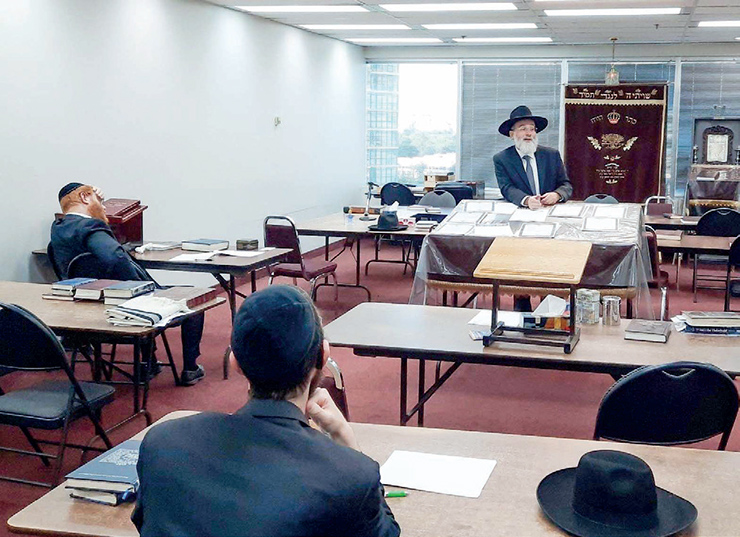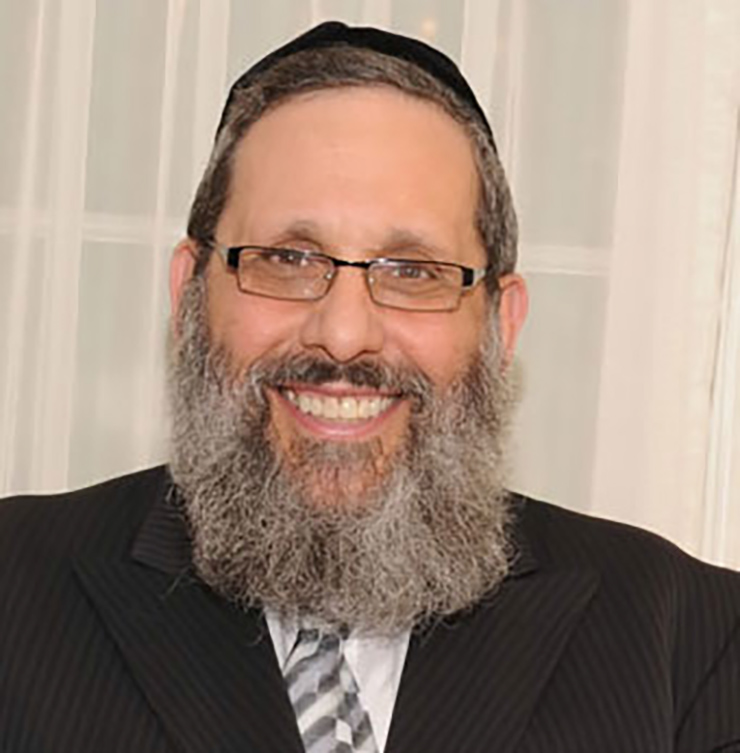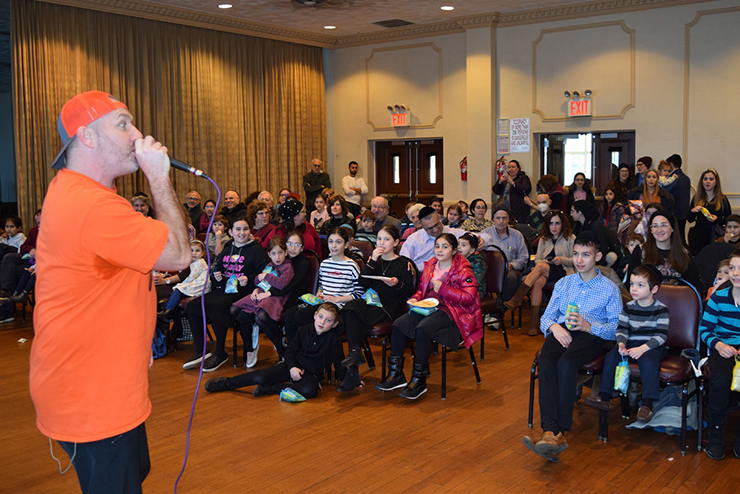

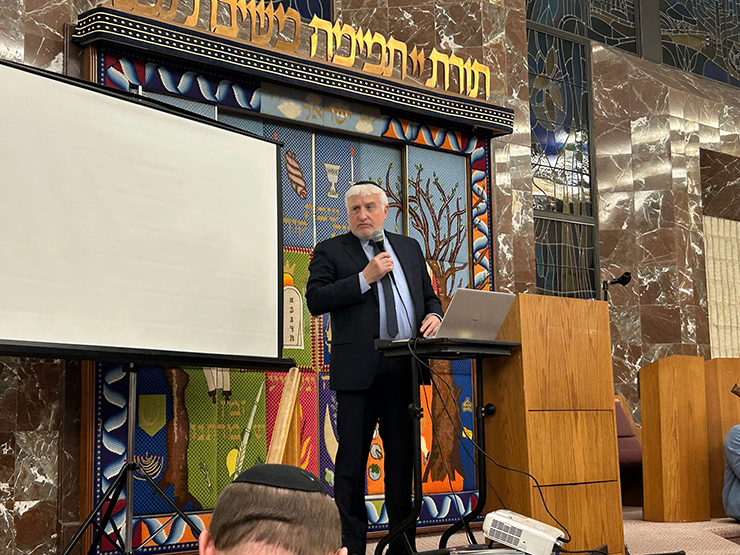
In the aftermath of the Holocaust, stories of survivors were initially overlooked as they rebuilt their lives and other crises shook the Jewish people, such as the Israeli War of Independence. Then there were historians who relied too heavily on the military and government records of the atrocities. Finally, there was Yaffa Eliach, who changed the way in which the world interacts with survivors of genocide. Her son, Rabbi Yotav Eliach, spoke about her work last Sunday at the Yom HaShoah program at the Young Israel of West Hempstead.
“I was in the shadow of the Holocaust. The Shoah was the world around me,” he said. “I did not have many friends who had grandparents, aunts, or uncles. Many of my friends had parents who were survivors. That’s the world that I grew up in.”
The Young Israel of West Hempstead hosted this event in partnership with the other synagogues of this community, with selected individuals lighting candles for the six million killed, naming the martyrs and survivors from their families.
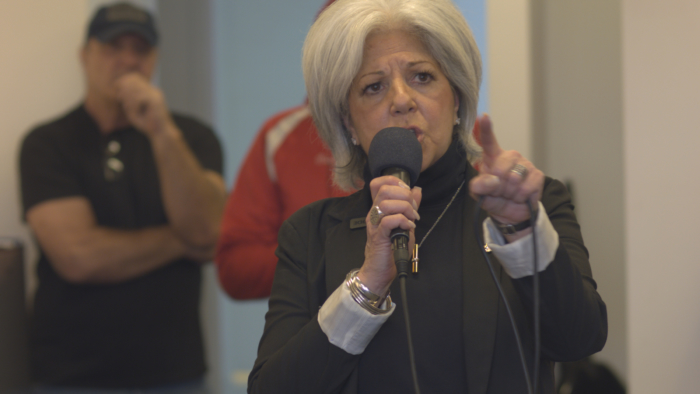
Representative Laura Gillen was scheduled to speak but, as she was not feeling well, her Jewish community liaison, Jared Bruh, spoke of her legislative efforts to promote Holocaust education and her recent meeting with survivor Leah Goldberg, 100, in her Valley Stream home. She shared her conversation with Goldberg on her social media.
“Yom HaShoah gives us a necessary and solemn opportunity to reflect on people killed, the unthinkable evil, and anti-Semitism today,” Bruh said. “She asked Leah what she would say to someone saying that the Holocaust never happened. She said that this is as if she was never born. In Washington, this is not a partisan issue and it shouldn’t be. Their memory will be a protection for the living.”
Rabbi Eliach was introduced as a scion of historians who revolutionized Holocaust education. His father, Rabbi David Eliach, was born in British Palestine, witnessing the aliyah of Holocaust survivors and the War of Independence. He later served as the high school principal of the Yeshivah of Flatbush, where he promoted student activism, particularly for Soviet Jews. His wife Yaffa was born in the Lithuanian shtetl of Eishyshok. She survived thanks to righteous Polish neighbors. After the war, she made aliyah and married Rabbi David Eliach. They emigrated to New York in 1954, where she began her academic career.
“She interviewed more than 2,700 survivors,” her son said. “There were stories nonstop, and then they became my mother’s life’s work. The effect it had on me!”
He then noted how her work stood apart from other researchers of that time. “Most scholars were in their 50s, often German Jews. The Nazis had many documents. My mother said, ‘That’s true, we certainly need that, but we certainly don’t need them to tell our story.’”
When she began interviewing survivors, some historians criticized her work as reminiscent of a daytime talk show, but she kept at it, assigning the task to her students at Brooklyn College.
“The sense I had was that in total there were 5,000 survivors,” he said. “My mother developed an entirely sensitive way to interview a survivor. An entire protocol.” In those days, tape recordings and VHS cassettes were the means of preserving their recorded experiences. Then Hollywood called Eliach.
“In 1994, Schindler’s List was made. That movie made it big. Steven Spielberg realized that people wanted to hear about it. Somebody told him that it was important to interview survivors, and my mother taught them how to interview survivors,” he said of the director’s production team. “To date, his people have interviewed 50,000 survivors.”
In addition to survivors, Professor Eliach also interviewed hundreds of liberators from the Allied armies. With the average age of World War II veterans at the century mark, they were teenagers when they served in the armies that defeated fascism and stumbled on the walking skeletons in striped uniforms.
Her birthplace shtetl, known in Lithuanian as Eišiškės, is a small town, not as well-known as the cities of Eastern Europe or places where g’dolim lived, presiding over yeshivos and chasidic courts.
“Photos in museums – all the photos were from the Nazis. Photos of “untermenschen.” My mother said no and said we need photos of what we looked like prior to this. She collected photos from survivors. Seventeen years of work for the book on Eishyshok. It was mind-altering. That was a huge contribution,” he said. Published in 1998, There Once Was a World: A 900-Year Chronicle of the Shtetl of Eishyshok covers its diversity of Jewish life in 818 pages. One could imagine a much bigger lost world of pre-war Jewish Europe if every shtetl had a Yaffa Eliach as its chronicler.
“She was the one who changed the way that we interview survivors,” Rachel Orenbuch said. “It’s the children of survivors who are now at the events.” She brought her husband and three teenage sons to the event. They attend Rambam Mesivta, where Rabbi Eliach served as principal until 2024.
Following the example of his parents, Rabbi Eliach also fostered activism among students in protesting anti-Semitism and rallying for Israel. Orenbuch’s mother-in-law, who survived the war as a hidden child, was interviewed on many occasions by her children and their peers. Her three oldest children made aliyah, with two of them serving in the IDF.
“It was important for my family and my teenagers to attend,” Orenbuch said. “I feel very strongly that young people, the grandchildren of survivors, should be attending these programs.”
By Sergey Kadinsky