
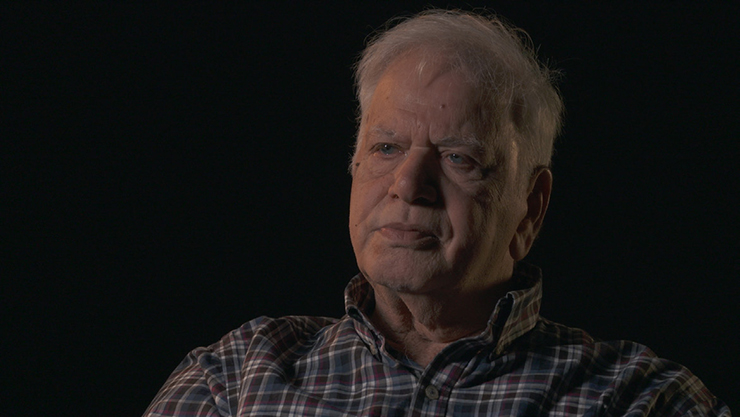
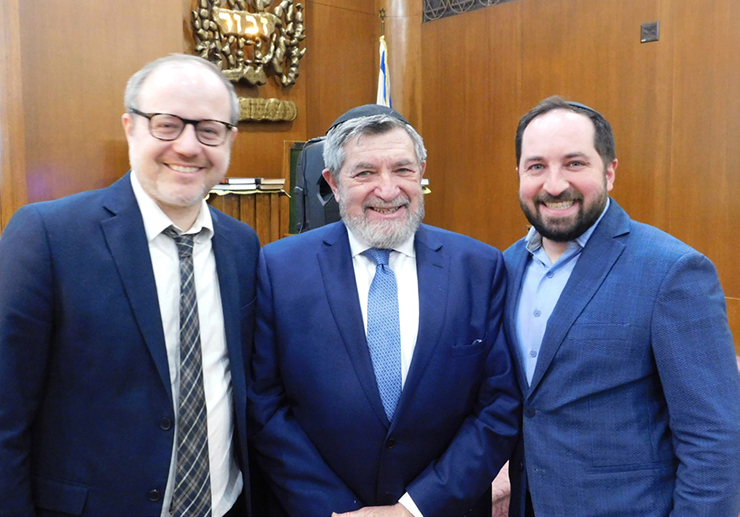
Arnold Newfield, a Holocaust survivor born in a transit camp in 1942, and Rabbi Dr. Elimelech Gottlieb, who has a master’s degree in Holocaust Studies, were the main speakers at the annual Yom HaShoah commemoration at the Young Israel of Forest Hills.
Newfield’s family was originally from Austria, where his father loved the cafes, friends, and the job he had in Vienna. “He never wanted to leave.”
His mother had a premonition, telling his father to come home early on a night that turned into Kristallnacht – November 9, 1938. Over 30,000 Jews were arrested. After that, his mother said it was time to get out of Austria.
Arnold was born in the Westerbork transit camp in Holland in 1942. At three years old, his father was sent to the Buchenwald concentration camp. Newfield, his mother, and two brothers, Bernard and Marcel, were deported to the Ravensbrück concentration camp.
Blond-haired, blue-eyed Marcel came down with tuberculosis. The Gypsies running the kitchen at Ravensbrück gave him butter to eat because fat helps fight TB. Marcel then gave any excess food to Arnold, his mother, and his brother.
By March 1945, with the Russian Army advancing, the Nazis put Arnold, his mother, and two brothers onto a cattle car with about 97 other people. It was a two-and-a-half-day trip to Bergen-Belsen. “People died on that cattle car.” “It was also used as a bathroom by everyone.” “Worse than that was the thirst.”
When the train stopped, everyone had to march three-and-a-half miles to the Bergen-Belsen camp. “If you didn’t choose to march, they shot you.”
Arnold was three years old, Marcel was almost seven, and Bernard was 11. The Germans gave a truck ride to Newfield. His mother worried she would never see him again. His mother went to the female SS guard where Newfield was being held at Bergen-Belsen, saying, “I am here to retrieve my son.” The SS guard screamed at his mother, but also whispered, “If you show me where your son is, I will get him. I will give him to you. You will run, and I will shoot over your head.”
Arnold’s mother buried the dead at Ravensbrück, so she was asked to bury a contaminated body at Bergen-Belsen. She agreed, only if she could get clean water. She didn’t get water, but spinal meningitis instead. She and Arnold were put into isolation.
Everyone knew the war was ending. Arnold’s mother warned her children not to eat the food the British would give when liberated, something very hard for children to do. “Nearly half the population of Bergen-Belsen died because they did partake. Their stomachs couldn’t handle it,” said Newfield.
A Jewish American soldier speaking German at Bergen-Belsen was his mother’s half-sister’s husband, whom she had never met before. “Aunt Edith charged him, ‘You better not come home unless you find my family.’” Uncle Fred found his brother Bernie, who took him to Arnold, where his mother and his brother Marcel were. “He had to show a picture of his sister to convince her who he was.”
Arnold feels Uncle Fred was the one who got the family sent to Holland instead of a Displaced Persons camp after the war. They lived with a Protestant family “who could not have been better to us.” Arnold’s father survived Buchenwald and came to their home in Holland.
Arnold Newfield’s message to those gathered, and also to young people he talks to, is: “You’re allowed to get angry. You can’t hold onto that anger. It’s a killer.”
When speaking to other groups, especially immigrants, Newfield describes how he and his brothers spoke only English with their mother in America. That way, she learned to read, write, and speak English. By immigrants speaking English here, “they will get better jobs.”
Rabbi Dr. Gottlieb has semichah from the Chofetz Chaim and Ner David yeshivos, and a PhD from Yeshiva University. His parents survived Auschwitz-Birkenau. He is the father of Dovid Gottlieb, the President of the Young Israel of Forest Hills.
From ancient days and up to the 19th century, the prophets and rabbanim were the custodians of Jewish history and its meaning.
“Moshe prepares the Jewish people for the future, and in his farewell address says, ‘Remember the days of old. Consider the years of ages past. Ask your father, and he will inform you. Ask your relatives, and they will tell you.’”
Rashi said to understand – because you’ll know what will happen to you in the future. Ramban adds, “What happened to the fathers, it’s going to happen in the future.”
The Bible is not so much a description of historically unique events, but “a repository of eternally valid patterns, the occurrences in the world are bound to unfold,” said theologian and historian Barbara Krawcowicz.
Jews are not “helpless actors,” said Gottlieb. By studying, understanding, and applying the events that we have found in our history, we create our future.
Rabbi Meir Simcha of Dvinsk, Russia, said in the early 20th century how “There is an undeniable, unmistakable, clear pattern of Jewish history.” Those patterns are: Jews settle in a country, they grow spiritually and theologically, become financially successful, and become great contributors and builders of that society.
“Then the storms come along and blow them into a new country,” whose language they do not know. “Jews get comfortable in a country, until we say, ‘Berlin is our Jerusalem.’ It doesn’t bode well.”
Historian Raul Hilberg sums up a pattern of 2,000 years of Jews living in Europe: conversion, expulsion, and annihilation.
The Holocaust is unique because of the magnitude and because it was state-sponsored, legalized, organized, and systematic. “Killing six million while conducting a war is a huge undertaking. It could not have happened without the involvement of the entire European continent. Somebody ran those trains, somebody greased those engines, somebody drove them, and lots of somebodies told the Nazis where the Jews were. This was unlike anything else before.”
Even in Palestine, the Mufti of Jerusalem, Mohammed Amin al-Husseini, had a pact with Adolf Hitler to kill the Jews there. However, the British Army stopped the German Army at El Alamein, Egypt, 12 days from Jerusalem. “It was a global undertaking,” said Gottlieb.
Now, people are not globalizing the Holocaust but globalizing the intifada. People in polite societies say Jews are committing genocide, “and Jews in every part of the world have to be killed in the name of justice.”
Rabbi Yosef Dov Soloveitchik, in 1948, spoke of fate and destiny. “Fate is what befalls you. Destiny is what you make.”
The Holocaust was fate, but it resulted not only in the flourishing of the Jewish people, but in the creation of one of the most important countries on earth. While Israel has fought wars since its inception, they have given the world technology, medicine, and thought – and brought healing and hope to the world, if only it were willing to accept it.
“What would our forefathers ask of us? What would those who perish – what would they want us to remember? To remember not just what they died for, but what they lived for. That we are part of an unbroken chain of destiny for us, for ourselves, and for our children and grandchildren.”
Rabbi Zalman Mergui, of the Tifferet Shalom congregation at the Young Israel of Forest Hills, said that every day we remember the victims of the Holocaust, leaving Egypt, and what Amalek tried to do. Each of those events has a special day for remembering.
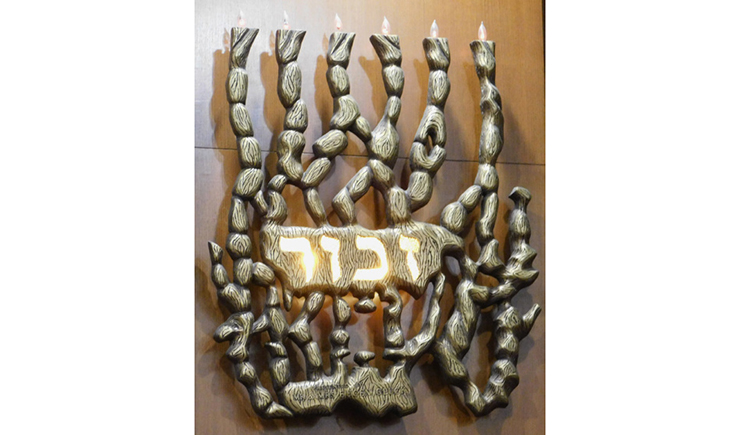
When Moshe trains the younger generation to enter the Land of Israel at the end of the Torah: “Remember the days since the creation, and build the future.” “It’s impossible to build the future if you don’t remember. Staying at the stage of Zachor is not enough. We have to build after that. We have to do something proactive.” Rabbi Mergui wants to build Jewish education and Jewish life, and with Hashem’s help, we will succeed.
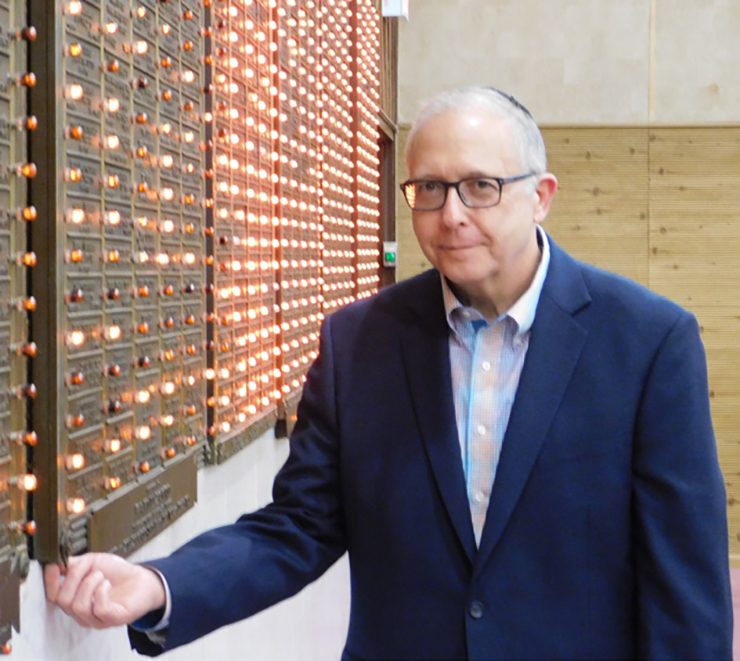
Six descendants of Holocaust survivors lit the memorial lights in the back of the synagogue. Rabbi Yossi Mendelson of Congregation Machane Chodosh said a Yizkor prayer in memory of the murdered. Rabbi Judah Kerbel of the Queens Jewish Center closed out the program by reciting Keil Malei Rachamim with the more than 75 people attending.
In April 1964, the Young Israel of Forest Hills was the first synagogue in America to organize a Yom HaShoah program. This was their 62nd continuous program.
By David Schneier