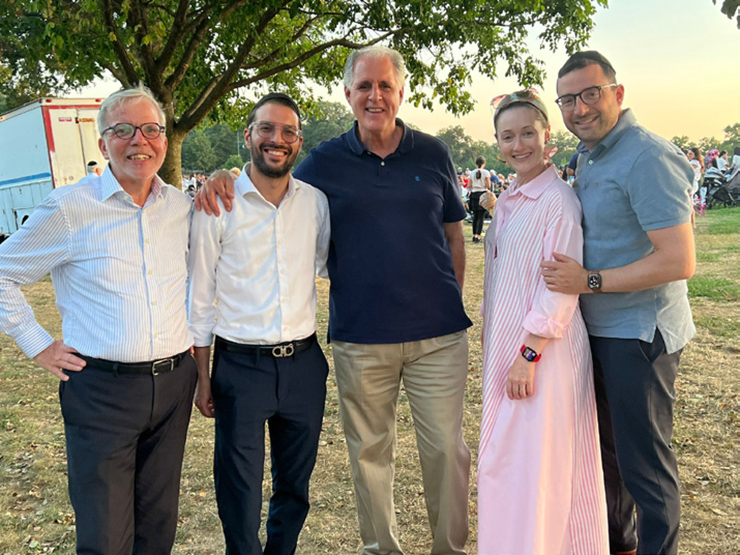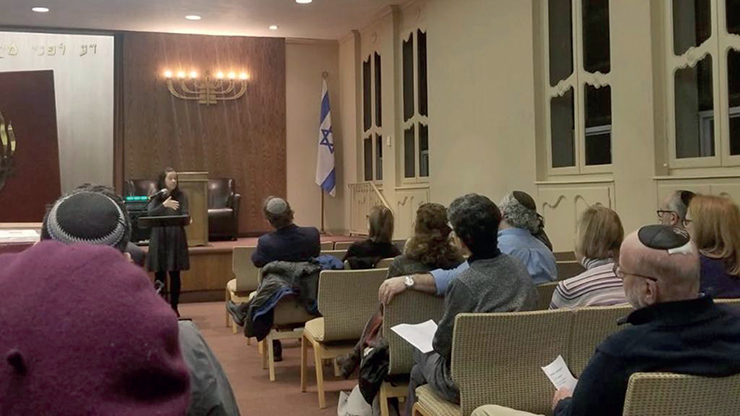

On Motza’ei Shabbos, February 7 – with Bryna Greenberg’s yahrzeit approaching the following Tuesday – the social hall at the Young Israel of Queens Valley filled with friends and family who knew her best. For those present, the room carried a quiet sense that Bryna was with them – not only as memory, but as a living influence.
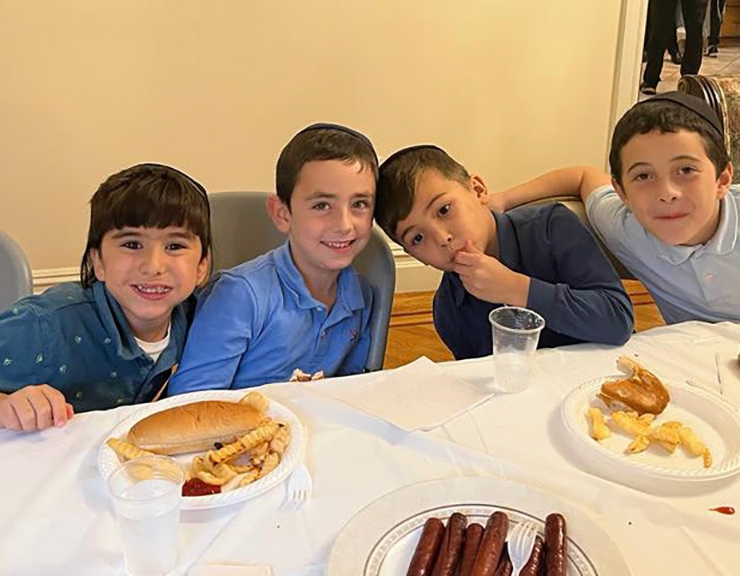
The evening centered on what Bryna cherished most: Torah in Eretz Yisrael. Proceeds supported the Bryna Legacy MMY Scholarship Fund, enabling young women who yearn to study Torah in Israel to attend Michlelet Mevaseret Yerushalayim (MMY). Guests enjoyed a generous dairy buffet catered by Gotta Getta Bagel.
Rena Greenberg, Bryna’s mother, served as emcee with quiet strength. She framed the night around empathy, sharing a brief Torah thought on those spared because they willingly absorbed pain for others – a reminder of how deeply Hashem values sensitivity to another’s suffering.
The program included a siyum on Maseches Bava Kama led by Bryna’s father, Aryeh Greenberg. He highlighted how communal norms shape halachah, echoing Bryna’s instinctive care for how people are treated.
Aryeh then spoke simply and from the heart about his daughter. He recalled how Bryna noticed those whom others overlooked: the special-needs camper needing a train set, homeless women on the subway, and the ill whom she supported even amid her own challenges. His message was clear: If we are still here, Hashem needs us to do good – especially for others.
Rabbi David Katz, MMY Director since its founding 23 years ago, reflected on Bryna’s spiritual clarity. He noted that the scholarship fund has enabled dozens of girls who otherwise could not have gone to Israel to learn at MMY – a quiet continuation of Bryna’s legacy of tz’dakah, Torah, and love for Eretz Yisrael.
One of the most moving moments came from Chloe Gertner Jaroslawicz, Bryna’s close friend and founder of Yaldei Bryna Bracha. Through her work with the Ahavas Chesed Center, Chloe met families uprooted by medical crises. In Bryna’s spirit, she began dressing these children for Yom Tov with dignity so they could enter school feeling normal and seen. Showing photos of children who had endured illness and loss, she said simply, “These are Bryna’s children.” The room understood exactly what she meant.
Rabbi Daniel Kalish, menahel of the Mesivta of Waterbury – a talmid of the Yeshiva of Far Rockaway and the Mir in Yerushalayim, known for his “radical warmth” and moving shmoozen – offered the evening’s Torah reflections. He arrived straight from a Shabbos in yeshivah with several talmidim after receiving Rena Greenberg’s invitation.
Before his address, heartfelt songs led by Rabbi Kalish’s talmid Shlomo on guitar lifted the room.
Rabbi Kalish explained that although he did not know Bryna personally, he feels deeply connected to her family through his longtime friendship with her cousin Dovi Perkal. Grounding his remarks in Parshas Yisro, he focused on Vayichan sham Yisrael – written in the singular – teaching that true achdus means no Jew is replaceable. He connected this to the past three years in am Yisrael: If one Jew is missing, all of us are missing.
Turning to Yisro’s advice to Moshe Rabbeinu, Rabbi Kalish noted that, while Yisro introduced efficiency, the Torah first recorded Moshe’s original approach to teach a deeper truth: Every task matters, and every person matters. Systems are necessary, but the fire must never be lost.
He illustrated this with a simple point: In a yeshivah, the custodian mopping the floor performs holy work; in a Jewish home, a mother doing laundry engages in sacred chesed. First, we must feel every task is precious – only then do we organize and delegate.
Bringing the message back to Bryna, Rabbi Kalish described her as someone who instinctively saw every person as essential – the foundation of Torah.
In a personal moment, he spoke of his own father, Rabbi Yehoshua Kalish z”l, longtime mara d’asra of Harborview Beis Medrash in Lawrence. Though he misses him deeply, he feels close through memory, legacy, and daily choices – the same, he said, is true of Bryna.
Rabbi Kalish closed with a t’filah that we should recognize our own light and see it flicker in others, just as Bryna did.
By Shabsie Saphirstein