
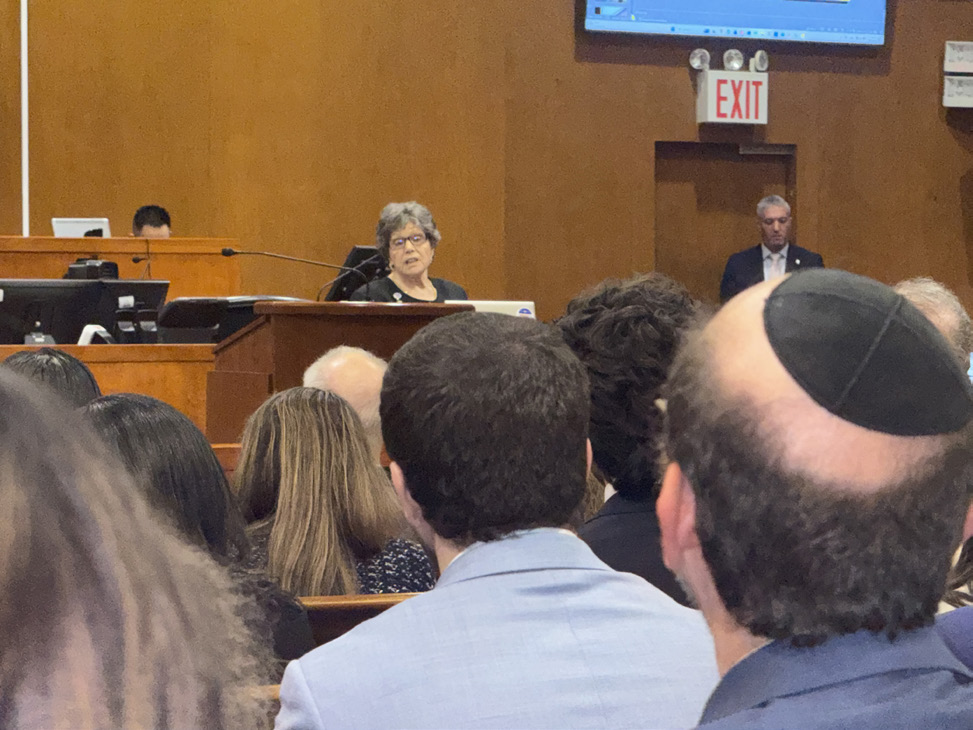
On Monday, April 13, members of the legal community gathered for the 18th Annual Holocaust Remembrance Day program, organized by the Brandeis Association and the Equal Justice Committee. Held in Courtroom 190 at Queens Criminal Court in Kew Gardens, the program honored the memory of the six million k’doshim while underscoring the responsibility borne by those entrusted with justice.
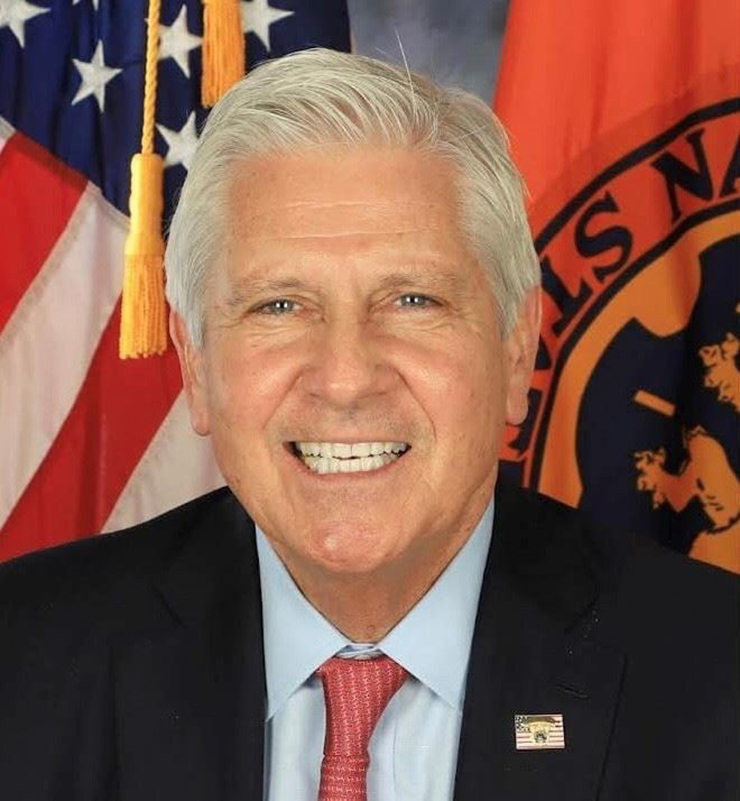
Hon. David Kirschner, Chair of the Brandeis Association, was joined by Hon. Michelle Johnson, Hon. Joseph A. Zayas, and Hon. Adam Silvera in addressing those in attendance. Their remarks reflected both remembrance and responsibility, emphasizing that justice requires constant vigilance and enforcement.
Following the national anthem, keynote speaker Dr. Aliza Levy-Erber was introduced.
What followed was a detailed account of how persecution unfolded step by step, how resistance emerged, and how survival often depended on courage and impossible choices.
Born in the Netherlands in 1943, Aliza entered a world already overtaken by Nazi control. Jewish life did not collapse overnight. Restrictions came gradually: exclusion from schools, limitations on movement, and public decrees stripping basic rights. Registration followed, forcing Jews to carry marked identification and submit to an increasingly oppressive system. Even as reports filtered in from refugees fleeing Germany and Austria, many could not yet fully comprehend the scope of what was unfolding.
Aliza’s father was active in the Dutch resistance and was later murdered in Auschwitz. Her mother, only 17 at the time, joined the underground. Gifted in art, she was recruited to forge identification papers that allowed Jews to evade detection. She learned how to alter documents, removing identifying markings – dangerous work that formed part of a broader resistance effort.
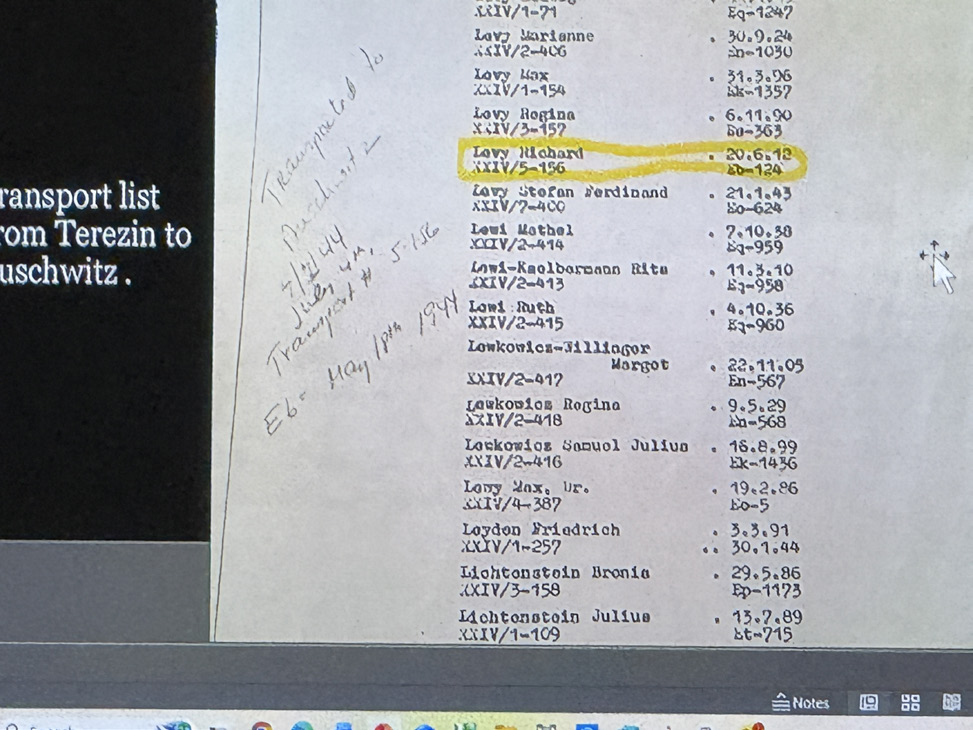
Her mother’s fiancé, Richard, carried out even more perilous missions. Members of the underground obtained deportation lists and passed them to operatives like him. His role was to reach targeted families and move them from one safe location to another. There was an 8 p.m. curfew; after that, anything that moved could be shot. Children were transported in sacks, their mouths taped shut. Families moved along walls and through darkness. On one such mission, Richard was captured and disappeared into the Nazi system.
He was eventually traced to Westerbork. What began as a refugee camp was converted into a transit camp – a staging ground for deportations to extermination camps. Determined to reach him, her mother managed to travel there despite restrictions. In an extraordinary act of defiance, she convinced a Nazi commandant to allow her to marry Richard inside the camp. His signature remained on the document. Her efforts to secure his release were unsuccessful, and she returned to Amsterdam alone.
By then, Aliza had been born. She was approximately six weeks old when a knock came at the door. It was a Dutch policeman, warning her to gather the children immediately and leave. As he turned to go, he asked if she recognized him. She did not. He then revealed he had been one year ahead of her in art school and told her, “A talent like you should not be destroyed.” That warning provided the time needed to escape.
The family was separated through a network of prearranged hiding places. Two underground operatives arrived on bicycles and took her mother’s younger sisters. When her mother begged to know where they were going, she was told she could not be informed – any knowledge could later be compelled. Her grandfather had already arranged hiding places. One question remained: How do you hide an infant?
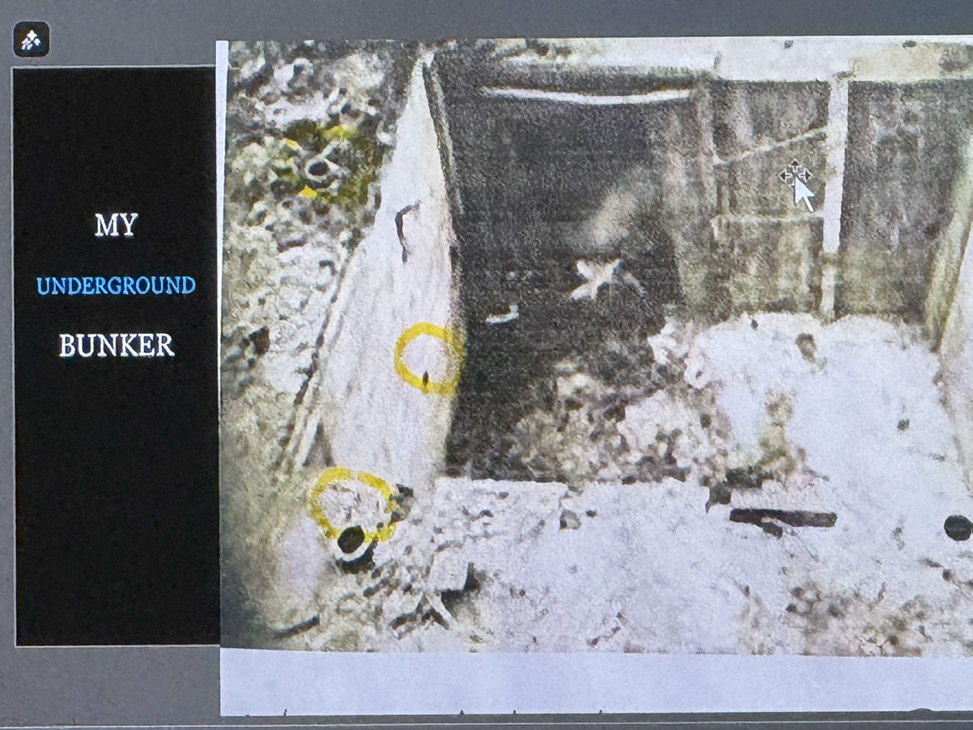
The answer was almost beyond comprehension. Aliza was hidden underground with nine other babies in a concealed bunker in the Dutch woods, a place she later returned to see. The bunker was sealed, with no natural light, no open air, and only narrow pipes providing minimal ventilation. She remained there for nearly two and a half years without seeing the sun or hearing normal speech.
Silence was essential. The babies’ mouths were taped shut. Once a day, members of the underground would arrive, remove the tape, feed the infants, and seal them again. Reflecting later as a physician, she described the damage this likely caused. Their food consisted of boiled contents of toilet bowls, barely sustaining life. One can only imagine what such conditions did to their developing bodies.
When the war ended in May 1945, Aliza emerged severely weakened after nearly two and a half years underground. The physical toll was immediate, and the emotional impact endured.
In the years that followed, the understanding of her own story deepened. Her mother later married a soldier from a British Jewish unit who became the father she knew. At age 16, she learned that her biological father had been murdered in Auschwitz.
Years later, Dr. Levy-Erber returned to Europe and visited sites connected to her family’s past. She described burial grounds filled with nameless graves and the aftermath of liberation, when bodies and remains had to be gathered and buried, often without identification.
During one visit, she entered a barracks where prisoners had been held in extreme overcrowding, with disease and starvation rampant. She later located documentation confirming her father’s presence in such a camp and obtained affidavits from witnesses to his death. These records, she noted, will eventually be preserved in an archive.
She also recounted the fate of her great-grandmother, deported despite being born Catholic, because of her marriage to a Jew. After enduring transport in a cattle car, she was murdered upon arrival at Auschwitz.
She later moved to what was then British Mandate Palestine and became both a physician and a rabbinic pastor, dedicating her life to healing. She expressed gratitude for the existence of the State of Israel, a place of refuge after centuries of exile and persecution.
A candle-lighting ceremony followed her story, bringing forward members of the legal community together with second- and third-generation descendants of survivors.
The Keil Malei Rachamim was then recited in both English and Hebrew.
Before HaTikvah was sung, its meaning was explained by Adam Orlow, Past President of the Brandeis Association, who emphasized that the anthem reflects a people who, even after destruction and exile, never relinquished their hope of return, and whose connection to Eretz Yisrael remains unbroken.
As the program concluded, closing remarks were delivered by Elizabeth Forspan, President of the Brandeis Association, joined by Hon. David Kirschner, Hon. Gia Morris, Past Chair, Bradley Siegel, Past President, Hon. Nestor Diaz, Chair of EJIC, and Hon. Jodi Orlow, reflecting on the deeply personal nature of remembrance and the responsibility to ensure that the lessons of the Holocaust endure.
As the number of survivors continues to diminish, the responsibility shifts to those who remain: to remember and to bear witness.