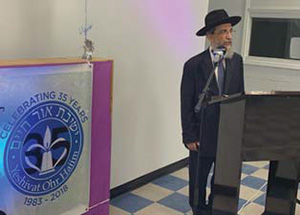


On Sunday evening, March 1, at Kehillat Beth El in Queens, Rav Yakov Nasirov, the Rav of Beth El, led the gathering in T’hilim.
Next, renowned speaker Charlie Harary spoke about Zichron Naftali.com, an organization that cares for people primarily in Israel and around the world. He encouraged everyone to support this holy cause.
Harary then shared a conversation he had with his rav, Rav Moshe Levy, about how we should approach Purim. His rav taught that the story of the Megillah is unbelievable: The Jewish people faced total annihilation due to a grave sin. What was that sin? The Jewish people participated in King Achashveirosh’s seven-day feast.
To understand this, we must go back to the beginning. The Jewish People were enslaved in Egypt. Hashem declared it was time to redeem His people. He could have done so in the easiest way possible: if Pharaoh had simply changed his mind. But the more Hashem openly breaks the laws of nature, the more it limits our free will. Hashem hides His presence to grant us free choice; miracles are necessary only when essential.
Instead, Hashem struck Egypt with ten plagues and led the Jews out on a circuitous route. The goal of the Exodus was not merely to save the Jewish people; it was to launch them into their mission in this world. We have a purpose: to change the world and reveal Hashem’s presence.
Before the tenth plague, Hashem instructed Moshe to tell the Jewish people to take a lamb, keep it for four days, then slaughter it and smear its blood on their doorposts. The lamb was the chief deity of Egypt, the most powerful nation and idolatry in the world. The Jews, long enslaved, had been influenced by this culture.
By parading the lambs through the streets and keeping them in their homes – where their bleating could be heard – then killing them and marking their doorposts, the Jews publicly rejected Egyptian idolatry. Hashem said: “I will do My part, and you do yours. Show that you believe in Me alone.”
Fear Hashem, and you fear no one else. True freedom comes when you stop fearing the world. Slavery means bowing your head to another; the Jews’ greatest test was to demonstrate that there is only one G-d who runs the world. When you are fearless in the eyes of the world, you reveal Hashem’s existence.
Only 20 percent of the Jews left Egypt; 80 percent could not break free from the host culture. The ones who departed with Moshe were those who proclaimed: “Hashem is One. I bow my head only to Him.” That is what it means to be a Jew – our reason for existence. We are not here to accumulate possessions but to fulfill a mission: to bring Hashem into the world by showing we bow only to Him.
Throughout history, when Jews lose sight of this oneness of G-d, they lose Hashem’s protection. In exile (galus), prolonged exposure to foreign cultures leads us to equate success with acceptance. We fear standing out, mistaking assimilation for achievement. We adopt the world’s values – materialism, athletics, wealth, appearance – and become embarrassed to be different.
In the Purim story, the Jews were invited to Achashveirosh’s feast in Shushan, after the destruction of the First Holy Temple. Achashveirosh miscalculated, believing the 70 years prophesied for the Temple’s rebuilding had passed. He threw the party to declare his dominance: no more Temple, no more chosen people, no more Shechinah. He used the Temple vessels and wore the garments of the Kohen Gadol.
Kissing Achashveirosh’s ring means acknowledging more than one king. The sin of that feast – if we are honest, a trace of it lingers in us – is the desire to be liked by others. We sometimes think our enemies fall to missiles and bombs rather than to Hashem.
Rav Hutner teaches that wherever assimilation flourishes, anti-Semitism follows. Berlin, the cradle of European assimilation, became the birthplace of the Nazis. Anti-Semitism arises when we fail our mission. When we crave to be like everyone else, we forfeit the Shechinah’s protection.
Assimilation often begins on college campuses, where anti-Semitism is most intense today. Forget your mission, and you lose your safeguard.
The solution? Stand proudly as a Jew. Open a Torah and deepen your commitment. Teshuvah is the greatest barrier to anti-Semitism today.
Who saves us in the Purim story? Mordechai, who refuses to bow to Haman. He fears only Hashem and takes pride in being Jewish. Esther calls the Jews to gather, fast, and pray for her. We have lingered too long in the material world. It comes down to one thing: how connected we are to Hashem alone. Do we wake each morning asking, “Am I making You proud?”
Esther thought only of Hashem.
Purim reminds us that we were once lost – and remain in that same exile mentality, still trying to impress others. We must awaken to our mission and ask: How can I serve Hashem better?
Fasting detaches us from galus and reminds us that we answer only to Hashem. Turn to Him and seek closeness. Purim is a day of prayer, akin to Yom Kippur (Yom HaKippurim). Its goal is t’shuvah. Mordechai and Esther call us to emulate them and remember why we are here.
By Susie Garber