
As Democratic primaries put Israel at the center of several NY races, Mamdani's rhetoric has crossed a dangerous line
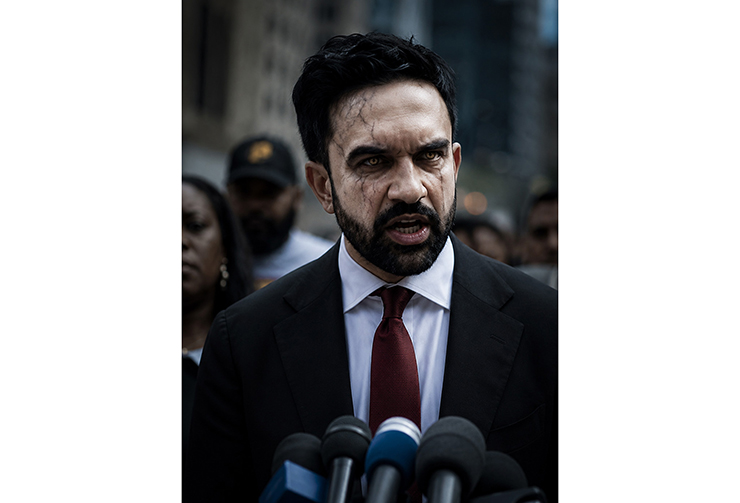
New York City Mayor Zohran Mamdani's latest attack on the American Israel Public Affairs Committee (AIPAC) has sparked a sharp backlash from elected officials, rabbinic leaders, Jewish organizations, and community members, after the mayor used language that went far beyond ordinary political disagreement at a time of rising antisemitism.
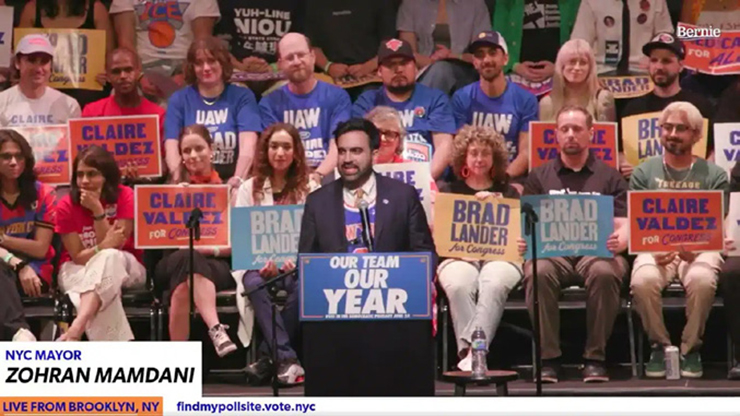
Speaking at a get-out-the-vote rally in Brooklyn alongside Senator Bernie Sanders and progressive congressional candidates, Mamdani singled out AIPAC as one of the "monsters" facing the progressive movement. He accused the pro-Israel advocacy organization of using "dark money" to preserve political power, divide voters, and protect Israeli Prime Minister Benjamin Netanyahu's war policies.
The comments came in the closing stretch of several closely watched Democratic primaries in New York, where Israel, Gaza, and AIPAC's influence have become central campaign issues. Mamdani used the rally to boost former City Comptroller Brad Lander, Assemblymember Claire Valdez, and Darializa Avila Chevalier, each aligned with the party's left flank on Israel.
Mamdani later defended the remarks at City Hall, saying the "monsters" reference was drawn from Italian political philosopher Antonio Gramsci and intended broadly, not only toward AIPAC. He said the group represents a "status quo for immorality" and argued its influence must be named in any discussion of the war in Gaza and American policy toward Israel. That explanation did little to quiet critics.
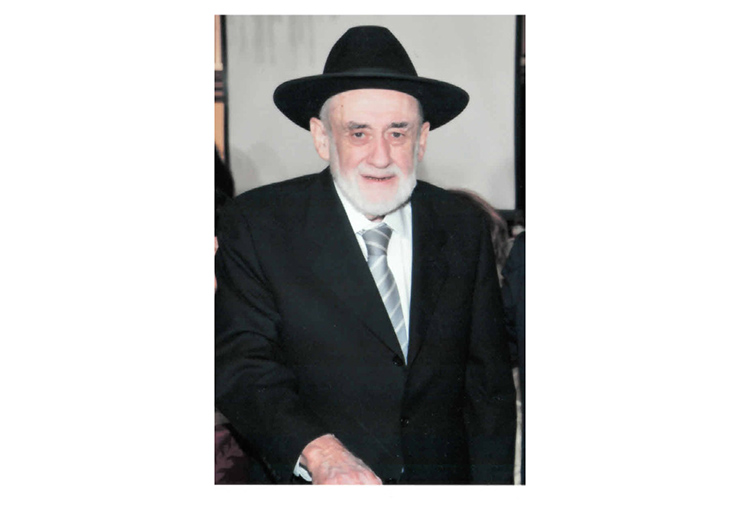
Rabbi Chaim Steinmetz, senior rabbi of Congregation Kehilath Jeshurun on Manhattan's Upper East Side, issued one of the most forceful responses. He wrote that Mamdani was accusing AIPAC of being "a monster that subverts democracy, supports genocide and wants to divide Americans," calling the rhetoric "pure incitement." Steinmetz warned that such language could inspire violence against AIPAC supporters and said Mamdani was "inciting hatred against people like me." With New York already facing a serious antisemitism problem, he accused the mayor of "pouring fuel on the fire." For many in the community, those words captured the central fear: that attacks on AIPAC are increasingly framed not as policy disagreements, but as claims that pro-Israel Jews are a sinister force endangering the public.
Queens Council Member James Gennaro issued a sweeping condemnation, calling the language "the open deployment of classic antisemitic conspiracy theories from the office of the Mayor of New York City." Branding AIPAC "monsters" and accusing it of using "dark money" to "turn us against one another" was not a criticism of lobbying, he said, but a dangerous demonization of a group associated with Jews and the State of Israel. "The Mayor again makes clear what many suspected for a while: he harbors a deep and personal hatred of Jews and of the Jewish state," Gennaro stated, arguing the rhetoric now carries the authority of City Hall and can no longer be dismissed as the words of someone without power.
Gennaro warned that antisemites do not need AIPAC as an excuse to hate Jews, but do seek "permission, normalization, and a sense that their bigotry is socially and politically acceptable." By invoking language about Jewish-associated money and control, he said, Mamdani was reviving "the oldest tropes about Jewish money and secret control." He was especially critical of the mayor's refusal to retract the remarks: "His refusal to retract these remarks when directly challenged is not courage. It is a confirmation." He called it "grotesque hypocrisy" for Mamdani to claim concern for Jewish New Yorkers while using rhetoric that has historically preceded violence. "One does not get to demonize groups that people associate with Jews, and then pretend your hands are clean when synagogues are vandalized, Jewish students are harassed, and Jews are attacked on our streets." He concluded: "I will not be gaslit. I will not be intimidated."
Representative Josh Gottheimer, a Jewish Democrat from New Jersey, wrote on X that replacing the word "AIPAC" with "Jews" exposes the underlying danger in the rhetoric, describing it as an old antisemitic conspiracy theory repackaged for modern politics and especially dangerous from the podium of the mayor of a city with one of the world's largest Jewish populations. Council Member Eric Dinowitz, chair of the City Council's Jewish Caucus and its Bipartisan Task Force to Combat Antisemitism, said Mamdani's words invoked "age-old antisemitic tropes" about money, power, and hidden influence. New Yorkers can and should debate foreign policy and the Middle East, he said, but demonizing language does real harm and does not promote coexistence. The American Jewish Committee's CEO Ted Deutch said labeling political opponents "monsters" is not a debate over ideas but a form of dehumanization. The Anti-Defamation League and the Simon Wiesenthal Center similarly condemned the remarks as echoing historic accusations about Jewish political power and manipulation.
What made the reaction especially notable was that concern did not come only from Mamdani's usual critics. Some progressive Jewish figures sympathetic to the mayor or critical of AIPAC also expressed discomfort. Rabbi Jill Jacobs, who leads the progressive rabbinic human rights group T'ruah, wrote that AIPAC can be strongly criticized without calling its backers "monsters" or hinting at a grand Jewish conspiracy. Rabbi Misha Shulman, a Mamdani supporter and leader of The New Shul in Brooklyn, told media the remarks were troubling, especially the repeated "dark money" language in the current climate.
Many Jewish leaders have long acknowledged that AIPAC, like any advocacy organization, is a legitimate subject for scrutiny. But critics argue that when the mayor of New York City speaks about a pro-Israel group using language about monsters, secret money, and the power to turn Americans against each other, the impact is felt far beyond a single rally.
For many Jewish New Yorkers, the concern is that this rhetoric is not staying confined to policy debate. Instead, it is increasingly used as a marker to question whether Jewish elected officials, pro-Israel voters, and supporters of Israel belong in ordinary civic spaces. On social media, some users accused Mamdani and the Democratic Socialists of America of using "AIPAC" as a stand-in for Jews. Others defended him, arguing AIPAC is a powerful organization and that criticism of its spending should not automatically be labeled antisemitic. But the strongest community concern focused on tone and timing. With the city already facing heightened anxiety over antisemitic incidents, synagogue protests, and intimidation aimed at Jewish institutions, leaders argued, public officials have an added responsibility to choose their words carefully.
The controversy now leaves Mamdani facing an increasingly urgent question: whether he can separate criticism of Israeli policy and pro-Israel advocacy from rhetoric that many Jewish New Yorkers hear as threatening. Criticism of AIPAC is fair game. Criticism of Israel is part of public debate. But turning Jews or Jewish-linked institutions into symbols of sinister power and secret money crosses a line that New York's Jewish community cannot ignore.
By Shabsie Saphirstein