

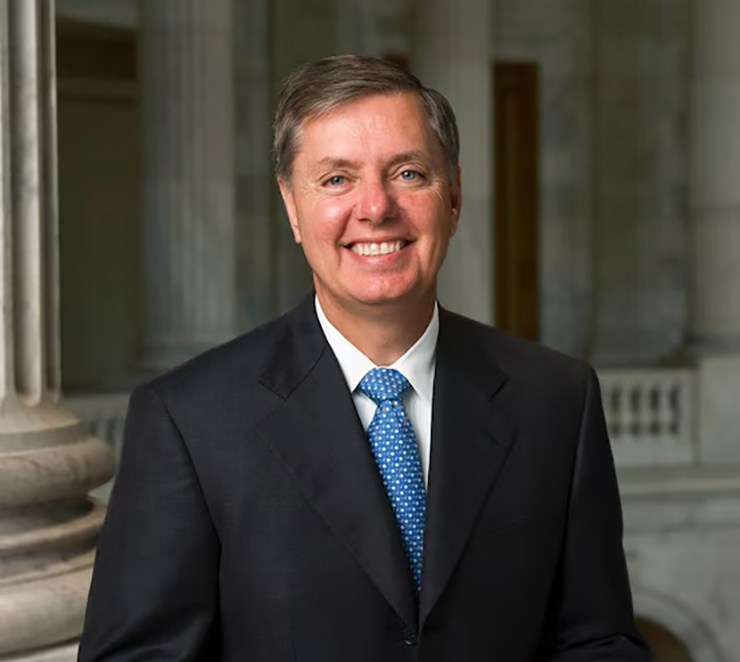
Senator Lindsey Olin Graham, the Republican from South Carolina whose decades-long career embodied a pragmatic, forward-leaning American foreign policy rooted in strength, alliances, and moral clarity, died suddenly of an aortic dissection on July 11, at age 71. He passed away shortly after returning from what would be his final trip to Ukraine, where he met with President Volodymyr Zelenskyy and helped advance new sanctions targeting Russia’s war machine.
Graham’s death removes one of the Senate’s most consistent and knowledgeable voices on national security at a moment when authoritarian aggression in Europe and the Middle East continues to test American leadership. Throughout his more than 23 years in the Senate and earlier service in the House of Representatives, he argued that the United States could not afford isolation or retrenchment. He viewed support for key allies – especially Israel and Ukraine – not as optional charity or endless entanglement, but as pragmatic realism essential to deterring larger conflicts, protecting global trade routes and energy security, and upholding the principle of peace through strength.
Born July 9, 1955, in the small town of Central, South Carolina, Graham was the first in his family to attend college. He earned a bachelor’s degree and law degree from the University of South Carolina. After graduation, he was commissioned as an officer in the US Air Force Judge Advocate General’s Corps in 1982. He served more than six years on active duty, including an overseas assignment from 1984 to 1988 at Rhein-Main Air Force Base in Germany. He continued in the South Carolina Air National Guard and later the Air Force Reserve, retiring in 2015 as a colonel after 33 years in uniform. That experience shaped his conviction that American power, when exercised with purpose and alongside allies, prevents wars rather than provokes them.
Graham entered elective office in the South Carolina House in 1993, won a US House seat in 1994, and succeeded Strom Thurmond in the Senate in 2003. He served on influential committees, including Armed Services, Foreign Relations, Judiciary, Appropriations, and Budget, and became a senior voice on national security, foreign policy, and the courts. Colleagues across the aisle respected his command of detail and willingness to work on complex issues, even as his hawkish instincts on defense and foreign policy placed him at the center of debate.
It was on foreign policy that Graham’s influence was most pronounced. He was among Israel’s most reliable champions in Congress for more than two decades, consistently backing robust security assistance, opposing the Iran nuclear deal, and pushing back against diplomatic and economic pressure on the Jewish state. He saw the US-Israel relationship as both a strategic asset in a dangerous region and a reflection of shared democratic values and historical experience.
More recently, he became one of the most vocal Republican advocates for Ukraine, following Russia’s full-scale invasion. He traveled to the country repeatedly – his tenth visit came in the final weeks of his life – and worked across party lines to sustain military aid and tighten sanctions on Moscow. He framed the conflict not as a distant European quarrel but as a test of whether the United States and its allies would allow a rebuilding of the former Soviet sphere of influence to go unchecked.
This clarity often made him controversial within the isolationist horseshoe of contemporary politics. Leftists frequently criticized his support for military assistance as “perpetuating conflict” or “advancing American colonialism.” On the fringe Right, those who embrace American retreat and frame it as “America First” non-interventionism questioned the costs of foreign aid and alliances, arguing that the United States should focus exclusively on domestic priorities and avoid being drawn into others’ fights. Graham rejected both impulses as shortsighted. He maintained that weakness or withdrawal invites aggression – whether from Iranian proxies targeting Israel, Russian forces in Europe, or Chinese ambitions in the Indo-Pacific. In his view, supporting partners who share interests and values was not idealism but the most practical way to raise the costs of adventurism for America’s adversaries and reduce the likelihood of direct US involvement in larger wars later. His recent work on Russia sanctions and continued advocacy for Israel’s defensive needs reflected that consistent, unsentimental assessment of threats.
Jewish organizations that valued his long record of support were quick to express their sorrow. The Coalition for Jewish Values (CJV) described Graham as “a steadfast friend of Israel and the Jewish people, whose moral clarity and courage distinguished his decades of public service.” In remarks reflecting the group’s deep appreciation, it continued: “He confronted anti-Semitism, defended religious liberty, and treated Jewish concerns with seriousness and respect. Senator Graham understood that America’s bond with Israel is rooted not only in strategic partnership but in shared moral purpose. He championed Israel’s security with unwavering resolve, strengthened US-Israel defense cooperation, and stood firmly against efforts to delegitimize the Jewish state.”
CJV emphasized that Graham’s voice “was consistent, principled, and deeply informed by an appreciation of Jewish history and its role in providing the ethical foundations of American and Western civilization.” For the Orthodox Jewish community, the senator’s advocacy had tangible impact through support for conscience protections, opposition to hatred, and recognition of Israel as the Jewish people’s ancestral homeland. “He understood that defending Israel and defending religious liberty were inseparable from defending the values that make America strong,” the group added.
The Coalition also highlighted Graham’s co-sponsorship of the Educational Choice for Children Act (ECCA) and his annual sponsorship of the Senate resolution designating Religious Education Week. These efforts reflected Graham’s belief that “faith, learning, and moral formation are essential to a healthy society” – a conviction that resonated strongly with America’s Jewish communities and all who value religious freedom. The group concluded that Graham’s passing “leaves a void in American public life,” while praying that he would serve as “an example and inspiration for future leaders to stand with the same courage for Israel’s security, Jewish dignity, and America’s moral commitments.”
Agudath Israel of America also mourned Graham as “one of the strongest and most outspoken defenders of Israel and the Jewish people in Congress,” noting that he had worked with Agudah on shared priorities, including the Taylor Force Act and the annual resolution honoring Religious Education Week. The organization noted that Graham represented South Carolina, a state without a large Jewish constituency, yet was considered – and considered himself – a close friend of the Jewish people, especially the Orthodox Jewish community. At one Agudah Mission to Washington, Graham captured that relationship with characteristic humor and warmth: “I may not be Orthodox, but I might as well be!”
Zionist Organization of America National President Morton “Mort” Klein, who knew Graham personally, offered a warm and personal tribute when reached for comment. “Sen. Lindsey Graham was a great American patriot and a friend of mine,” Klein said. “He was a most sincere and heartfelt friend of and advocate for the Jewish people and the Jewish state. He fought for strong US-Israel relations and fought those who were hostile to Israel.” Klein pointed to Graham’s clear-eyed assessment of global threats, noting, “Sen. Graham also understood the dangers posed by the Islamic Republic of Iran to America and the West and fought to minimize and eliminate that danger. He would always make clear that whatever endangers Israel also endangers America.” Beyond policy, Klein recalled Graham’s engaging personality: “He was also a great orator and extremely witty and funny and a great storyteller. What a terrible loss. He will be sorely missed.”
NORPAC, a leading grassroots pro-Israel advocacy organization, expressed profound sadness at the passing of Senator Graham, describing him as “a steadfast friend of the Jewish community, a tireless champion of the US-Israel relationship, and one of the Senate’s most influential voices on American foreign policy.” The group highlighted Graham’s decades of principled leadership and moral clarity, noting that he was “widely recognized as one of Israel’s strongest advocates in Congress,” where he championed critical security assistance, advanced bipartisan legislation to bolster Israel’s defenses, and spoke forcefully against threats from Iran, Hezbollah, and other extremist actors. NORPAC also praised his role as a trusted ally who stood firmly against anti-Semitism, supported protections for Jewish institutions, and used his platform with empathy and resolve. The organization recalled welcoming Graham to a packed room in Englewood, New Jersey, just months ago, where he was met with enthusiasm and gratitude as an unwavering pro-Israel voice. Serving with distinction on the Senate Judiciary, Appropriations, and Foreign Relations Committees, Graham’s passing, NORPAC concluded, “leaves a void in the halls of Congress and in the hearts of all who valued his friendship, his courage, and his unwavering dedication to the US-Israel alliance and the Jewish community.”
President Trump, with whom Graham developed a close working relationship on foreign policy matters after earlier differences, led bipartisan tributes describing him as a “true American Patriot.” Leaders in Israel, Ukraine, and across NATO expressed similar appreciation for his consistent advocacy.
Lindsey Graham’s career spanned eras of both consensus and polarization on America’s role in the world. He leaves behind a clear record: a belief that the United States is most secure, prosperous, and influential when it leads with confidence, keeps its word to allies, and confronts threats before they metastasize. In an age when isolationist pressures from multiple directions continue to challenge that tradition, his example of pragmatic engagement remains relevant. His voice will be missed in the Senate and in the broader debate over how America should navigate an increasingly dangerous world.
Moshe Hill is a political analyst and columnist. His work can be found at www.aHillwithaView.com and on X at @HillWithView.