
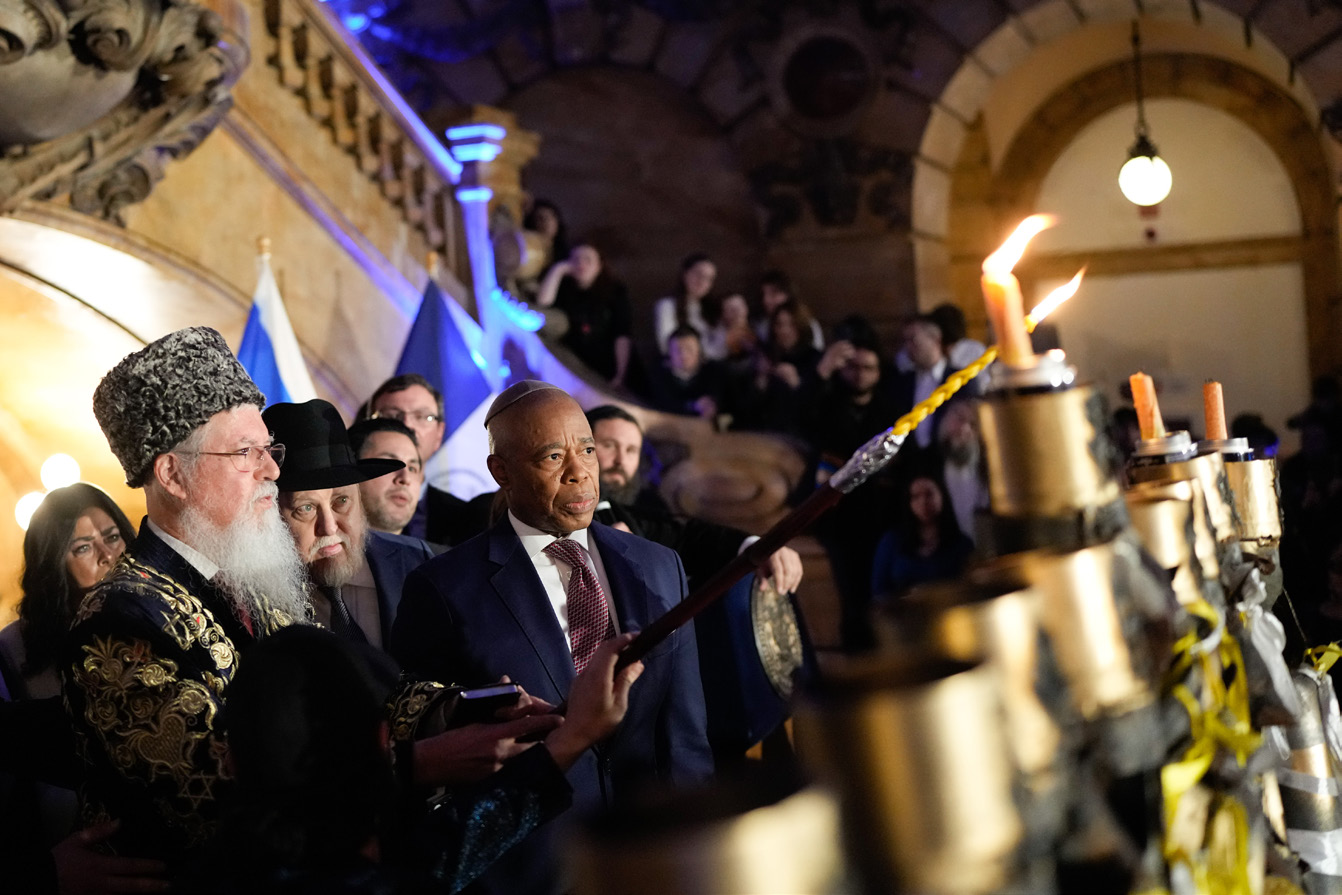
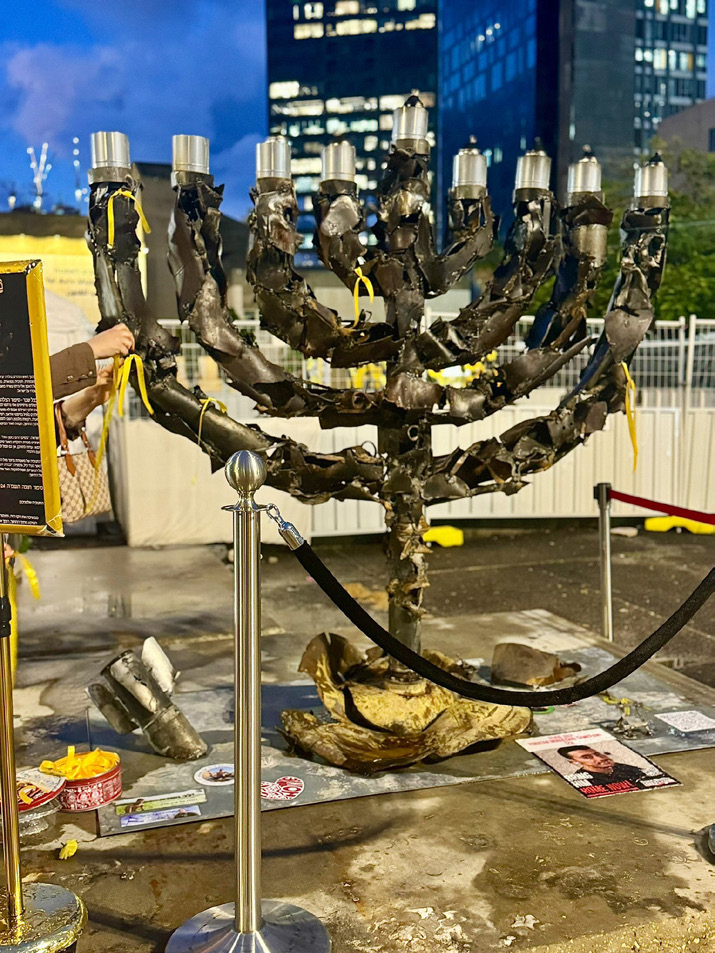
The Chanukah program held at New York County Surrogate’s Courthouse in Manhattan last Tuesday marked the arrival of a powerful symbol that has traveled from Israel to New York over the past year. At the center of the evening was the Chanukiah of Hope, created by Israeli artist Eli Gross. The menorah is constructed from fragments of missiles and projectiles fired at Israel, repurposed into a ritual object that reflects Jewish resilience and continuity in the face of war.
Gross’ work occupies a singular place in contemporary Jewish expression. His large-scale installations are displayed in Hostages Square and at Ben Gurion Airport, alongside mezuzos and pendants crafted from authentic missile shrapnel.
Last Chanukah, the Chanukiah of Hope stood in Hostages Square in Tel Aviv. Over the course of the past year, it became a focal point for national solidarity and unceasing prayer for the return of the hostages. Families of captives gathered before it. Soldiers paused beside it. Ordinary Israelis returned repeatedly, anchoring themselves to its light during a period marked by anguish and uncertainty.
Ahead of Chanukah 5786, the Chanukiah of Hope was transported to the United States via diplomatic mail. Its arrival represented a link between Israel and the Jewish Diaspora at a time when unity is essential.
As part of its journey, the Chanukiah of Hope was lit opposite United Nations Headquarters in New York by Israel’s Ambassador to the UN, Danny Danon, together with Shira Guvili, sister of Ran Guvili, the last remaining hostage held by Hamas terrorists. From there, it continued across the United States, bringing light and meaning to Jewish communities throughout the Diaspora.
The program formally opened with Moshe Davis, Executive Director of the Mayor’s Office to Combat Antisemitism. “I’m a loud and proud Jew, with my yarmulke on my head, and proud of who we are as a people,” Davis said. “And I want people to know I’m not the only one—at City Hall, we can easily make a minyan.”
Deputy Mayor Fabien Levy spoke candidly about the antisemitic terror attack in Australia, then shared his own family’s history of persecution and hope, describing his service as deputy mayor as the realization of a Jewish immigrant dream.
Invoking the words of Rabbi Lord Jonathan Sacks - “Never believe that a handful of dedicated people can’t change the world” - Levy connected the courage of the Maccabees to the moral obligations of the present, underscoring the responsibility to confront hatred with clarity and resolve.
Police Commissioner Jessica Tisch addressed the crowd following the terror attack at Bondi Beach, naming it plainly as Jew-hatred. While confirming there was no specific or credible threat to New York City, she announced significantly increased NYPD security at Chanukah events and Jewish institutions across all five boroughs.
A recitation of kapitel 121 followed.
Next, Yudi Cohen, the soulful tenor, filled the hall with song, culminating in a moving rendition of Leonard Cohen’s “Hallelujah,” interwoven with verses inspired by Dovid HaMelech and Tehillim. As attendees raised their phone flashlights, the modern anthem transformed the space into hundreds of points of light answering the Chanukiah at the center of the room.
As the final speaker of the evening, Mayor Eric Adams did not take the podium. Instead, he stepped down onto the floor and addressed the crowd from among the community itself, intentionally closing both physical and symbolic distance between City Hall and those gathered.
Adams acknowledged senior members of his administration standing with the Jewish community, including FDNY Commissioner Robert Tucker, CAU Commissoner Fred Kreizman, Deputy Mayor Tiffany Raspberry, and Menashe Shapiro, son of Rabbi Mordechai Shapiro, mara d’asra of Congregation B’nai Abraham in KGH, reflecting the multigenerational rabbinic leadership represented at the gathering.
Speaking personally, Adams referenced Devorah Halberstam, whose son Ari was murdered in a terror attack on the Brooklyn Bridge in 1994, reminding the audience that while bullets may stop, emotional trauma continues to tear at the very anatomy of the Jewish community. He forcefully rejected euphemisms used to mask antisemitism, insisting that hatred of Jews is not about geography or politics, but about Jews themselves.
Adams urged Jews not to live in fear - not to hesitate before entering synagogues, not to remove yarmulkes on public transit, not to hide a Star of David. “If we live in fear, they win,” Adams said.
As his remarks ended, Adams declared that while administrations may end, his commitment does not. “I am going nowhere,” he said, calling on modern-day Maccabees to stand up and defend what is right together.
The recitation of the hadlakas ha-menorah was led by Rabbi Itzhak Yehoshua, Chairman of the Bukharian Rabbinical Council in Forest Hills, together with Mayor Adams.
The evening reached its apex as the Chanukiah of Hope was brought forward for lighting. Its branches were wrapped with ribbons representing hostage families, white ribbons marking reunions, and prayers physically bound into the Chanukiah itself.
By Shabsie Saphirstein