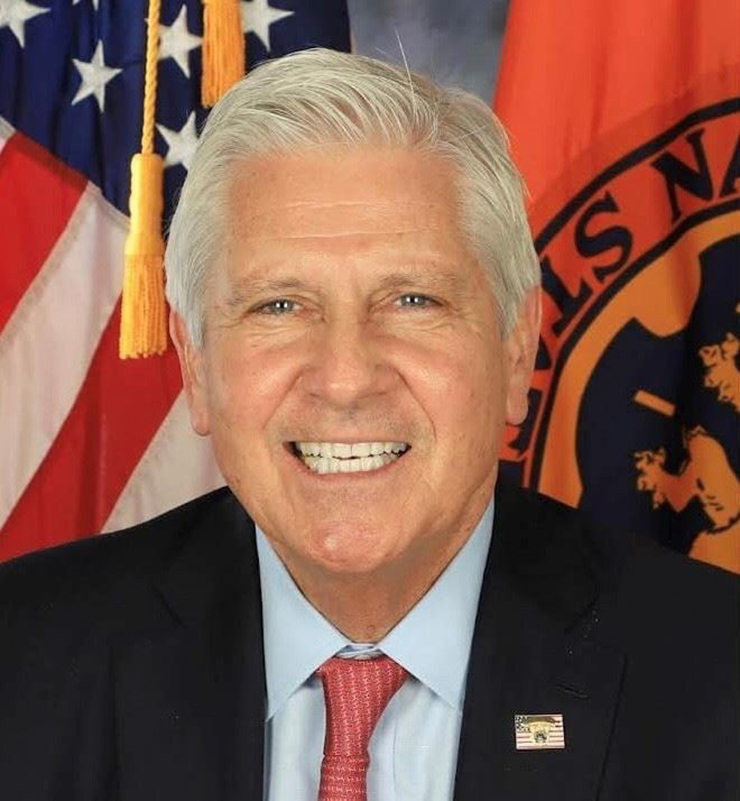

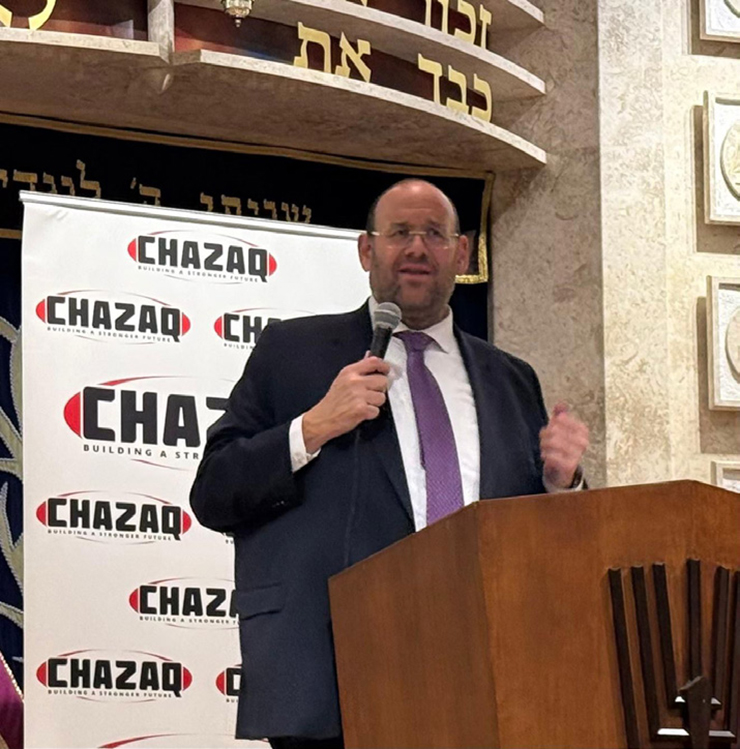
On Sunday night, April 19, the community gathered at the Young Israel of Hillcrest for a beautiful program on emunah hosted by Chazaq. The evening began with Rabbi Yaniv Meirov, CEO of Chazaq and Rav of Congregation Charm Circle, leading the assembly in reciting T’hilim.
The first guest speaker, Shlomie Steinmetz, shared the heartbreaking story of losing his son on Lag BaOmer five years ago. This tragedy led him and his wife on a journey to spread the light of emunah all over the world in memory of their son, Dov z”l. Mr. Steinmetz, who lives with his family in Montreal, told the audience, “It’s a z’chus to be here – to give chizuk to klal Yisrael.”
He described his son’s background and the various yeshivos he attended before going to learn in Israel at the Mir during Covid. He recalled that Dov was always there for his friends, and he possessed a very special neshamah. After returning to learn in his yeshivah in Montreal and bringing life to it, Dov returned to Israel for the summer z’man.
Dov traveled with a group of friends to Meron the day before Lag BaOmer. That night, 45 people were niftar. Dov and his friend Yossi Cohen tried to save two children; tragically, while one of them was saved, Dov was not. Mr. Steinmetz and his wife decided to focus on Ani Maamin as a z’chus for their son’s neshamah. They printed and distributed 300,000 Ani Maamin cards, which were also given to the audience. In addition, the first 50 participants received a free copy of the sefer Ani Maamin in the Dov Steinmetz series.
Mr. Steinmetz shared that there were five or six thousand people at his son’s l’vayah, and he continues to hear more and more stories about his son’s deeds. A young man recently told him that when he arrived in Israel, he didn’t know how to get to the yeshivah he was supposed to attend. He asked people, but no one could help him. He was distraught until Dov appeared, helped him find his way, and assisted him in getting set up in a dirah.
At the shiv’ah, the family sang “Ani Maamin,” one of Dov’s favorite songs, and his father said he felt as though Dovi was singing with them. “To have emunah, you have to constantly work on it, live it, talk about it, and sing it,” he said. He noted that his grandfather, a Holocaust survivor, would say the same brachah at every simchah, thanking Hashem for the ability to build a Yiddishe dor. “Everything is good – we just don’t understand it,” he told the crowd. He explained that everyone has challenges, but we must move forward and believe that Hashem does everything for a reason. After October 7, they even brought these Ani Maamin cards to soldiers fighting in Gaza. “Emunah speaks to everyone. Ani Maamin. Sing it. Live it. This is who we are!”
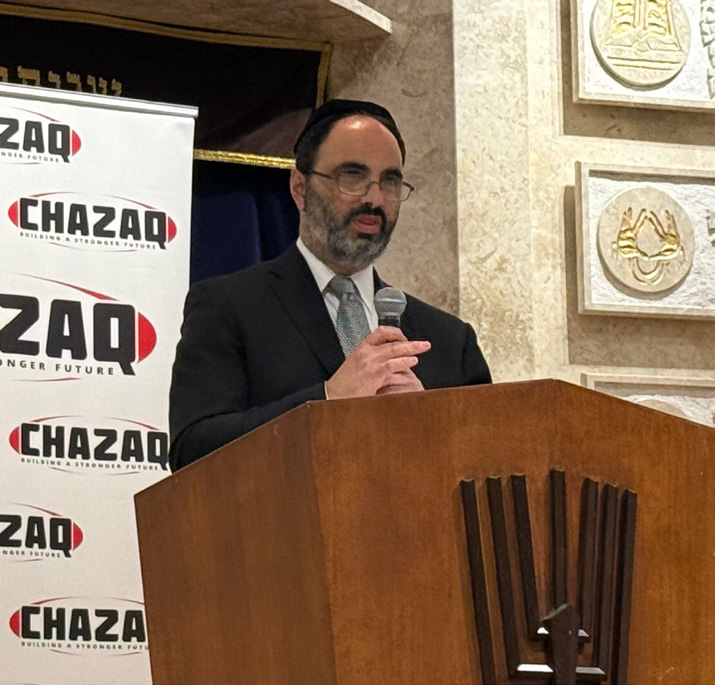
Next, Rabbi David Ashear, the well-known author of the Living Emunah series, spoke. He noted that the weekly parshah teaches that a woman is tamei after giving birth to a baby boy and cannot bring a korban to the Beis HaMikdash. He explained, based on the Chidushei HaRim, that the parshah addresses people who feel that Hashem is pushing them away. A woman might think, I’m trying to be good, and now I’m not welcome in the Beis HaMikdash. The Torah also teaches that a m’tzora must be in quarantine and cannot come to shul. Many different people can become tamei and feel distant.
This can happen in our own lives. We may feel that Hashem is pushing us away. The answer, he said, is to look at what Avraham Avinu would do. Day and night, his mission was to bring the word of Hashem into the world. Even when he was commanded to bring his son to the Akeidah, he woke up early, ready to fulfill Hashem’s will. He performed the greatest act at a moment when he might have felt pushed away. This is what made him who he was.
We must know that Hashem never pushes us away. In difficult challenges, He provides opportunities to grow higher and higher. Hashem is saying, “I want something greater from you.” This challenge made Avraham great, and our challenges can make us great. “Life is not about what we feel is right; it’s about what Hashem wants us to do.”
He also spoke about how we can pray and feel that there is no response. We pray again and again for something we want in order to serve Hashem, and we ask, “Why aren’t You giving it to me?” Chazal teach that Hashem made the Imahos barren because He desired their t’filos. When a person feels that Hashem doesn’t want them, yet continues to pray, those t’filos are incredibly valuable. We should say, “Hashem, You know better than I do what I need. I will continue to serve You and pray to You.” He noted that the reward for a mitzvah is another mitzvah, and that every challenge is an opportunity to grow. He spoke about how Yaakov and Yosef each faced many challenges and steadfastly clung to Hashem. Emunah means believing that Hashem knows, that He has a plan, and that we trust Him.
Next, Rabbi Paysach Krohn addressed the audience. He explained that we cannot understand Hashem’s ways now, but we will when Mashiach comes. He shared a personal story: When he was 21 and spending Shabbos with Rav Schwab, his father was ill in the hospital. Rav Schwab asked how his father was doing, and he replied, “I have emunah that he will get better.” Rav Schwab responded, “That is not emunah.” Emunah does not mean things will turn out the way we hope; it means understanding that Hashem has a plan, and one day we will understand it.

We recite T’hilim, and David HaMelech endured a very difficult life. In T’hilim 13, he asks, “How long will Hashem forget me?” Yet in the same chapter, he declares his trust in Hashem. Hashem’s response to Iyov was: “Where were you when I created the world?” We cannot understand Hashem’s plan, but we must trust that He knows what He is doing. “Emunah is knowing that Hashem has a Master Plan.”
He shared an idea from Rav Schwab’s sefer on prayer: When reciting Sh’ma, think about the names of Hashem. The name Hashem represents G-d’s attribute of chesed, while Elokim represents His attribute of justice. When saying “Hashem,” reflect on the kindness in your life; when saying “Elokeinu,” think about the challenges. And when saying “Echad,” remember that ultimately it all comes together.
We don’t ask “Why me?” when things are going well; so we shouldn’t ask it when things are difficult. Emunah means accepting that we cannot understand Hashem’s ways. “If I believe that Hashem has a plan, that’s emunah.” Rabbi Krohn concluded with a practical idea: Every night, think of ten good things that Hashem did for you that day.
We should merit to see the g’ulah speedily in our days.
By Susie Garber