
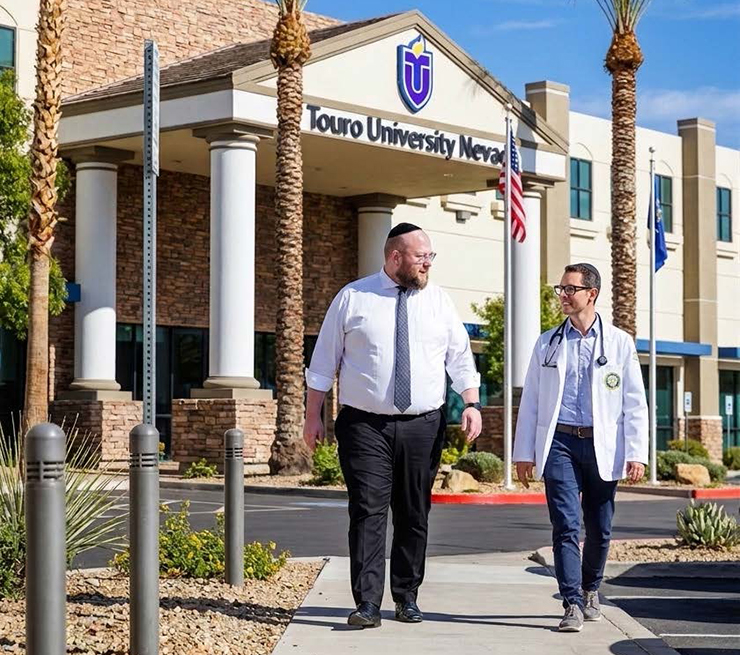
Strong academics, a growing Orthodox community, and high quality of life draw Jewish medical students to Henderson, Nevada
When Tzvi Crystal began applying to medical school, the Orthodox Jewish student from Denver found himself weighing more than academics. Religious observance, family stability, and long-term training logistics all shaped his decision.
While he had been accepted to a medical school in his hometown, Crystal said the administration made clear it would not formally accommodate Shabbos or Jewish holidays. At Touro University Nevada College of Osteopathic Medicine (TUNCOM), he found a very different environment.
“At Touro, you don’t have to worry about Shabbos or Yom Tov,” Crystal said. “Classes end early on Fridays and before holidays, and the whole system makes it possible to stay fully observant while in medical school.”
Equally important was the ability to remain in one geographic area for clinical rotations, providing stability for his family during the demanding training years.
“The community is close-knit, welcoming, and affordable,” he said. “It’s a place where you can focus on becoming a doctor while still building a strong Jewish home.”
Crystal, now in his third year and planning to pursue pediatrics followed by a pulmonology fellowship, said he was also drawn to osteopathic medicine’s broader approach to care.
“Osteopathic medicine looks at the whole person,” he said. “It gives you more tools to help patients in practical ways.”
A medical education with strong outcomes
Beyond lifestyle considerations, TUNCOM offers the same outstanding four-year osteopathic curriculum found across the Touro system, paired with strong performance metrics.
“Our board scores are consistently above the national average, and our residency placement rate is 100 percent every year,” said Dr. Paul Kalekas, dean of TUNCOM.
Students spend their first two years studying basic and clinical sciences with faculty that include both Ph.D. researchers and practicing physicians before moving into hospital-based training.
“In the third year, students complete core rotations locally,” Kalekas said. “In the fourth year, we allow them to rotate anywhere in the country if they choose to do so.”
That flexibility allows students to complete audition rotations at hospitals nationwide, while maintaining strong placement results across specialties, including primary care, orthopedics, general surgery, anesthesiology, and neurology.
Synagogue and community life in Henderson
About three miles from campus, the Ahavas Torah Center anchors a rapidly developing Orthodox Jewish community that many students discover only after arriving. “We really cater to everyone,” said Dr. Yakov Weil, president of the synagogue. “We have different styles of minyanim, regular learning, youth programming, and a very young community with many families. There’s a strong sense of community that brings people together.”
Despite its size, community leaders say Henderson offers unusually robust infrastructure. The synagogue oversees the local mikvah and eruv, hosts nightly shiurim, and runs extensive children’s programming, with more than 100 young children regularly participating on Shabbat.
Educational options include The Yeshiva Day School of Las Vegas, The Zucker Jewish Academy of Las Vegas, a boys’ mesivta, a girls’ high school, and post–high school yeshiva learning opportunities. “For a community this size, it’s remarkable how much exists,” said Rabbi Yitzchok Summers, who recently relocated from Los Angeles. “People don’t realize how much Jewish life is already here.”
Rabbi Zecharia Rubin, campus rabbi at Touro Nevada and High School Head of Judaics at the Zucker Jewish Academy high school, said the community “punches above its weight,” offering levels of programming and religious infrastructure more typical of much larger cities.
Affordability, safety, and long-term viability
Cost of living also plays a major role for students balancing medical school expenses with family life. “Homes here would cost millions of dollars in New York or South Florida,” Rabbi Rubin said, noting that students often share houses to reduce expenses.
Rabbi Summers also emphasized Henderson’s quieter suburban environment. “It’s peaceful, clean, and welcoming,” he said. “You don’t always appreciate that until you experience it.”
For Crystal, those factors ultimately confirmed he had made the right decision. “You come here thinking you’re just choosing a medical school,” he said. “But in the process of becoming a physician, you end up finding a community that supports the life you want to build.”