
On any given weekday in Queens or Great Neck, a woman walks into her local kosher supermarket, selects chicken, meat, or fish, and heads to checkout like any other customer. She provides only a phone number. There are no vouchers, no public lines, and no visible indication that assistance is being provided. To those around her, she appears simply to be preparing for Shabbos.
For many families, however, that quiet moment represents something far deeper: relief from constant financial strain and the ability to welcome Shabbos with dignity and peace of mind.
This is the work of Keren Almones V’Yesomim, an international organization supporting widows and orphans throughout the United States and Canada. While the formal Keren was established in 2016 by Rabbi Avraham Laufer, its roots stretch back more than seventy years to the tireless chessed work of Harav Shulem Laufer zt”l, who carried out a sacred mission entrusted to him by the Satmar Rebbe, Rabbi Yoel Teitelbaum zy”u: to ensure that widows, orphans, and struggling families would always have what they needed for Shabbos and Yom Tov.
In earlier decades, R’ Shulem Laufer personally arranged food packages and Shabbos provisions for families, often working directly with fishmongers and suppliers while quietly fundraising to sustain the effort. His home, together with his wife Rebbetzin Henya a”h, became synonymous with generosity and hachnasas orchim, feeding countless guests and supporting families with extraordinary sensitivity. Over time, that deeply personal mission evolved into a structured system that would eventually serve communities across North America.
The modern Keren grew from a single moment that revealed a deeper need. After arranging Shabbos fish for a struggling widow, Rabbi Avraham Laufer learned that while she could now manage Shabbos, she still could not afford chicken for weekday meals. Disturbed by the gap, he arranged an open account at a local butcher so the family could take whatever they needed without calculation or embarrassment. That simple act became the foundation of what is today a revolutionary model of assistance.
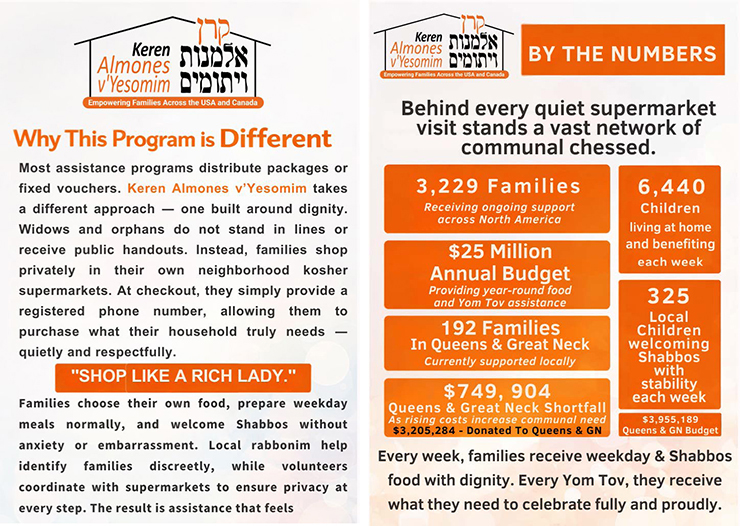
Rather than distributing food publicly, families shop discreetly through arrangements coordinated with local supermarkets and food vendors. During the week, families are able to take chicken and cold cuts for everyday meals, while for Shabbos the program provides higher-quality meat and fish — ensuring that even in difficult circumstances, the Shabbos table remains elevated and dignified. Volunteers and organizers often repeat the philosophy that defines the program: “shop like a rich lady.” The phrase means exactly what it sounds like — families should be able to shop normally, choosing food according to their needs without worrying about limits, stigma, or public attention.
The system operates through close cooperation between dedicated volunteers and local rabbonim who understand the sensitive realities facing families in their communities. Rabbonim help identify genuine need with discretion, while volunteers coordinate logistics, maintain relationships with stores, and ensure assistance is delivered privately and respectfully.
One local mother raising five teenagers alone described what the program means to her home. During the week she works tirelessly while managing financial pressure and family responsibilities. But when Shabbos arrives, everything changes. “We sit at our table like royalty,” she said. “The kids feel amazing — like a million dollars.”
Today, Keren Almones V’Yesomim assists more than 3,220 families with over 6,440 children living at home. The organization’s annual budget has reached approximately $25 million as food costs and communal needs continue to rise. In Queens and Great Neck alone, 192 families and 325 children rely on the program’s support.
Support extends beyond weekly groceries. Before Pesach, families receive essential holiday items including matzah, wine, grape juice, eggs, potatoes, and other necessities. Before Sukkos, lulav and esrog sets are distributed so families can fully participate in the mitzvos of the chag.
During the Covid-19 pandemic, the need grew dramatically as many families suddenly lost their primary breadwinner, transforming the Keren into a vital lifeline providing both food and reassurance.
Financial records now show a nationwide deficit exceeding $5.5 million, while the Queens and Great Neck division faces a shortfall approaching $750,000 — even as Shabbos arrives each week without delay.
For one Queens mother and her children, the impact is visible every Friday night. After a difficult week, they gather around their table, share a meal, and feel normal again. In that moment, the purpose of the program becomes clear. It is not simply about providing food, but about restoring dignity, preserving tradition, and allowing Shabbos to once again become a source of comfort, warmth, and hope.
Those interested in supporting or learning more about the work of Keren Almones V’Yesomim may contact Queens and Great Neck coordinator Rabbi Shamai Hechel at (718) 207-0167 or visit www.kerenalmones.org.