
It’s hard for a keen political observer, let alone a casual one, to determine when President Trump is seriously pushing forward a policy proposal, setting up leverage to negotiate a settlement, or simply mouthing off. This uncertainty is a unique gift that Trump alone has, which makes his supporters love him, his detractors hate him, and his negotiating partners wary of him. While “make Canada the 51st state” seems to be in the “joke” category, “rename the Gulf of Mexico,” “abolish the penny,” and “shut down the southern border” were all policies that pundits underestimated his seriousness on. The acquisition of Greenland jumped from joke to serious policy proposal this week.
President Trump once again reached for tariffs as a tool of statecraft, this time signaling that Denmark and several European partners could face new trade penalties unless Copenhagen reconsiders its refusal to sell Greenland to the United States. The reaction across Europe was swift and indignant, with accusations of economic coercion and threats of retaliation. Democrats, as always, vowed to “do something” against Trump (when they really can’t do anything). Beneath the theatrics and the predictable outrage, however, lies a serious question: Does it make strategic sense for the United States to seek control of Greenland?
American interest in Greenland did not originate with Donald Trump. It dates back to the aftermath of the Civil War, when Secretary of State William Seward, fresh off the acquisition of Alaska, viewed Arctic territory as a natural extension of American security and commercial reach. In the early twentieth century, American diplomats explored various schemes, including territorial swaps, that would have placed Greenland under U.S. control. None succeeded, but the interest never disappeared. The most concrete attempt came in 1946, when the Truman administration formally offered Denmark a substantial sum to purchase the island. Denmark declined, but the episode made clear that U.S. leaders viewed Greenland as a strategic asset.
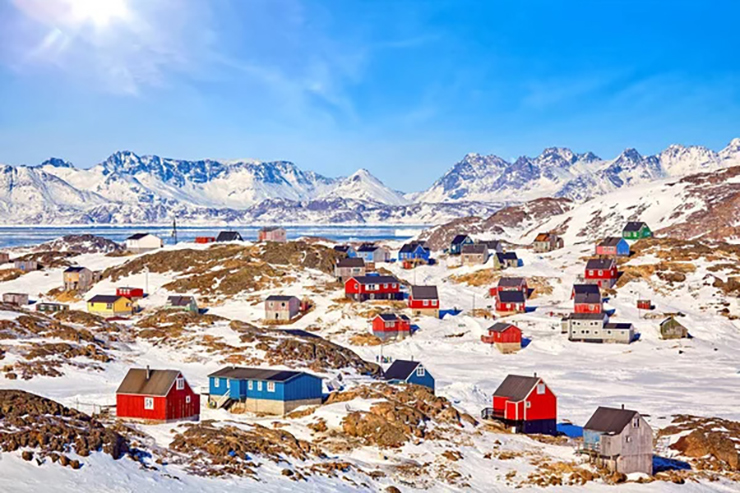
That assessment was shaped decisively by World War II and the Cold War that followed. Greenland’s location made it indispensable for transatlantic defense. It sits astride the shortest air and missile routes between North America and Eurasia and anchors the Greenland-Iceland-United Kingdom gap, a critical choke point for naval and air forces moving between the Arctic and the North Atlantic. During the Cold War, the United States established and maintained major installations there, including what is now Pituffik Space Base, which remains central to missile warning and space surveillance. Even without sovereignty, American planners treated Greenland as a linchpin of continental defense.
What has changed is not Greenland’s importance, but the strategic environment around it. The Arctic is no longer a frozen buffer zone insulated from great-power competition. Russia has rebuilt and expanded its Arctic military infrastructure, deploying air defenses, submarines, and long-range strike capabilities. China, styling itself a “near-Arctic power,” has sought access to ports, minerals, and infrastructure throughout the region, blending commercial investment with long-term strategic positioning. In this context, Greenland is not peripheral. It is central.
From a purely strategic standpoint, American control of Greenland would simplify defense planning, secure critical basing rights permanently, and strengthen U.S. leverage in the Arctic at a moment when that theater is becoming more contested. It would also reduce the risk that future political shifts in Europe, or economic pressures on Greenland itself, could open the door to adversarial influence. These considerations explain why the idea of acquisition has resurfaced periodically, regardless of who occupies the White House.
Much like the Democrats here at home, left-wing politicians in Europe can use opposition to Trump as a method of gaining or regaining political power. Regardless of how you feel about Trump, he is a global force. So European leaders like Keir Starmer, Emmanuel Macron, and others (who have very low poll numbers) get a boost when they stand against Trump. There is no logical reason why they should care whether or not Denmark has control of Greenland, other than European solidarity and the concern that Trump might come after their territory next.
There is also the matter of Greenland itself. The island has steadily expanded its autonomy and has its own political identity and aspirations. Any serious discussion of sovereignty that ignores Greenlanders could have serious implications on how the island is run if it were transferred to the United States. Does it become the 51st state, or does it become a territory like Puerto Rico? If the former happens, it would have one-tenth the population of Wyoming, the smallest state by population, yet with as many Members of Congress, Senators, and Electoral Votes as that state (and five others). Making it a territory like Puerto Rico allows it to retain the same autonomy it had with Denmark while having the benefits of U.S. partnership.
The existing framework of defense agreements, NATO cooperation, and economic engagement offers ample room to deepen American influence without detonating a trade war or alienating partners. Investment in infrastructure, joint resource development, expanded security cooperation, and clear commitments to Arctic defense can achieve many of the same strategic objectives that outright ownership promises.
Trump knows this, which is why it seems like he is employing his favorite tactics: “set the leverage, negotiate the settlement.” He’s used it in business for decades and in many of his political negotiations. It’s how he has negotiated nearly all of his tariff deals so far. The media loves this tactic because they can paint Trump as crazy as his wildest proclamation. The Democrats love this tactic because they can make demands and then when Trump negotiates the settlement, they can claim he “chickened out.” Trump supporters love this tactic because it usually means the country gets something for nothing.
The strategic case for deeper American involvement in Greenland is real and compelling. Trump thinks about Greenland in the same way he thinks about his ballroom, the Gulf of America, the Kennedy Center, the Department of War, Trump Hotels, or any of the other dozens of acquisitions or personal stamps he put on countless projects and endeavors he has made over the years—this is a legacy. Acquiring Greenland after 150 years of attempting to do so would not only put yet another accomplishment on his record, it would strengthen American security in the process. That, at the end of the day, is Trump’s main goal.
Moshe Hill is a political analyst and columnist. His work can be found at www.aHillwithaView.com and on X at @HillWithView.