
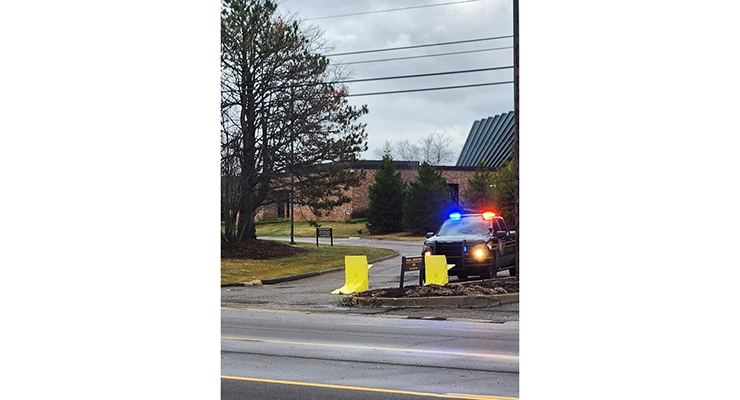
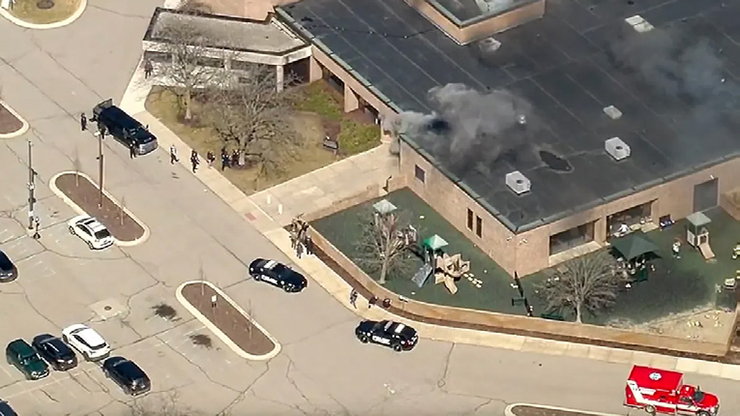
A tragedy of epic proportions was averted in Michigan when an armed security guard shot and killed a would-be terrorist who drove an explosives-laden truck into Temple Israel. Ayman Mohamed Ghazali, a 41-year-old Lebanese-born U.S. citizen, rammed his Ford F-150 pickup truck—loaded with fireworks, flammable liquids, and explosives—through the front entrance, drove it down a hallway toward classrooms packed with over 100 preschool children and staff, and opened fire with a rifle as the vehicle erupted in flames. The synagogue, which houses a busy early childhood program, could have become a scene of unimaginable horror. Yet, not a single child, teacher, or congregant was seriously injured or killed.
This was no accident or “bit of luck,” as some headlines suggested. Temple Israel did everything right. For years, the congregation had invested heavily in armed security, physical hardening, and repeated active-shooter training. They hired Danny Phillips, a veteran police officer with deep experience in stopping active shooters, as full-time security director in June 2025. Three to seven armed guards were on duty daily—even on a weekday afternoon. Visitors were buzzed in through every door. Bollards protected the perimeter. Metal detectors and additional police were standard for larger events. Just weeks earlier, the entire staff and preschool teachers had completed an FBI-led active-shooter prevention class emphasizing “Run, Hide, Fight.” Rabbi Joshua Bennett later said, “We’ve done trainings over the last number of years... because we expect these things to happen. We just never want them to be real.” Sheriff Michael Bouchard praised the response succinctly: “Everything that was supposed to happen, happened. Security did their job.”
The guards immediately confronted the attacker, exchanging fire through the windshield and rear window of the burning truck. Staff and teachers calmly evacuated the children through windows while following lockdown protocols they had drilled countless times. The preschoolers were safely reunited with parents at a nearby country club. As CNN reported days later, “Temple Israel was prepared for an attack. Jewish institutions have to be.” Michigan Governor Gretchen Whitmer called the security team “heroes” who saved lives. The FBI is investigating the incident as a targeted act of violence against the Jewish community. Ghazali’s truck contained $2,000 worth of fireworks purchased just days prior—clear evidence of planning. Yet, the layered defense worked perfectly.
This success offers a powerful lesson for every soft target in America: schools, shuls, churches, malls, and public venues. Instead of chasing the illusion of safety through gun control, we must treat terrorist violence the way oncologists treat cancer. Cancer cannot be legislated away by banning cells; it must be detected early, screened for aggressively, and met with immediate, decisive intervention when it appears. The same is true of terrorism. You cannot outlaw every truck, every knife, every pressure cooker, or every legal firearm. Determined attackers—whether radicalized by ideology, personal grievance, or foreign influence—will always find a weapon. Gun control laws disarm the law-abiding while doing nothing to stop those who ignore them. Ghazali used a vehicle as his primary weapon and had explosives; a rifle ban would not have prevented the ramming or the fire. What stopped him was an armed, trained good guy already on-site.
Jewish institutions have understood this reality for years. Since the 2018 Tree of Life synagogue massacre in Pittsburgh, the American Jewish community has spent an estimated $765 million annually nationwide on security, according to the Jewish Federations of North America. The Secure Community Network (SCN)—often called the “FBI for the Jewish community”—has trained over 40,000 people and works with local groups like the Jewish Federation of Detroit. Temple Israel’s model—full-time armed directors, regular drills, bollards, cameras, and rapid-response protocols—has become standard. Other synagogues are now reviewing their own defenses in light of this attack, as Forward magazine reported. Rabbis and leaders openly state that visible armed security, layered barriers, and “Run, Hide, Fight” training are no longer optional; they are essential in a world where antisemitic incidents have surged.
The same approach must now be scaled to America’s schools. Too many campuses remain “gun-free zones” that function as magnets for evil. Columbine, Sandy Hook, Parkland, Uvalde, and countless others prove that waiting for police—whose average response time in an active-shooter event is measured in critical minutes—is unacceptable when lives are measured in seconds. Armed school resource officers (SROs), trained teachers or administrators who choose to carry, and private security teams have already shown results in districts that adopted them. Israel, facing far more frequent threats, has long protected schools with armed guards and perimeter security; attacks there are rare precisely because the response is immediate and overwhelming. Temple Israel’s preschool evacuation succeeded because staff knew exactly what to do. Schools can—and must—do the same.
Critics will argue that more guns equal more danger. History and data refute this. The attacker in Michigan was stopped by legally carried firearms in the hands of professionals. In every documented case where armed civilians or security have intervened early—whether at the 2017 Sutherland Springs church shooting or the 2022 Indiana mall shooting—the body count stopped rising the moment resistance appeared. Gun control proposals, from assault-weapon bans to universal background checks, fail against illegal guns, stolen weapons, or non-firearm attacks like vehicle ramming (a favored ISIS tactic worldwide). They also erode the constitutional right to self-defense that allows citizens to protect themselves when government response lags. Disarming law-abiding defenders while terrorists improvise with trucks or bombs is not compassion; it is surrender.
Terrorism, like cancer, is a chronic societal threat. It metastasizes through ideology, online radicalization, and geopolitical tensions. You do not cure it by banning scalpels; you screen aggressively (intelligence sharing, watchlists, deradicalization programs), harden the body (bollards, doors, cameras), and deploy rapid-response teams (armed security and “good guys with guns”) when a tumor appears. Temple Israel caught the cancer early. Their training detected the threat the moment the truck breached the doors. Their armed personnel excised it instantly. The children survived because the synagogue refused to be a victim and instead became a fortress of preparedness.
Every synagogue, church, and school in America should adopt this model. Federal grants for security—currently underfunded and bureaucratic—should be expanded and streamlined to pay for armed guards, training, and hardening. States should encourage, not restrict, concealed-carry rights for qualified personnel on campuses. Local law enforcement must partner proactively, as Oakland County did here. The alternative—more “thoughts and prayers” followed by calls for gun confiscation—has failed repeatedly. It leaves the innocent defenseless and signals to predators that soft targets remain easy prey.
This does not mean that the unfettered immigration and naturalization process of past administrations should continue unabated. On the same day as the attack in Michigan, an Islamist attack occurred at Old Dominion University in Virginia. A week earlier, IED-throwing jihadists attacked in New York City. These people were radicalized in the United States, claim allegiance to ISIS, and are citizens. Something is deeply wrong with our immigration and education systems if this is what they are churning out.
While the Trump administration seems to be hampering this type of immigration, those policies may only last a few years. Jewish institutions cannot assume that the federal government will prevent these strikes before they happen. We must remain vigilant in order to protect ourselves when no one else will.
Moshe Hill is a political analyst and columnist. His work can be found at www.aHillwithaView.com and on X at @HillWithView.