
Walk past 71-12 Park Avenue today, and you will see a massive development site. The Park Avenue in question is not Manhattan’s famous boulevard, but a modest Queens street tucked between Parsons Boulevard and 71st Avenue. For years, this parcel was simply an empty lot to the families pushing strollers past it. But land in Queens has a long memory. This site, the future home of a residential project known as Utopia Living, tells a much bigger story: old wetlands, postwar housing, union electricians building their own neighborhood, Orthodox Jewish institutions taking root, and the modern pressure to find a place to live in a city where housing remains historically tight.
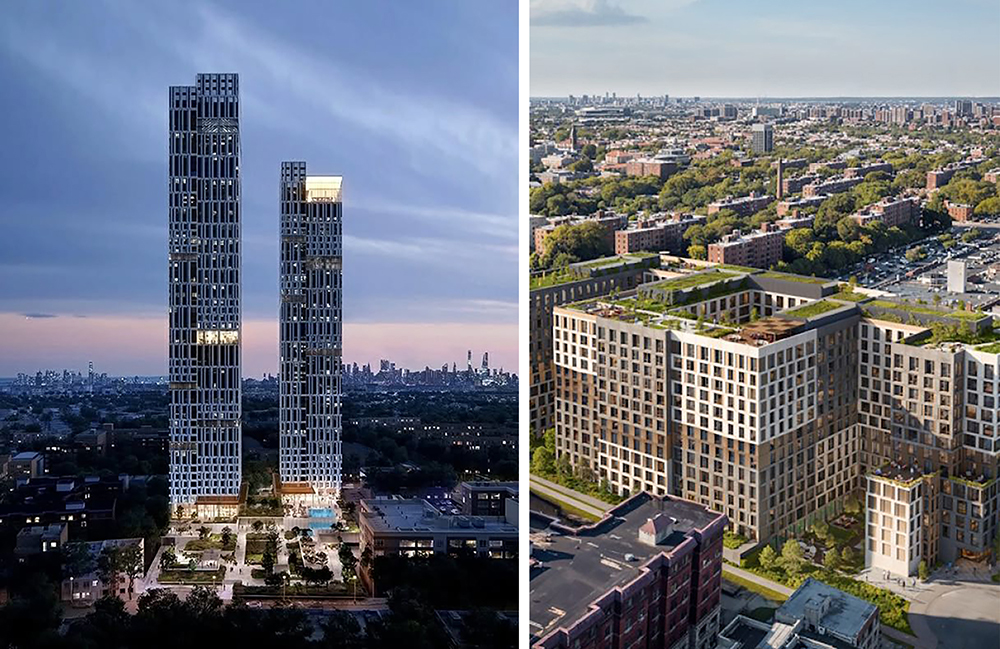
Advanced by longtime New York developer Menachem Marx, the proposal recently underwent a dramatic pivot. Just this month, the original skyline-altering concept that alarmed many local residents was set aside in favor of a lower, broader 13-story plan, proving how the future of Queens is shaped not only by developers and global investors, but by the families, civic leaders, and community boards who must live with what gets built.
To understand why a skyscraper proposal caused such a visceral reaction here, you have to look at how the neighborhood was born. Long before the mid-rise co-ops, yeshivos, and kosher bakeries defined the area, this was difficult, swampy terrain. Nearby was Gutman’s Swamp, a stubborn piece of wetland tied to Kissena and Flushing Creeks. While the rest of the borough was gridded and paved, this land sat wild, explaining why certain large parcels here remained open far longer than others. Even local civic anchors have shifted over time, with the current 107th Precinct now standing near the development site on Parsons Boulevard.
The neighborhood’s first great modern transformation was not driven by private luxury development, but by working-class New Yorkers. When the Pomonok Country Club closed in 1949, it paved the way for Pomonok Houses, bringing thousands of working families into central Queens by 1952. Just down the road, something even more remarkable happened. Harry Van Arsdale Jr. and Local 3 of the International Brotherhood of Electrical Workers decided their members needed a place to live. They built Electchester – a sprawling, union-built cooperative where the electricians who wired the city could afford to raise their own kids. That history is exactly why Utopia Living isn’t viewed in isolation. When a developer proposes dropping a complex of this size into the neighborhood, longtime residents instinctively ask: Who is this for? And can our streets, schools, and infrastructure handle it?
If the postwar era brought union housing, the next major shift was driven by education and faith. Rabbi Dr. Bernard Lander, the visionary founder of Touro College, created a framework for Orthodox Jewish students to pursue academic degrees without compromising their Torah observance. His educational vision fostered a broader network of Jewish scholarship, a legacy reflected nearby at Yeshivas Ohr HaChaim and its affiliated high school, Mesivta Yesodei Yeshurun. Under the ongoing leadership of his son, Rosh HaYeshivah HaRav Doniel Lander, alongside the establishment of Lander College for Men, these institutions helped turn the neighborhood into a premier center for advanced Torah study.

This era of expansion culminated in the summer of 2002 with the landmark relocation of Yeshivas Chofetz Chaim, also known as the Rabbinical Seminary of America. Moving from its long-time home in Forest Hills to an expansive, newly-constructed sprawling campus on 147th Street at 76th Road in Kew Gardens Hills, it was a massive construction project that completely reshaped the landscape of the neighborhood, signaling a new standard for institutional development in Central Queens.
But institutions need capital. In 2003, Touro College sold an adjacent parcel to The Dermot Company for $13.6 million. That site became The Opal, a 14-story rental building that shifted the area’s real estate ceiling. Years later, in 2015, A&E Real Estate purchased the property for $134 million. It proved that the neighborhood could absorb a high-end mid-rise, but Utopia Living asks a much heavier question. The comparison is striking: The Opal rose 14 stories and became a major neighborhood address; the new project is planned at 13 stories, but with a unit count nearly double the size. Its impact could be far larger.
Part of the community’s anxiety surrounding 71-12 Park Avenue stemmed from a dizzying decade of changing promises. In 2012, Marx’s team advanced plans for an eight-story, 298-bed nursing home on the Parsons side of the property. Special permits were reportedly obtained, but later lapsed, and the project never moved forward. Five years later, reports described a hybrid concept: a 250-unit rental building sharing the lot with a healthcare facility. By the time the ambitious two-tower residential plan was filed in 2019, the lot had become a blank canvas for local anxieties: a fenced-off question mark where no one quite knew what the final answer would be.
When the plans for Utopia Living were updated in 2024 to include 50- and 42-story towers, it represented a massive vertical shift for the area. However, it is important to clarify that this was never a “lost approved skyscraper.” As local reporting highlighted at the time, the Department of Buildings indicated the tower construction was not fully approved and was missing required documents, including a zoning diagram. Still, for housing advocates, the filing was a dream: hundreds of much-needed apartments during a housing shortage. But for the people who actually live here, it was a major concern. Parents worried about additional children entering already crowded local schools, while seniors and homeowners feared the years of heavy construction noise, dust, and delivery trucks. That concern is easy to understand: A development of this magnitude changes traffic, schools, parking, and the whole feel of the block.
The pivot to a 13-story design was a total reimagining of the project’s footprint and aesthetic. The redesigned complex will sit on approximately 107,500 square feet of land, yielding a 784,015-square-foot building. Publicly released blueprints reveal a square main volume extending into two L-shaped wings. Instead of imposing walls of sheer glass, the facade will feature a grounded mix of white, gray, and earth-toned paneling surrounding an irregular grid of recessed windows. The wings feature a small setback with a terrace on the seventh floor, and the entire building will be topped with a green roof. On the Park Avenue side, double-height floor-to-ceiling windows will sit behind an arcade lined with angled columns, while a newly landscaped pathway will connect Park Avenue straight through to Parsons Boulevard.
By reducing the plan by 37 stories, the developer gave up sweeping Manhattan views and nearly half a million square feet of bulk, but crucially kept almost all the housing. The new mid-rise building will hold approximately 800 for-rent units. The unit breakdown offers a glimpse into the market the developer is targeting: 61 studios, 378 one-bedroom units, and 361 two-bedroom units. The plans also include a parking garage entrance tucked into the northwest corner, leading to three levels of below-grade parking for roughly 468 vehicles, plus dedicated storage for 408 bicycles.
While locals view this as a Queens neighborhood story, Marx Development markets Utopia Living globally as a premier luxury residential offering. Seeking a capital raise of up to $255 million, the project aims to attract foreign investors looking for a pathway to US residency. The materials describe the building as an “oasis of sophistication,” featuring an outdoor garden and terrace, a resort-style swimming pool, a fully equipped fitness center, private movie screening rooms, and an exclusive rooftop lounge.
The debate over the building is no longer hypothetical. Developer materials now list Utopia Living as under construction, with an anticipated 2029 opening. Recent site photos show heavy machinery, trenching, rebar, and foundation work underway.

The developer behind the project, Menachem Marx—known professionally as David—is no stranger to these blocks. While he and his wife, Gila, are now longtime residents of Lawrence, central Queens is where their stories began. Both grew up in the area; Menachem is the son of Robert “Bobbie” and Fran Marx, with family ties that have remained closely connected to the Kew Gardens Hills and Flushing communities. His in-laws, Rabbi Moshe and Judie Weinbach, are rooted in nearby Kew Gardens.
Marx’s existing footprint is woven into the neighborhood’s development history. Atria 2000, located nearby and owned by Marx, was completed in 2002 to provide 137 middle-income apartments. Also nearby stands Boulevard ALP Assisted Living, another Marx-related facility that has operated as a licensed senior-care residence since 2005.
Look at the history of this land, and you see a mirror of New York City itself. In the early 1900s, the area remained difficult-to-develop wetland around Gutman’s Swamp. Between 1949 and 1952, the closing of Pomonok Country Club helped make way for public housing and the union-built Electchester cooperative. In the decades that followed, religious education became a defining force as visionary leaders anchored the neighborhood with world-class Torah institutions.
The question that has followed this land for a century remains the same: How much growth can this part of Queens absorb? The latest chapter may no longer scrape the clouds, but for families trying to stay in the neighborhood where they grew up, renters desperate for new supply, and global investors placing their bets on central Queens, Utopia Living remains one of the most consequential development stories in the borough.
By Shabsie Saphirstein