
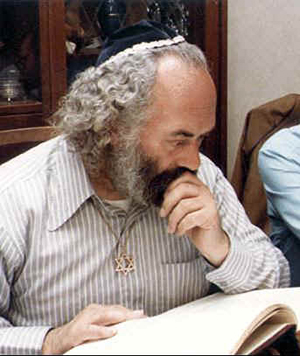
The release of a new documentary, The Darkest Light, about Rabbi Shlomo Carlebach has once again opened a discussion that many in the Jewish world probably thought had quieted down years ago.
My friend Rabbi Harry Maryles recently addressed the subject in “The Sad Legacy of Shlomo Carlebach.” Harry goes considerably further than merely acknowledging Carlebach’s influence: He compares his lasting impact on Jewish music to the influence of Beethoven and the Beatles on music generally. Yet, in light of the serious allegations made by women who say that Carlebach abused or mistreated them, he questions the continued veneration of the man himself.
I understand his position. But the more I think about Shlomo Carlebach, the more I believe that the most accurate thing one can say about his legacy is simply this: It is complicated. Period.
Carlebach’s standing within the Orthodox world was controversial long before allegations of physical misconduct became widely known. During the 1970s and 1980s, much of the yeshivah world looked upon him with considerable suspicion. His earliest melodies had already entered the accepted Jewish repertoire, but his later music, and certainly his lifestyle, were frowned upon in many yeshivah circles.
My rebbi at the time, Rav Nachman Bulman zt”l, who was himself very musical, was uncomfortable with Carlebach. Rebbetzin Shaindel Bulman a”h felt even more strongly and would not allow his niggunim to be sung in her home. Only much later, after stories about Carlebach became widely known, did I wonder whether she had heard things about him that the rest of us did not yet know.
Interestingly, another rebbi of mine, Rav Michel Twerski shlita, knew Carlebach when they learned together in Lakewood and has retained a deep love for his music. When I visit Milwaukee, Rav Michel will often ask me to sing Carlebach’s majestic Mimkomcha, perhaps his musical magnum opus, which I am always happy to do. It invariably produces a powerful response from the shul.
There is even a fascinating 1959 responsum of Rav Moshe Feinstein (Igros Moshe, Even HaEzer I:96) concerning an unnamed popular Jewish singer, widely understood to be Carlebach, who had begun performing for mixed audiences. Rav Moshe was asked whether his melodies could continue to be used at Jewish weddings. His answer was more nuanced than one might expect: He certainly did not prohibit the earlier melodies and offered substantial grounds for permitting the later ones as well.
Of course, Rav Moshe was addressing mixed performances in 1959, not the far more serious allegations that emerged decades later. But it reminds us that the Orthodox community’s struggle over how to relate to Shlomo Carlebach is hardly new.
My own perspective was shaped by something I experienced firsthand.
I arrived as a rabbi in Portland, Oregon, only a few months after Carlebach died in October 1994. On his first yahrzeit, we held an evening in his memory, singing his music and retelling some of his famous stories. Shlomo was an extraordinary storyteller. He could invest a story with emotion and spiritual meaning in a way few people could.
But what I remember most was the audience.
People seemed to come out of the woodwork from all over Oregon, including Jews who would never otherwise have darkened the doorstep of our Orthodox synagogue.
They came because of Shlomo.
Over my years in the rabbinate, I learned how extraordinary his ability was to reach Jews whom the rest of us simply were not reaching. People uncomfortable with rabbis, synagogues, and organized Judaism would listen to Shlomo. Somehow, he could ignite a Jewish spark in a person who seemed completely disconnected. I have no way of counting how many Jews eventually became seriously committed to Judaism, some fully observant, because Shlomo first touched something within them, but I would be astonished if the number were not in the hundreds, and quite possibly far more.
And it wasn’t only the music.
Carlebach’s Torah emphasized spirituality, joy, human dignity, and, above all, an almost limitless ahavas Yisrael. Those teachings continue to be studied and published; Rabbi Shlomo Katz, for example, has edited volumes of The Torah Commentary of Rabbi Shlomo Carlebach from hundreds of hours of recorded teachings.
His generosity was legendary as well. Rabbi Yaakov Haber once told me of a concert in Buffalo for which the scheduled performer canceled. Shlomo came to the rescue, agreeing simply to accept whatever came in at the gate. Afterward, a man approached him in desperate financial straits, and Shlomo gave him every dollar he had just earned. I have heard many similar stories from people I trust.
Yet this remarkable capacity for loving and reaching people may also point us toward the tragedy of his story.
Carlebach apparently believed that the Jews he was trying to reach could not always be approached within the conventional boundaries of Orthodox life. Rabbi Chaim Dalfin, in writing about Carlebach’s complex religious personality, describes his belief that some people were simply not yet ready for all the restrictions of halachah.
Most famously, Shlomo hugged everybody – men and women alike. Presumably, he saw this as a way of communicating unconditional love to Jews who might otherwise run from anything resembling traditional Judaism.
The motive may have been noble. But perhaps it also demonstrates why halachah establishes boundaries in the first place. Once we persuade ourselves that a boundary must be crossed because of the good we can accomplish, the next boundary can become easier to cross. And the allegations against Carlebach describe conduct far beyond an innocent hug.
For me, this is not abstract. I personally know women who had very negative interactions with Shlomo Carlebach. They were hurt, and those wounds did not magically disappear. Nothing about the Torah he taught, the melodies he composed, the Jews he inspired, or the kindness he showed others can erase their pain. Carlebach’s own daughter Neshama, writing about the new documentary, has movingly insisted that the voices of women who were harmed must be heard.
There is one more complication.
Stories have circulated for years that Carlebach regretted aspects of his conduct later in life. Most striking is an account recorded by Rabbi Chaim Dalfin about the very day Carlebach died. According to the story, a religious Jew named Yossel confronted him directly: You have made so many baalei teshuvah; why haven’t you made one more, yourself? Carlebach reportedly became serious, acknowledged the criticism, and publicly accepted upon himself to do teshuvah.
Within hours, he was dead.
It is a remarkable story, if accurately reported. But it cannot serve as a magic eraser. Teshuvah for sins against another person also requires addressing the person who was harmed and seeking forgiveness. We have no basis for saying that this occurred with the women who say Carlebach hurt them. Still, if we are seeking an honest picture, the story deserves to be part of the record as well.
My own relationship with Shlomo makes all of this particularly difficult. From my earliest memory, Shlomo Carlebach’s music was central to me. My mother tells me that the first tune I would sing, even in my crib, was Carlebach’s Esa Einai. That melody remained so precious to me that it was the tune to which I walked to the chupah. Carlebach would interpret the words “Ezri mei’im Hashem,” “my help comes from G-d,” as an allusion to one’s eizer k’negdo: the helpmate whom G-d sends.
The handful of personal encounters I had with Shlomo were inspiring, and I witnessed with my own eyes his almost unique ability to touch Jewish souls. At the same time, I know women who were hurt by him, and I cannot pretend that one reality makes the other disappear.
Perhaps that is why I resist any simple verdict on Shlomo Carlebach. Human beings do not always fit comfortably into the categories in which we would like to place them. The same person can bring extraordinary music, Torah, ahavas Yisrael, and generosity into the world, can ignite Jewish souls whom almost no one else knows how to reach, and can at the same time cause real and lasting hurt. Acknowledging one side of that story does not require us to deny the other.
That leaves me without a neat conclusion, and perhaps that is as it should be. I am not prepared to forget the women who were hurt, nor am I prepared to pretend that the music, Torah, kindness, and Jewish lives transformed by Shlomo Carlebach never happened. Both are part of the record, and both are part of his legacy. Living honestly with that tension may be uncomfortable, but it strikes me as far more truthful than reducing a very complicated human being to either a saint or a villain.
Rabbi Yehuda L. Oppenheimer, former rav at several congregations in the United States, lives in Israel and is an educator, writer, and licensed tour guide. He eagerly looks forward to showing you our wonderful land on your next visit. He blogs at www.libibamizrach.blogspot.com and can be reached at This email address is being protected from spambots. You need JavaScript enabled to view it. or voice/WhatsApp at 053-624-1802.