
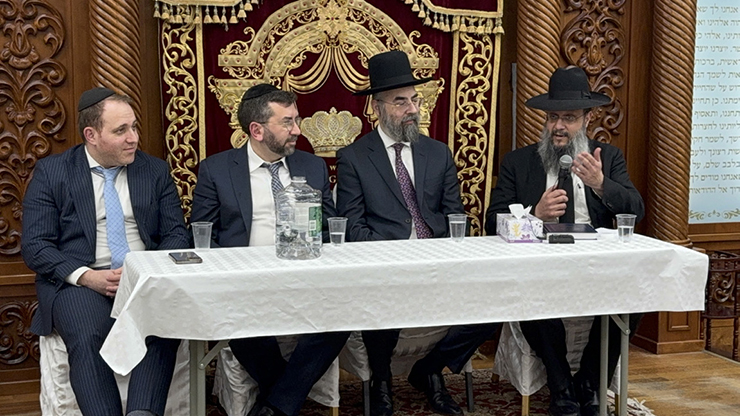
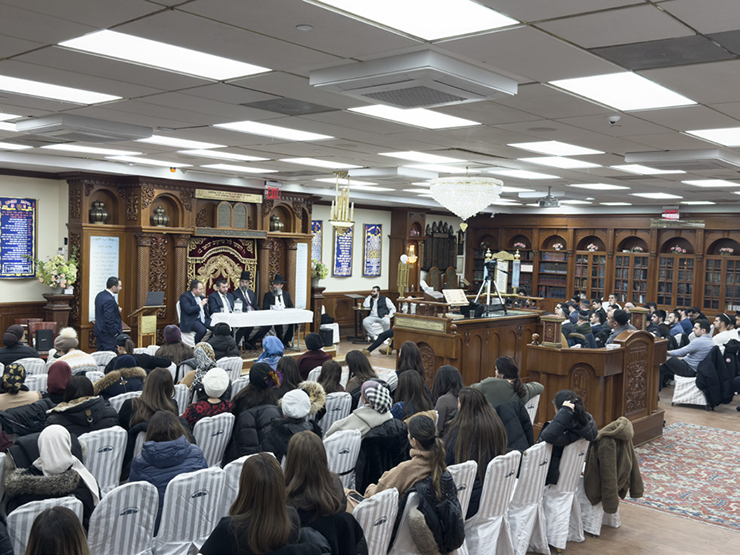
On Motza’ei Shabbos, February 28, the Beth Gavriel Community Center in Forest Hills hosted a well-attended evening devoted to one of the most vital foundations of Jewish life: building strong marriages and raising children in homes filled with shalom bayis. The program, titled “Parenting & Shalom Bayit Panel,” was organized jointly by Chazaq and Emet Outreach and brought together rabbanim, professionals, and community members for an open and practical conversation about the realities of marriage and parenting.
The evening began in a warm and relaxed atmosphere as attendees enjoyed sushi and refreshments while greeting friends and neighbors. Couples, young parents, and community members filled the room. Before the panel discussion began, the audience stood together to recite chapters of T’hilim, grounding the evening in emunah and the shared concerns of klal Yisrael.
Moderator Shay Yonaiev, Director of Couples Programming and Human Resources at Emet Outreach, welcomed the audience and noted the meaningful partnership between Chazaq and Emet, both of which have longstanding ties to the Beth Gavriel community and a shared commitment to strengthening Jewish families.
“I know everyone here could be doing something else on a Saturday night,” Yulayev remarked with a smile. “But the fact that people came out shows that working on our homes and relationships matters.”
The panel featured Rabbi Ilan Meirov, Director of Chazaq, Rabbi Refael Ribacoff of Hewlett’s Sephardic community, Rabbi Akiva Rutenberg, CEO of Emet, and licensed marriage and family therapist Nissan Borr, LMFT. Each brought a different dimension to the conversation: Torah guidance, pastoral experience, and professional therapeutic insight.
Audience members submitted questions anonymously on index cards, allowing the panelists to address topics that are often difficult to discuss openly. The questions touched on many aspects of married life, including communication struggles, differing levels of religious growth between spouses, parenting disagreements, and maintaining emotional connection through life’s pressures.
One question addressed a challenge many couples encounter when one spouse grows more quickly in religious observance than the other. Rabbi Meirov responded with a message that resonated deeply with the audience.
“One of the biggest mistakes people make is using religion as a weapon,” the rabbi said. “Growth in avodas Hashem must come with sensitivity.”
Rabbi Meirov explained that pushing too strongly can create distance rather than inspiration. “You want your spouse to feel uplifted, not pressured,” the rabbi added.
Rabbi Ribacoff spoke about strengthening emotional connection within marriage, particularly during periods when physical closeness is restricted. Those times, he noted, are meant to encourage deeper emotional communication.
“The Torah created a system that helps couples strengthen their bond,” the rabbi explained. “When you invest in conversation and understanding, the relationship becomes stronger.”
Rabbi Rutenberg addressed the reality that once children arrive, the demands of daily life can easily consume a couple’s attention.
“People schedule meetings, appointments, and activities for their children,” the dynamic CEO said. “But the marriage itself sometimes gets pushed aside.”
Rabbi Rutenberg’s advice was straightforward and practical: “Set aside time for each other. Protect it. Put the phones away and focus on one another.”
Therapist Nissan Borr offered insight from years of counseling couples, noting that many disagreements escalate because each person feels misunderstood.
“Very often couples are not fighting about the issue itself,” he explained. “They are reacting to the feeling of not being heard.”
Learning to express feelings calmly rather than assigning blame can transform the tone of difficult conversations.
One of the more memorable moments came when Rabbi Meirov addressed the idea of respect within marriage. “You don’t gain respect by banging on the table and declaring that you are in charge,” the rabbi said, drawing laughter from the room. “Respect is earned through how you treat your spouse.”
“A Jewish home built on honor and kindness becomes a mikdash me’at, a place where the Shechinah rests.”
Many of the questions submitted reflected the complexities of modern family life: balancing parenting responsibilities, navigating outside pressures, and maintaining connection despite busy schedules.
Throughout the evening, the panelists returned to several essential themes: patience, humility, thoughtful communication, and the importance of investing time in one’s marriage.
When the formal program concluded, many participants lingered to speak with the panelists and continue the conversation.
Judging by the full room—and the many questions that remained on the moderator’s table—the conversation about parenting and shalom bayis is one the community clearly values and hopes to continue.