
Gate of Life: Is that a gate in the Old City of Jerusalem?
Upon entering the headquarters of United Hatzalah of Israel in Jerusalem, the words “Gate of Life” are inscribed above the doorway. Indeed, this organization is dedicated entirely to preserving and saving life.
During a recent tour, our guide, Karen Arieli, shared her inspiring personal story while describing the remarkable work of United Hatzalah. The organization radiates a profound sense of divine light and compassion, standing in stark contrast to the darkness of evil in the world.
United Hatzalah boasts more than 8,000 volunteers across Israel, drawn from all segments of society: chasidic Jews, secular Jews, individuals from every religious background, Arabs, Druze, and others. They work together in remarkable harmony toward a single shared goal: saving lives. This unity (achdus) offers a glimpse of the messianic era.
Volunteers remain on call 24/7. Karen recounted that just that morning, while shopping in a supermarket for her children, her beeper alerted her to a nearby fire. She rushed to assist a mother and her children who had been asleep when the blaze started. Baruch Hashem, everyone emerged unharmed.
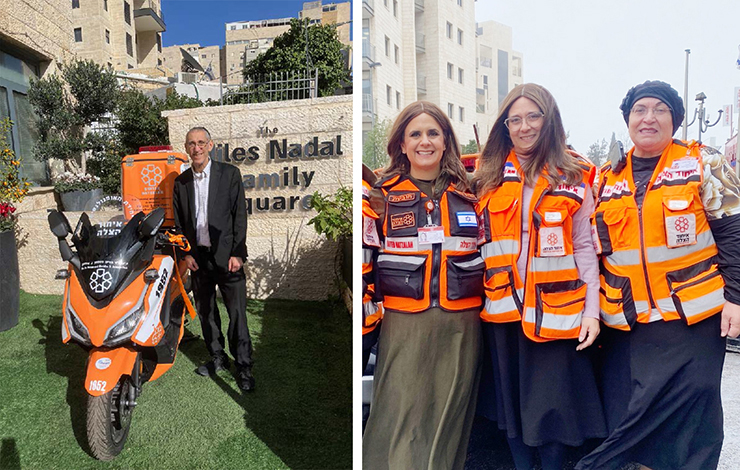
The organization dispatches two volunteers to each emergency, aiming to arrive within 90 seconds. To achieve this rapid response, United Hatzalah employs a diverse fleet of vehicles. Founder Eli Beer, author of 90 Seconds, envisioned responders reaching scenes in that critical window – whether to aid a choking infant or address any life-threatening situation. Since the brain can suffer irreversible damage after just three to four minutes without oxygen, every second is vital.
Karen presented a compelling video comparison of response times. On one side, a conventional ambulance sat gridlocked in traffic; on the other, a United Hatzalah ambucycle – a specially equipped motorcycle – navigated swiftly through the congestion, arriving at the scene in under 90 seconds as the Mission: Impossible theme played. (Note: Official sources indicate an average nationwide response time of less than three minutes, with a goal of 90 seconds in metropolitan areas.)
In contrast to the car- and ambulance-based Hatzalah familiar in places like Queens, United Hatzalah in Israel operates an impressive array of vehicles: ambucars, e-bikes (ambu-bikes), ambuboats, a large fleet of ambucycles, ambulances, a dedicated drone unit, and a recent pilot program featuring the ambuscooter.
Next, Karen led us to the dispatch center, where staff monitor a wall of large screens. Incoming calls are instantly routed to the nearest volunteer or vehicle, with phone guidance provided until help arrives. The focused intensity in the room underscored their singular mission: saving lives.
Rooted in the sanctity of life, United Hatzalah is Israel’s only fully volunteer-based first-response emergency medical network. It delivers fast, free, and professional care to every segment of society, regardless of background, religion, or ethnicity. The organization handles approximately 2,000 emergency calls daily and has responded to over 750,000 calls since its founding in 2006. (Recent figures reflect more than 8,000 volunteers and millions of responses overall.)
Among its many programs is the Ten Kavod initiative, which supports homebound elderly individuals through weekly volunteer visits for vital-sign monitoring, companionship, and assistance. The organization also offers family safety courses covering CPR, bandaging, choking response, and basic psychological first aid. Additionally, medics volunteer in hospital emergency rooms to support patients and staff.
Launched in 2021, the Adele and Joel Sandberg Women’s Initiative has empowered over 2,000 female volunteers to serve as emergency medical responders, enhancing response times and providing culturally sensitive care. United Hatzalah also maintains a dedicated chareidi women’s unit.
The Psychotrauma and Crisis Response Unit comprises 750 trained specialists, including mental health professionals and trauma-trained EMTs, focused on preventing PTSD among victims and responders. Following Operation Rising Lion, the organization held retreats to help participants process their experiences.
Other efforts include Make-A-Wish ambulances that transport terminally ill patients to meaningful sites, such as the Kosel, and International Missions Rapid Deployment Teams that deliver humanitarian aid during global disasters. In June 2025, the Ruderman Family Foundation Mobile Emergency Care Clinic was launched.
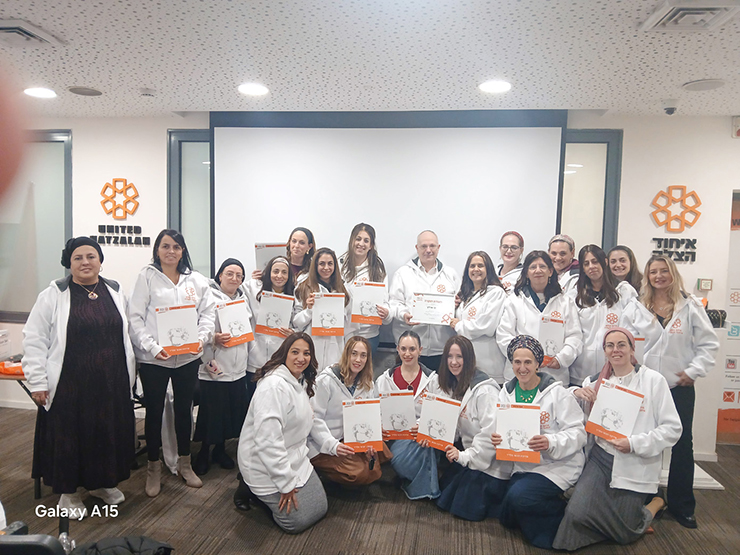
Karen then shared her own deeply moving story. While pregnant with her sixth child, her husband suddenly complained of feeling unwell, clutched his chest, and collapsed. He passed away shortly thereafter, leaving Karen an almanah (a widow). Reflecting on her lack of CPR training at the time, she transformed her grief into action. Leaving her advertising career, she spearheaded the Weisz Family IMAH Initiative, which trains widows – and now also divorced women – as medics and phlebotomists.
Under Karen’s leadership, the program has flourished. Over the past three years, more than 75 single mothers have graduated as medics or phlebotomists, working in hospitals, in clinics, and in the field. Participants receive diplomas, wear white coats, and gain skills such as drawing blood, assisting in deliveries, and other lifesaving techniques. Many enter feeling broken and emerge empowered, with sadness giving way to purpose and strength.
Karen also highlighted United Hatzalah’s response on October 7. At 6:29 a.m., as sirens blared and communication with the IDF and police faltered, the organization issued a radio dispatch warning volunteers that this was war and that responding could cost their lives. Yet hundreds rose to the challenge. Deploying 300 response vehicles, volunteers from diverse backgrounds — chasidic, Druze, Arab, secular, and religious – rushed south into the war zone. That day alone saw 12,000 emergencies, transforming United Hatzalah into a civilian lifeline.
Wearing bulletproof vests and helmets, they entered communities like Be’eri, Kfar Aza, Nir Oz, Alumim, Nirim, Holit, and Nahal Oz to rescue babies, civilians, and soldiers. Volunteers used drones to locate missing people, distract threats, and deliver defibrillators and other equipment. In total, the organization distributed 5,000 bulletproof vests and 6,000 defibrillators that day.
Karen concluded with a recent tragedy at an Israeli daycare, where two babies sadly died. United Hatzalah received the first calls, and one of her trainees played a pivotal role in saving over 50 other children. Amid the heartbreak, she emphasized the lives preserved.
“Every village in Israel has Hatzalah,” Eli Beer has said. “Let’s be ready for that baby who is choking.”
As Karen aptly described it, United Hatzalah represents “chesed on steroids.”
For more information about the Weisz Family IMAH Initiative, visit israelrescue.org/program/imah.
To learn more about United Hatzalah, donate, or read inspiring stories, visit www.israelrescue.org.