
A trauma expert discussed coping and resilience skills as Jews worldwide undergo challenging times.
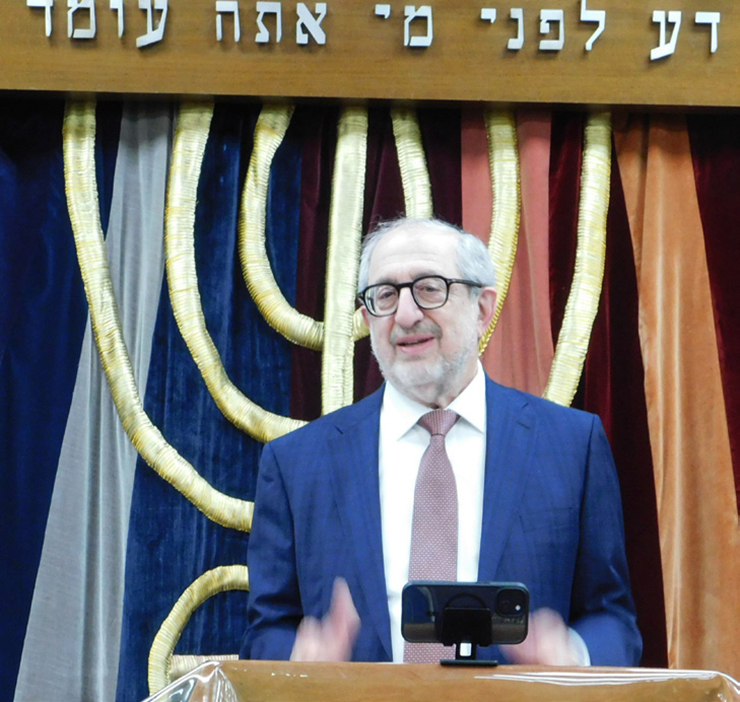
“Resilience is not one size fits all,” said Dr. Norman Blumenthal, a licensed psychologist and Adjunct Professor at Yeshiva University, at Congregation Machane Chodosh in Forest Hills on December 22.
At his private practice in Lawrence, Dr. Blumenthal tells his patients, “I’m not going to change you; I’m going to make you better at who you are.”
As Director of Trauma Services at Ohel Children’s Home & Family Services, his team “doesn’t come with a prescribed approach.” They interact, identify people’s “strengths and coping styles, and try to maximize it.”
Resilience is like a psychological muscle inherent in all of us that we build up. The Torah teaches how Hashem gives us the cure before He gives us the ailment.
Dr. Blumenthal went to Surfside, Florida, to counsel survivors after a condo building collapsed in the middle of the night due to structural deficiencies. The people didn’t know if their loved ones had survived.
Dr. Blumenthal prepared them for different eventualities. He learned this from the Torah when Yaakov saw Esav approaching. Yaakov prepared to defend himself, prayed to Hashem, and offered gifts to Esav. Yaakov prepared for different possibilities.
Both of Dr. Blumenthal’s parents were Holocaust survivors. His mother moved from a shtetl in Eastern Europe to a western city with a small Jewish population. She was the only Jew in her public school class. “The kids used to chase her home every day, throwing rocks at her, shouting anti-Semitic slurs.”
“Compared to pre-Holocaust Europe, we’re still living in very good circumstances, and we’re very fortunate to have the support and the protection of our government. We can’t lose sight of that, even during difficult times.”
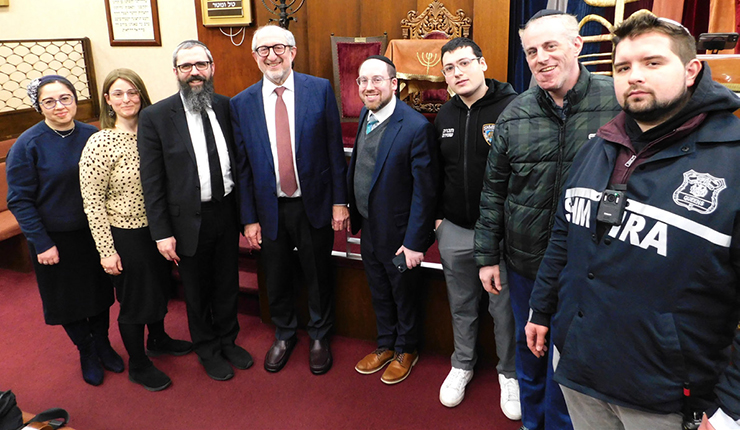 L-R: Malka Yunaev-Shimonov, Rebbetzin Mushky and Rabbi Yossi Mendelson, Dr. Norman Blumenthal, Rabbi Judah Kerbel, Moishe Rechester, Shabsie Saphirtstein, and Daniel Winchester
“Life changes. Life is not stagnant,” said Dr. Blumenthal. “Have an accurate read as to what danger actually exists.” If there is danger, we should have the appropriate amount of awareness, anxiety, and response.
Talk with other people and professionals about what dangers exist and don’t exist, and what to do about them. Learning self-defense is something we might need to do.
Having one’s reality invalidated hurts. “That’s a form of assault, because you are taking away my reality. That is something very painful as well, and part of our history.”
If someone is scared or angered, “don’t try to talk them out of it” unless it’s really off the mark. “Educate, discuss. Don’t criticize anybody for feelings they have.”
If feeling traumatized or wronged, take realistic action like protesting, reporting to law enforcement, and writing letters to politicians and newspapers. Even if the letter is not published by a newspaper, “when we correct the distortions, at least we’re not sitting back; we’re doing something about it, and that helps us.”
“Remind ourselves what’s good. Remind ourselves that most Americans are not anti-Semitic. Most Americans are not violent.”
“We have to remember that most people are good and most people mean well, and not come to believe that the majority of the world is out to harm us and express gratitude when we do have those instances where we are protected and when our reality is validated.”
A trauma study of San Francisco Police Officers showed, “Mere exposure to trauma did not increase resilience.” If they experienced trauma and had a narrative—somehow made sense out of it or learned a lesson from it—then they had more resilience. “We have to try to fit it in some context, some meaningful context that makes sense.”
An Emory University study found that people who know their family, nation, and/or their people’s history have more resilience than those who don’t. “Just an awareness of where you come from, of stories of grandparents, great-grandparents, etc.” A lot of Judaism, like the Pesach Seder, provides that.
Of all the narratives we tell—whether things were great and then got bad, or vice versa—“The Oscillating Narrative” was most associated with resilience. Things got good and got bad at different times.
“If we can put what’s happening in that broader historical perspective, both in terms of the hardship and the pain but also in terms of the heroism and survival, it’ll increase and enhance our resilience.”
“Preserve our dignity. Know who we are, know where we come from, know what we stand for.” Holocaust survivors could have “very legitimately” protested, rioted. “We didn’t. We rebuilt.”
Research shows people who believe in G-d have more resilience than those who don’t and handle trauma better. “We know that even things that seem negative have something good about them. We also believe we’re heading somewhere”—“closer to that long-awaited day when Moshiach will come.”
In Questions and Answers with about 45 people attending that night, Rabbi Yossi Mendelson asked about making plans for safety without “heightening people’s anxiety.”
Dr. Blumenthal said we have “the imperative to live and not cower in fear.” “We have to go on with our lives as much as possible.” “We have to strike a balance, but we do have to take precautions.”
QJL asked about how to be present for someone who has experienced trauma and is feeling anxiety. “Let him talk it out,” said Dr. Blumenthal. A very primitive part of the brain is activated when trauma occurs. “There’s that fight-or-flight part of the brain that is activated. And when you put it into words, when you speak about it, it kind of shifts to that more rational part of our brain.”
As a listener, giving advice and telling what to do is not necessary. Just allowing them to put it into words is helpful. Ask questions to clarify, not to question their experience.
Rabbi Yossi Mendelson of Congregation Machane Chodosh said before Dr. Blumenthal spoke, “If we are concerned that our enemies wish to see an end to us”—we must survive and not let them win. We stay alive physically, but also in identity. “The proper identity of a Jew is one who is joyful, enthusiastically, and productively engaged in life.” Resilience and calm are needed to do this.
“We have to serve G-d with joy, and the ability to have Ahavas Yisrael and to have Simchas HaChaim. To be able to love our fellow man and to have joy in life. And for this, we turn to the help of our Torah, our tefilah.” We also do this by doing hishtadlus, connecting with law enforcement and mental health professionals.
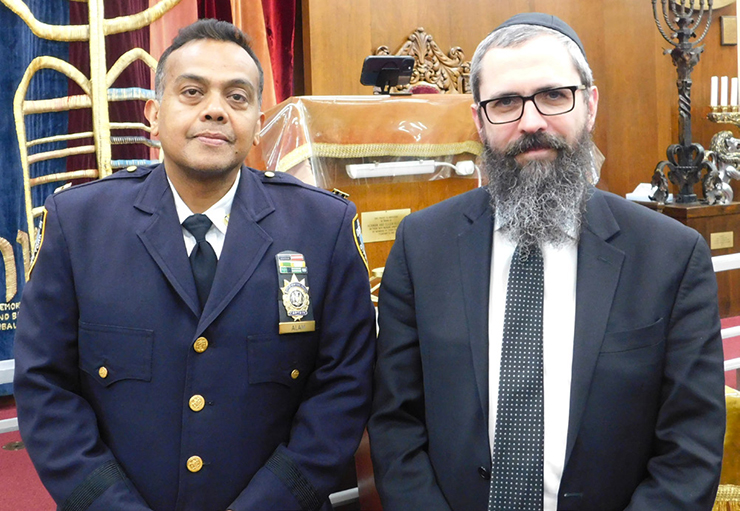
Captain Akm Alam, Executive Officer and second in command at the 112 Precinct, began the evening by saying, “The NYPD takes the safety of all synagogues and this neighborhood very seriously.” “Our goal is simple: to make sure everyone feels safe, protected, and supported.” “Violence and hate of any kind will not be tolerated.”
Detective Keith Tuohey and Officer Christopher DeSantis, Community Affairs Officers at the 112 Precinct, are available for direct communication between the community and the police. “The NYPD stands with you,” said Captain Alam. “Your safety and peace of mind are our priority.”
Rabbi Yossi Mendelson doesn’t take police protection for granted. “For most of our history, our people have not known that they could feel comfortable and trust men and women in uniform.”
Rabbi Judah Kerbel of Queens Jewish Center and Rabbi Elisha Friedman of the Young Israel of Forest Hills attended.
Queens Shmira members Shabsie Saphirstein, Daniel Winchester, and Moishe Rechester provided security for the evening.
The event was quickly organized with the help of Malka Yunaev-Shimov, LCSW, Therapist and Program Supervisor at Ohel Children’s Home & Family Services.
The entire 51-minute presentation can be seen on YouTube by searching Congregation Machane Chodosh’s “Tools for Resilience and Calm during Uncertain Times.”
By David Schneier