
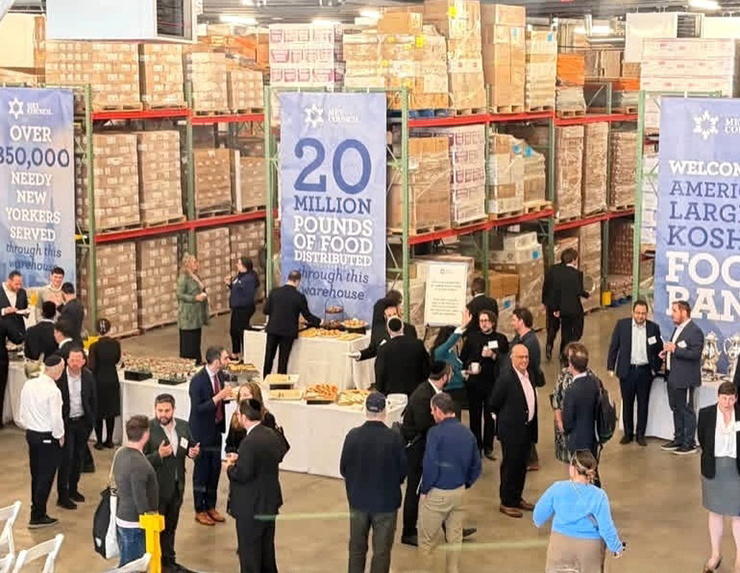
Met Council celebrated the opening of its new $25 million food warehouse and conference center in Canarsie on Monday, October 26, marking the largest capital project in its history. As I toured the 22,000-square-foot facility, capable of supporting food assistance for up to one million New Yorkers, I thought of the Queens families who had benefited from Met Council’s generosity long before this milestone.
For more than two years, while I operated the Chazaq Food Pantry, Met Council supplied our entire inventory through regular deliveries. Yet families’ needs did not always follow a distribution schedule. Some sought assistance after distribution had ended; others had missed their pickup. I traveled to Met Council’s Brooklyn warehouse for supplemental groceries, where staff consistently accommodated our requests. Families who might otherwise have gone without received the food they needed. Mi k’amcha Yisrael.
Our partnership continued through holiday distributions for Queens Cheder families, staff, and rebbeim. The Pesach initiative entered its second year, easing the considerable expense of preparing for Yom Tov, particularly for working families whose financial struggles may be invisible.

Those experiences deepened my appreciation for employees who may never meet the families they feed, yet whose responsiveness can determine whether a household has enough food.
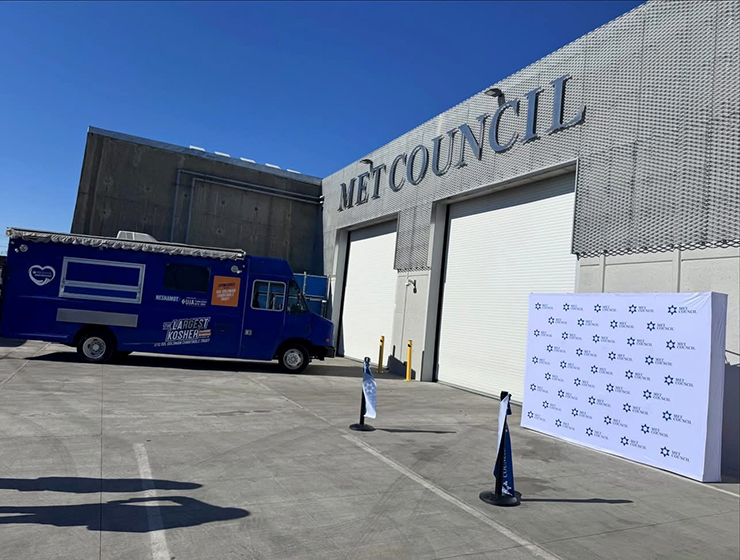
The new facility at 5361 Preston Court gives America’s largest kosher food bank a permanent home and supports 344 pantry partners. It also marks a new chapter for an organization established more than half a century ago to confront Jewish poverty.
In 1972, two major academic studies estimated that approximately 350,000 Jewish New Yorkers were living in poverty, challenging assumptions about Jewish affluence. With support from the American Jewish Congress and the Federation of Jewish Philanthropies of New York, communal leaders established the Metropolitan New York Coordinating Council on Jewish Poverty. Rabbi Jack Simcha Cohen became its first executive director, and Jerome M. Becker its founding chairman.
That November, Mayor John V. Lindsay announced $250,000 in municipal assistance for impoverished Jewish New Yorkers.

The organization subsequently expanded to provide emergency financial assistance, benefits enrollment, housing support, domestic violence services, and programs for Holocaust survivors and seniors. Food assistance became a defining responsibility, particularly for observant families unable to obtain suitable groceries through conventional emergency programs.
Expertise developed to supply kosher food also enabled Met Council to serve Muslim households requiring halal provisions. I have witnessed that same spirit in Kew Gardens Hills through my friendship and partnership with Rabbi Shlomo Nisanov of the Kehilat Sephardim Food Pantry. Although the pantry primarily serves Jewish families, Rabbi Nisanov also welcomes residents of other backgrounds.
Met Council Chief Executive Officer David G. Greenfield emphasized that the warehouse was built to meet growing demand without compromising recipients’ dignity. Families should not have to choose between groceries and rent, and the organization needed infrastructure capable of reaching more households.
In fiscal year 2026, Met Council distributed more than 20 million pounds of food. Its food assistance and social service programs serve approximately 350,000 New Yorkers annually, while its National School Lunch Program reaches 144 schools. During the recent High Holiday season, the organization distributed a record 2,016,982 pounds of kosher food through 162 participating organizations, helping families prepare for Rosh HaShanah, Yom Kippur, and Sukkos. Its year-round operations also support distributions for Pesach, Thanksgiving, Ramadan, and Eid al-Adha.
I remember Greenfield’s determination to secure dependable supplies of eggs, a Pesach staple whose soaring prices and uncertain availability had complicated holiday preparations in recent years. For Pesach 2026, Deb El Food Products and the Gibber family donated 2.1 million eggs to Met Council, supporting a distribution that reached more than 350,000 people through 250 locations.
The warehouse combines expanded refrigeration and storage systems with barcode scanning, real-time inventory tracking, and route optimization. Artificial intelligence will help forecast demand and reduce waste, enabling pantry partners to receive more dependable supplies of food.
An on-site digital food pantry, made possible by UJA-Federation of New York, brings Met Council’s choice-based model to Canarsie. Eligible residents can select groceries online, including kosher and halal options, and collect their orders rather than receive predetermined packages. The model has been examined in a Harvard Business School case study and is designed to reduce waiting times and waste while allowing households to choose foods suited to their needs.
Through New York’s Social Care Network program, Met Council also provides medically tailored meals and nutritious groceries to eligible Medicaid members, accommodating medical and religious dietary requirements. Home deliveries to Holocaust survivors and homebound seniors, mobile pantries, and community distributions extend its reach.
Met Council Board Co-President Joseph S. Allerhand highlighted food insecurity among working- and middle-class families. The project received city, state, federal, and private funding, including a $1 million state matching grant secured by State Senator Sam Sutton and matched by Met Council donors and board members. Board Co-President Benjamin Tisch helped guide the undertaking, while Managing Director of Food Programs Hannah Lupien and the operational staff oversee its implementation.
My years operating the Chazaq Food Pantry gave me particular appreciation for the professionals connecting Met Council with neighborhood partners. Benjamin Zaientz, Senior Manager of Agency Relations, Food Programs, has helped pantry operators navigate distribution challenges. I am also grateful to Benjamin Segal, Met Council’s Chief of Staff, for his cooperation with the Queens Jewish Link.
Two other dear friends, both Kew Gardens residents, have offered valuable counsel in my advocacy for the Queens Jewish community: Rabbi Avrohom Hecht, Executive Director of Project Lead and the Jewish Community Council of Canarsie, and Reb Aaron Cyperstein, Met Council’s Managing Director of Legal & External Affairs.
The building also houses the Jewish Communal Fund Conference Center, a space for pantry partners, community organizations, funders, and public agencies to collaborate.
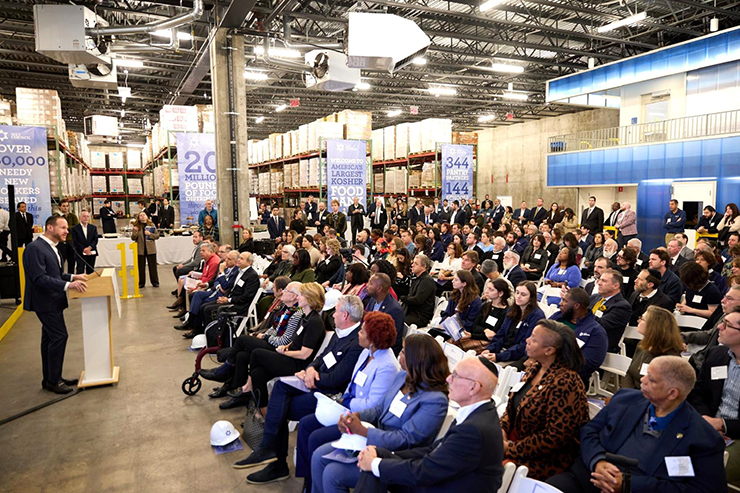
More than 200 community leaders and over 20 elected officials attended.
As I toured the warehouse, I remembered the unexpected trips for supplemental groceries and the families waiting for those provisions. The technology and scale have changed, but the commitment I encountered years ago remains.