

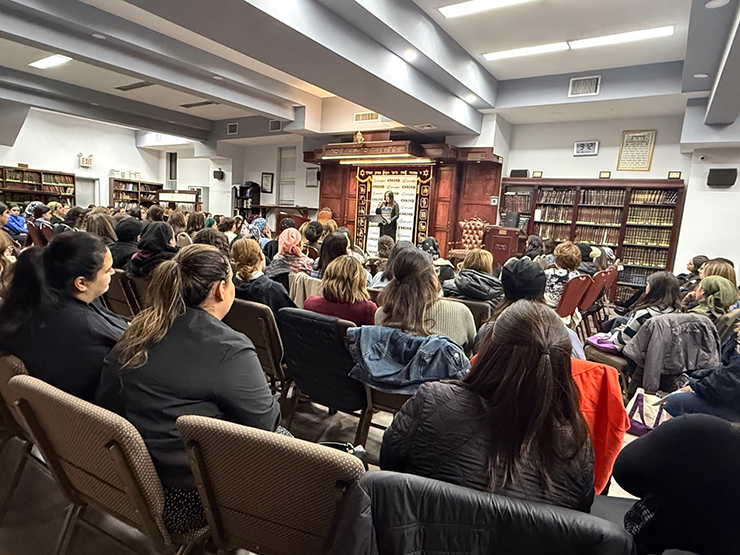
Sometimes you hear a shiur that changes your perspective and goes straight to your heart - and that is what this Rochel Imeinu gathering accomplished.
Community women gathered at Congregation Ohel Simcha on Wednesday night to hear two mothers speak about their exceptional daughters who were nifteres but left a lasting impact and imprint on the people who knew them. Hearing about who these young women were and how they lived continues to inspire us to be better people, while hearing the strong emunah of these mothers is totally transformative.
Rachel Samani, who coordinated this event, shared that when we think of Rochel Imeinu, we think of a mother. There was something so special about Rochel Imeinu because she was able to put someone else’s feelings before her own. There is a powerful lesson in what she did for her sister Leah: She gave away something so precious for the sake of shalom when she taught her sister the signs she and Yaakov had prepared. She didn’t want her sister to be embarrassed, even when it meant forfeiting her own happiness.
Sometimes it is difficult for us to offer shalom, but Rochel Aliza a”h was a peacemaker. Mrs. Samani related that her daughter was friends with Rochel Aliza and that they were in school together. Rochel Aliza brought all the girls together and always wanted to make others happy. She noted how, one time, Rochel Aliza brought an extra umbrella for her daughter, and another time, she filled her daughter’s room with pink balloons that she blew up for her birthday. Mrs. Samani said that Rochel Aliza knew how to live chesed because of where she came from.
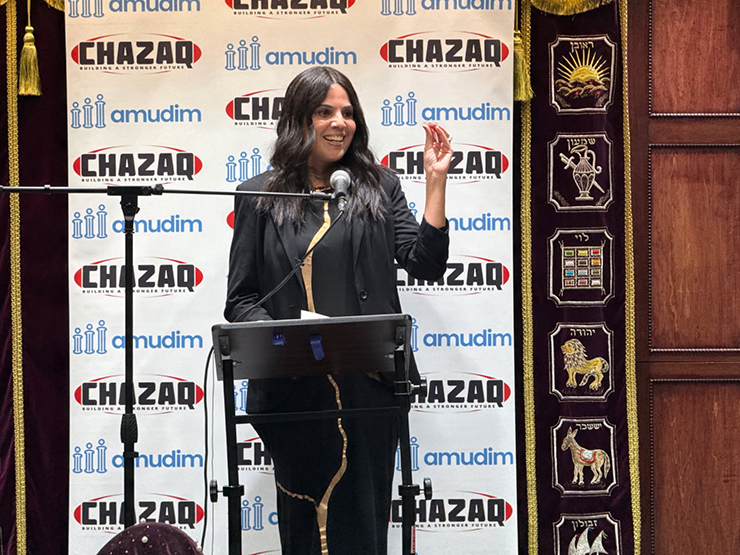
Next, Rebbetzin Ora Nisanov, mother of Rochel Aliza a”h, spoke. She shared that Mama Rochel is still crying for us, as she is the mother of all mothers and cries for her children. She read a piece another mother wrote after losing a daughter, describing her experience at Kever Rochel: “I put down my title of mother and became a daughter again.”
Sometimes we need a place where we can come with our tears. The Gemara tells us how Rochel shared the signs with her sister Leah. Rochel had her own hopes, but she didn’t want her sister to suffer embarrassment, so she acted to protect her sister’s dignity. In our own lives, when we are upset or disappointed, we can remind ourselves to remember the feelings of other people.
Rebbetzin Ora shared that Rochel Aliza was the youngest of eight children and brought warmth and joy wherever she went. She was a gentle spirit with natural chein, and conflict hurt her deeply. She encouraged her siblings and friends to be kind to each other and knew how to listen. “Sometimes I’d feel comforted by my own daughter,” Rebbetzin Ora said. “I treasured her trust.”
She shared a special memory of her daughter asking if she would be her kallah teacher when the time came, a request that meant so much to Rebbetzin Ora. There was also a special moment before the accident when Rochel Aliza asked her mother to braid her hair. “I hold that moment in my heart.”
Hashem braided Chavah’s hair before bringing her to Adam. “I had the opportunity to beautify my daughter before giving her back to Hashem,” she said, adding, “I am deeply grateful for that moment.”
Rochel Aliza’s teachers described her as a quiet leader, a source of positivity and growth. Minchah was important to her, and she encouraged friends to daven Minchah. She also encouraged classmates to take on kabbalos for spiritual growth. She had taken on a thirty-day kabbalah, and the accident occurred on the 30th day.
She loved music and dancing with friends, and family meant so much to her. She babysat her nieces and nephews and spoke about the home she hoped to build with a talmid chacham.
Her brother Nissan founded a kollel in Israel and named it after Rochel Aliza, with ten men learning there every night in her z’chus. At the sh’loshim for Rochel Aliza, the family gave out the Daily Dose book from TorahAnytime, which was the book Rochel Aliza had wanted.
Rebbetzin Ora related that she now uses her daughter’s room for davening, learning, and coaching. “It’s a place I can feel close to Rochel when I daven and learn. It helps me keep going.” She shared that she is grateful for every bit of good and for her daughter Aviva’s recovery, carrying in her heart both gratitude for Aviva’s recovery and pain over losing Rochel Aliza. She also shared that friends arranged a burial plot for her daughter at the entrance to Har HaMenuchos.
She shared a mashal that brought her comfort: A baby grows inside its mother but can’t see her. We can’t see Hashem, but the cord connecting us is our Torah, mitzvos, and chesed.
She shared the acronym HOT for how we should listen to and speak to others: H is how to say it, O is thinking of the outcome of what we say, and T is the timing. Our tone of voice affects how a person receives what we say. Ask yourself if what you are going to say will bring you closer to the person you are speaking with, and remember that timing is also important.
Love means surrender, letting go of the feeling that we can control what happened. We say to Hashem, “I don’t understand. I wish it were different, but I place this in Your hands.”
“I’m not letting go of my child, but I’m letting go of thinking I am in control.” She concluded with the hope we all hold that Mashiach should come soon.
Following this, Mrs. Maya Namdar, mother of Liel Dina a”h, spoke. She began by stating that she was honored to be speaking after Rebbetzin Ora Nisanov and asking how we make peace when we are deeply hurt. Hashem sends us challenges so we can grow, and she spoke about searching for clarity and turning pain into purpose. Her daughter Liel Dina was nifteres on December 11, 2021, killed by a drunk driver in a car accident while coming home from a Camp Sternberg reunion.
She shared that she became a new person after the accident. Liel’s name means “Hashem is mine,” and her entire essence was bringing Hashem into every place she was. She had the gift of noticing people, brought girls together, and made sure everyone was happy and dancing at bas mitzvah celebrations. Every girl wanted Liel at her bas mitzvah.
Mrs. Namdar said that her daughter taught her v’ahavta l’rei’acha kamocha by treating her friends the way she wanted to be treated. We all need to live as Liel did, with the three L’s: “Live Like Liel.”
She shared a letter that a friend sent about Liel two weeks after the accident. The friend wrote that she wanted to have a birthday gathering, but because it was during Midnight Madness on Central Avenue, she was sure her friends would not want to come. She messaged Liel because she knew that if Liel came, the other girls would come, too. Liel texted that of course she would come and wouldn’t miss it, and the other girls then all came. Liel’s presence made this friend feel so special.
The director of Camp Sternberg said that Liel had an impact on everyone at Sternberg.
Mrs. Namdar said that we need to rise above our emotions and see the neshamah in the other person. The Kotzker Rebbe taught that there is nothing more whole than a broken heart.
She shared that her heart had shattered, and now she understands that the cracks create room for light to enter and for the heart to expand. “Now I can let Hashem in.” True healing comes from letting Hashem into the cracks.
There is a Japanese art in which broken pottery is repaired by filling the cracks with gold, making the piece stronger, unbreakable, and beautiful. In this galus, she said, we are all feeling so much. What are we filling our broken hearts with? Fill them with Hashem’s intimate love.
Thank you to the sponsors of this inspiring, life-changing program: Chazaq, Shalom Task Force, Met Council, Amudim, Jewish Board Wave Initiative, and NY Legal Assistance Group.
By Susie Garber