
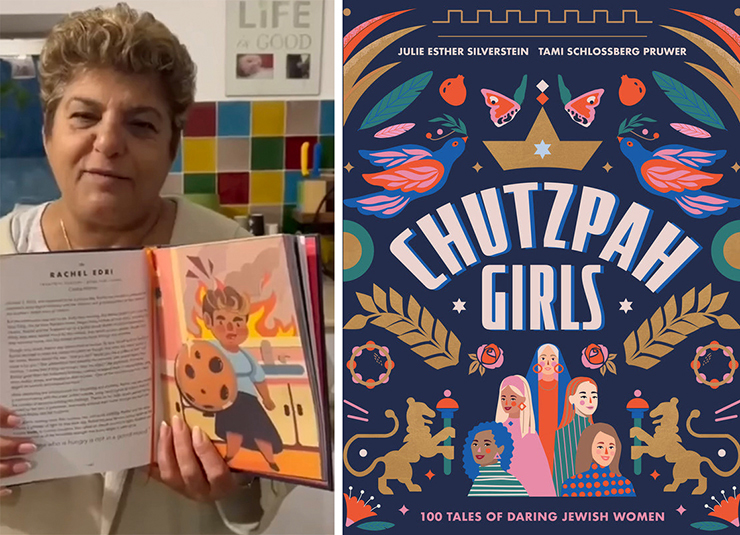
Purim is the ideal time to highlight the role of heroic Jewish women in history, with Esther having the leading role in saving the Jewish nation from a genocidal plot. Written by Julie Esther Silverstein and Tami Schlossberg Pruwer, Chutzpah Girls has 100 examples of Jewish women, each with a descriptive page and illustration. The book was published in late 2024, but I only found out about it recently at my public library in the year of bat mitzvahs in my daughter’s grade.
The authors also have daughters whose coming of age included questions about the roles of women in Jewish life. In an interview with Unpacked, a Jewish social media stream, Silverstein spoke with ambition about Chutzpah Girls. “It was then that I realized: We need to create the most beautiful, diverse, and engaging book ever written about Jewish women.”
Pruwer spoke of the parameters for the book, that its subjects exemplified the achievements of women guided by Jewish values. “You can see the connection between the Jewish values that these women live their lives by and their contribution to the world,” she said. “The other parameter was trying to be as diverse as possible—covering all time periods, and as many countries, fields of contribution, and ethnic backgrounds as possible.”
Visually, twelve women illustrators were selected to depict the subjects, all accomplished in their careers as graphic designers, educators, and artists. Like the women in this book, the artists are Ashkenazi and Sephardi, born in Brazil, Great Britain, Russia, Israel, America, and other places.
In regard to historical examples, the list includes women from the Tanach: our four matriarchs, Miriam, the daughters of Zelophehad, Devorah, Hannah, Huldah, and Yael. The Talmudic period has Bruria and Yalta. Benvenida Abravanel, Miriam Shapira-Luria, Gluckel of Hameln, and Dona Gracia Nasi represent the medieval to Renaissance periods.
Closer to our time, the geographic variety includes Ethiopian-born Israeli activist Ashager Araro; Chana Leviev, who kept her family observant during the Soviet period in Uzbekistan; humanitarians Meera Jacobs Mahadevan of India and Yemenite Bracha Kapach; and Iranian-born author Roya Hakakian.
Initially, I assumed that a book about Jewish women with “Chutzpah” in its title would be feminist and partial toward non-Orthodox denominations that offer women the rabbinate and equality in religious matters. Knowing that this book has the imprint of Koren Publishers, one would know that the content is appropriate for an Orthodox girl. However, there are not so many rebbetzins here who helped their husbands achieve gadol hador status by maintaining the home and raising families.
Instead, the book offers Orthodox women who stood on their own merits. Sarah Schenirer, founder of Bais Yaakov, has a page, but so do Asenath Barzani, Hannah Rachel Verbermacher, and Nechama Leibowitz, who delivered divrei Torah to sizable audiences—sometimes behind a screen or a desk, not on the pulpit—but nevertheless were respected as talmidei chachamim for their insights on the Torah.
Remarkably, there are living Orthodox women in this book whose leadership and education continue to inspire the public. Anne Neuberger was raised in Borough Park and became a Deputy National Security Adviser during the Biden administration; Beattie Deutsch runs marathons in Israel wearing her skirt; Rivka Ravitz is a mother of twelve children working as chief of staff for the president of Israel. Perhaps you’ve heard Lori Palatnik speak about donating kidneys, and Ruchie Freier serving as a judge. Perhaps you’ve read the weekly parsha column by Sivan Rahav-Meir; they also appear in this book. Chani Lifshitz is the Chabad shlucha in Nepal, exemplifying the role of rebbetzins as “co-directors” in every Chabad House, sharing outreach responsibilities with their husbands.
Further examples of diversity in Jewish life depicted in Chutzpah Girls include scientists, businesswomen, poets, athletes, and politicians whose achievements were guided by their faith. The authors began their project during the time available at home during the pandemic, and as events provided additional examples of inspiring women, they were added to the book.
In the aftermath of the October 7 attack on Israel, Inbal Lieberman of Kibbutz Nir Am is noted for her bravery against Hamas terrorists, and Rachel Edri, who fed cookies to the attackers while secretly communicating with Israeli police. Their heroism is informed by Deborah and Yael of the Tanakh; Gisele Braka, Zivia Lubetkin, and Roni Zuckerman of the Holocaust resistance; and Mossad operative Malka Braverman.
In a time when some Orthodox publications omit images of women for reasons of modesty, and much of the historical content is assigned to men, Chutzpah Girls has become an indispensable resource not only for bat mitzvah girls but for all Jews. It ends with a page for girls to “Write your own Chutzpah story” and draw a portrait. Inevitably, many will do so, and perhaps a second volume will emerge with more inspiring examples. In the meantime, the book continues to gather momentum as it is being translated into Hebrew, French, Italian, and Spanish.