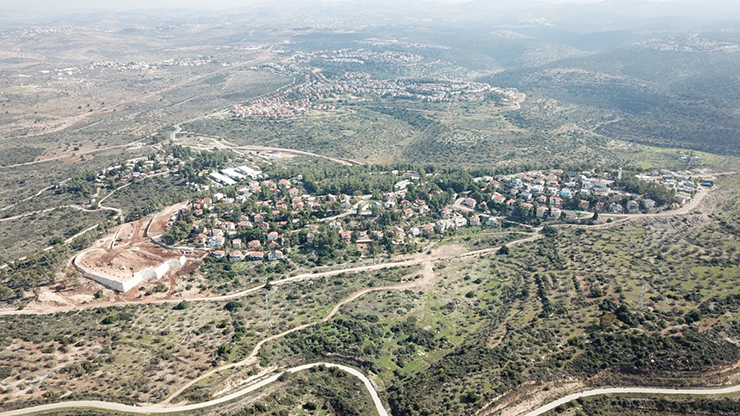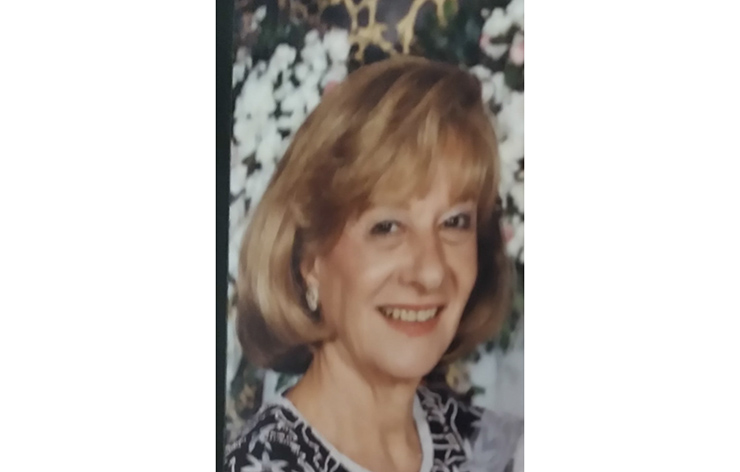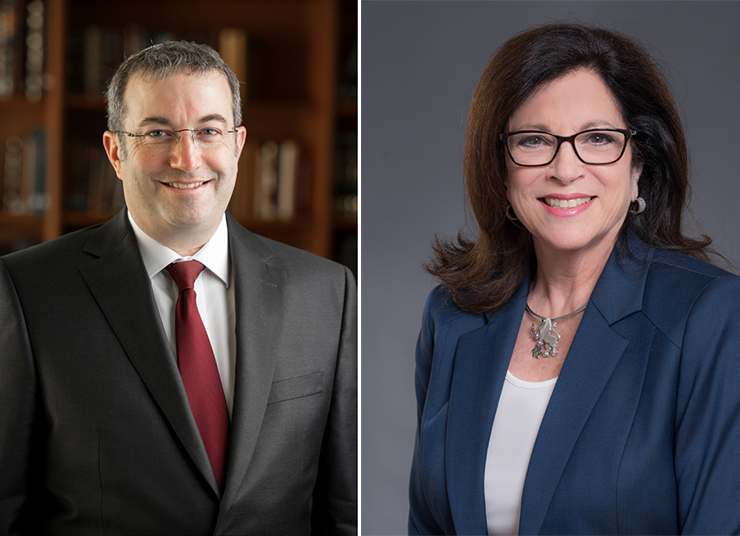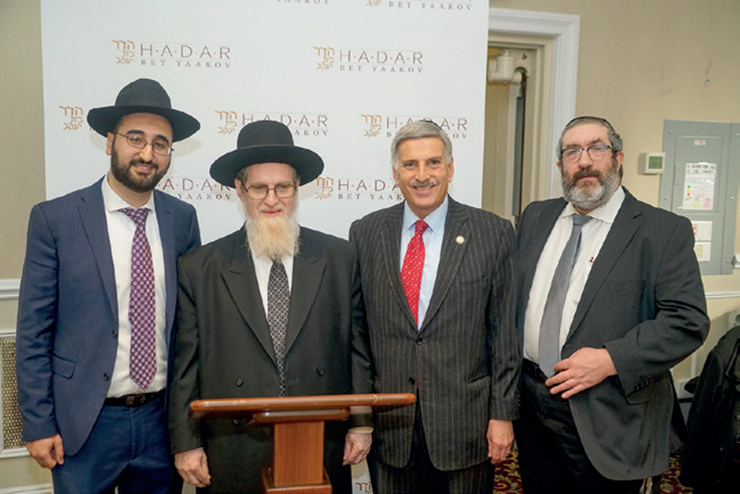

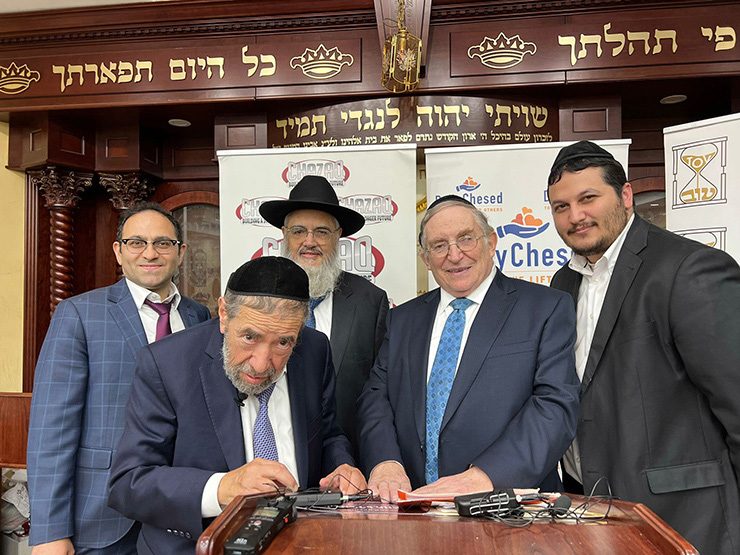
The l’vayah of Reb Avraham Aharon “Abe” Rosenthal z”l was held on Motza’ei Shabbos, June 6, at Bet Midrash TOV in Kew Gardens Hills. It drew hundreds of mourners, with standing room only. Rabbanim, family, friends, and those he quietly helped gathered to pay final respects. The k’vurah took place at Har HaMenuchos in Yerushalayim.
The hespeidim traced the story of a man who worked hard from a young age, built a major business, and used his success to support Torah, chesed, family, and klal Yisrael.
Rav Menashe Tzadka, TOV’s mara d’asra, drew from the Torah’s description of the two silver trumpets used by Moshe Rabbeinu. Abe, he said, lived with both: the trumpet of kesef – the money he gave constantly – and the trumpet of action, the effort he invested in building, organizing, and bringing others closer to Hashem.
Abe never sought kavod. While others called him a president, founder, or benefactor, he saw himself as someone with work to do. When something needed to be done for Torah or a fellow Jew, he acted.
Bet Midrash TOV itself told that story. As president, Abe invested time, energy, and vision into its growth, ensuring it became a home for Torah, t’filah, shiurim, and community. One son recalled standing with him when the site was still a house. Abe already had his vision: “We’re going to build a big shul.” When asked who would daven there, Abe was unfazed. Build it, he believed, and it would become what it needed to be.
This vision extended to future generations. Abe was instrumental in supporting the Bet Midrash TOV Women’s Center, an initiative dedicated to tz’nius, taharas ha’mishpachah, and programs strengthening Jewish families.
His commitment reached far beyond one building. For years, Abe was involved in outreach efforts that brought Jews closer to Torah u’mitzvos. If someone could not afford a seminar, Abe became the address. If a participant hesitated because of money, he would call until the obstacle was removed. Rabbanim and friends said many who today are raising Torah families were influenced by efforts Abe quietly supported.
His home was also an address for those in need. Rabbanim visiting from Eretz Yisrael, families facing illness, and those seeking support knew that Abe and his eishes chayil, Rebbetzin Tamar Rosenthal, opened their door and hearts.
Rav Tzadka recalled the family’s close connection to Rav Nissim Yagen z”l, the renowned m’kareiv whose work inspired countless Jews to strengthen their Torah observance. Rav Yagen’s mission helped shape the spirit that would later be carried by the TOV network of shuls, including the Kew Gardens Hills affiliate: a commitment to Torah, t’filah, outreach, practical guidance, and strengthening Jewish families. For Abe, that mission was personal. He opened his home to rabbanim and made himself available whenever another Jew needed a place or a connection.
Born in Haifa to Tzvi Dov and Zahava Rosenthal, Abe grew up in a generation marked by sacrifice. When the family came to America, they started over with little. As the eldest, he understood responsibility early, working days and attending school at night to support his family while building a future.
He began as a waiter, owned that restaurant within two years, and then moved to the next challenge. He sold auto parts from a van, building relationships across Queens and Long Island. Those beginnings grew into Abe Rosenthal and Sons, then Clearway Auto Parts, and eventually The Parts Authority.
Success was a tool, never his goal. Customers trusted him because he was fair, loyal, and generous. His son described it simply: Abe built businesses, but more importantly, he built people.
Stories were shared of borrowers who received large sums decades earlier and were never chased for repayment. When asked why, Abe replied that if they no longer needed the money, they would have come to tell him. He preferred to protect a person’s dignity rather than create embarrassment.
For years, he called family and friends to raise money for weddings of couples they had never met, refusing to let financial hardship stand in the way of building a Jewish home.
Others recalled meshulachim receiving $100 bills from Abe, often without fanfare. As one grandson summarized, “The money wasn’t in Chase Bank; it was in Hashem’s bank.”
While his business earned him wide respect, the lessons he brought home were more lasting. His brother spoke of a man who honored his parents, remained devoted to his siblings, and left many gifts to the world. The shul where the l’vayah was held was one legacy; another was a shul in Bar Ilan that he helped finance. Yet his brother said that beyond the institutions he helped build, Abe’s greatest legacy was his family: Rebbetzin Tamar, his children Ronnen, Eyal, Ophir, Ohad, Tzvi, and Rut, his grandchildren, and future generations who embraced the values he lived every day.
Abe’s son Eyal recalled a special gift from his cousin Michael, who built a shul in Eretz Yisrael and dedicated it in honor of Abe and Tamar. Michael explained that one should not wait until after a passing to show appreciation. Abe and Tamar were able to visit and stand inside together, an experience that filled them with joy.
Another son shared a story that became a family description of Abe. While planning a basement project, Abe drew construction plans. When the contractor said a hallway could not be built because a support pole stood in the way, Abe answered, “Move the pole.” The contractor explained that the pole held up the house. Abe replied, “We’re going to move this pole.”
Obstacles were not excuses to stop, but problems to solve. Abe always searched for the way forward.
That strength was clear during his illness. Abe suffered from Parkinson’s and endured a difficult final period, yet he did not complain. When first diagnosed, his response was Mizmor L’Sodah. One son asked if he was depressed. Abe answered the opposite: He believed completely that Hashem loved him and that the challenge was for his benefit. His life was harder, he admitted, but he remained grateful.
Family members recalled him continuing to daven, put on t’filin, attend shiurim, and learn even when physically difficult. In Eretz Yisrael, after climbing stairs with effort, he would still say Mizmor L’Sodah, grateful he had reached the top. When he could no longer speak clearly, his lips still moved with the words of Mizmor L’Sodah. His children said that gratitude remained with him until his final breaths.
Abe loved Torah. Though he did not receive the benefit of a full yeshivah education in his youth, he pushed himself to learn, attend shiurim, learn Daf Yomi, and buy a Shas. When a son wanted to open a night kollel, Abe began making calls immediately. That kollel continued for over two decades, an example of his instinct to act when Torah needed support.
One son described arriving early on the Friday morning of Abe’s final day, hoping to put on t’filin with him. Looking back, he felt his father waited for him to come one last time.
One message, repeated by his son Eyal, stayed with the room: “Blink your eyes.” Abe would tell him that life passes quickly. Blink your eyes, and one day all possessions will not matter. Only Torah, mitzvos, and the good done for others come with a person.
Abe Rosenthal z”l leaves behind his family, friends, and a grateful community. May his neshamah have an aliyah, and may he be a meilitz yosher for all of klal Yisrael.
Y’hi zichro baruch.
By Shabsie Saphirstein