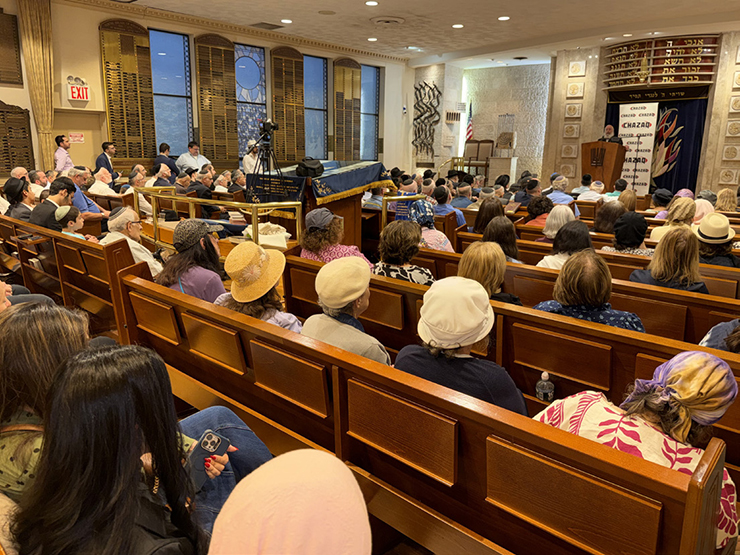


Just days before tens of thousands would flood Fifth Avenue in a sea of blue and white, a packed social hall at the Young Israel of Kew Gardens Hills became the setting for a different kind of mobilization. Co-hosted by Arutz Sheva–Israel National News and Chazaq, the gathering brought together Israeli ministers and local activists to address the growing global campaign of misinformation targeting Israel and the Jewish people. Guests entering the hall were greeted by an archaeological exhibit showcasing discoveries from Judea and Samaria, reinforcing the day’s focus on the Jewish connection to the land.
The modern defense of Israel is fought on multiple non-military fronts, including journalism, archaeology, social media, and education. Arutz Sheva executives emphasized that accurate reporting is a vital component of this broader national defense.
The program opened with a rendition of the “Star-Spangled Banner” by Dr. Paul Brody, President of the ZOA of Long Island and Queens. It would later close with “Hatikvah.” Dr. Brody’s decades of advocacy on behalf of Israel, its people, and its soldiers was recognized by the emcee.
Rabbi Ilan Meirov, Director of Chazaq, delivered an opening address focused on the younger generation. He recalled that immediately following the tragedies of October 7, public school and college students felt an unprecedented surge of Jewish pride and a desire to reconnect. But now, many of those same students are reluctant to publicly identify as Jews, hiding their identity or becoming detached from their heritage. He insisted that the antidote to rising global anti-Semitism is deep investment in heritage, stating that he is a believer in “peace through education” before hostile social media narratives and outside influences erode their pride.
Yaakov Serle, co-publisher of this newspaper, noted that Israeli resilience directly mirrors the spirit here in Queens. He highlighted the broader impact of community mobilization, recalling his participation alongside more than 1,000 advocates on an annual NORPAC mission to Washington to walk the halls of Congress. He noted that the local community also had the unique privilege of hearing directly from Israeli frontline soldiers who later visited Queens to share their raw battlefield experiences. Serle praised the local unity he has documented across Queens, remembering how neighbors stood shoulder-to-shoulder to defend their neighborhood when anti-Israel agitators marched down the streets of Kew Gardens Hills.
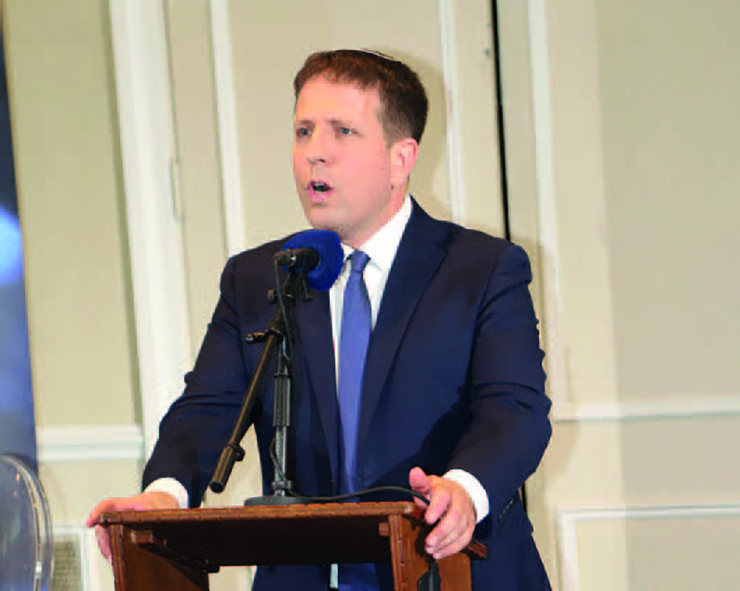
The event did not shy away from political friction, particularly regarding the narrative battles playing out in both global religious institutions and local government. New York City Councilman James Gennaro, of the 24th District in Queens, delivered an unfiltered address that targeted revisionist narratives from both secular politicians and religious leaders. A devout Catholic, he expressed profound frustration with his own church leadership’s post-October 7 rhetoric, describing his dismay at hearing prayers from the pulpit that equated defensive military operations with atrocities.
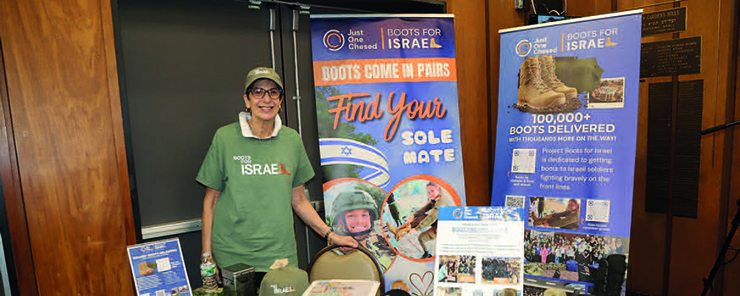
The focus then shifted to practical, on-the-ground initiatives, including a video presentation highlighting the vital work of Boots For Israel, an initiative that began with a single phone call from a frontline soldier with disintegrating footwear. Operating with just four volunteers handling everything from sourcing and packing to shipping and distribution, the group has delivered more than 100,000 pairs of tactical cleated boots directly to frontline units.
In a live interview, Rabbi Avi Berman, Executive Director of OU Israel, challenged how the world views aliyah. He argued that true success isn’t just about the emotional moment immigrants step off the plane, but what happens “the day after.” Berman detailed how OU Israel has strategically mapped out 300 different communities across Israel—including Katzrin, Nahariya, and Haifa—to ensure English-speaking families are absorbed into robust local networks rather than isolated enclaves. Eyal Freiman, Deputy Staff Officer for Archaeology for Israel’s Civil Administration in Judea and Samaria, brought that battle for truth directly to the ancient soil. Freiman spoke of excavating physical remnants of history – like the Palace of Herod Agrippa in Sebastia – reinforcing that the biblical narrative is rooted in historical reality. “Our story is not a myth,” Freiman said, pointing out that international journals routinely censor or ignore critical archaeological discoveries simply because they originate in the biblical heartland.
Amidst heavy discussions of war and media bias, Rabbi Mashiach Kelaty provided a moment of contrast by sharing a sports story that went viral in 2019. He described an international lacrosse match where the Israeli women’s team decisively beat Kenya 13-to-4. Yet, noticing the Kenyan players were dangerously slipping on the rain-slicked field because their shoe shipment had arrived in the wrong sizes, the Israeli team refused to accept such an uneven playing field. That night, the Israeli players and their parents tracked down a local store, convinced the owner to stay open all night, and bought brand-new cleated athletic shoes out of their own pockets for the entire Kenyan team. Rabbi Kelaty highlighted the words of the Israeli goalkeeper: “In 20 years’ time, nobody is going to remember that we beat Kenya 13 to 4. What they will remember is the smile on the faces of that Kenyan team as they got their new shoes and they acquired their new friends.”
A senior delegation from the Israeli government took the stage, accompanied by Itay Granek, Director General of the Ministry of Heritage, reinforcing how seriously the state views its cultural battlefront. Minister of Heritage Amichai Eliyahu shared a reflection from his time as a young combat reservist in Lebanon more than 20 years ago, recalling restrictive operational policies that prevented soldiers from returning fire on terrorists shooting from residential roofs. He labeled that mindset a distorted morality born from a disconnect from historical identity. “When a generation does not respect the earlier generations and the heritage, they’re just like a leaf flying away in the wind,” Eliyahu stated.
The morning proved that even in an era of intense political division, those roots can still bridge major divides. Minister of the Negev, Galilee, and National Resilience Yitzhak Wasserlauf shared a personal story about a close friend who is a staunch left-wing activist. Despite his friend organizing loud protests right outside Wasserlauf’s home, shouting “Shame!”, the Minister checked his watch and told him to come upstairs when he was done. The activist came to the house with his friends for Havdalah, asking specifically for Wasserlauf’s musical rendition.
Community leaders underscored the necessity of building that internal resilience on every platform. Victoria Zirkiev, President of Chazaq’s Women’s Division, spoke about the digital battlefield, warning that pro-Israel voices remain vastly outnumbered online and placing the responsibility on parents to raise children with unshakeable pride so they never back down in the face of societal pressure. Dr. Shuki Friedman, Director General of the Jewish People Policy Institute (JPPI), tackled internal polarization, explaining that the JPPI’s core mission is to force open channels of dialogue. Friedman described JPPI’s mission as encouraging people to “put down the chairs” and engage in meaningful dialogue rather than view ideological opponents as enemies. He was joined by Izhak Lax, Chairman of the Kehillot Foundation, who spoke about deploying over 10,000 families into grassroots “seed” communities across Israel to ensure that vulnerable, elderly, and isolated citizens are enveloped in a warm communal embrace.
The final crescendo of the morning belonged to Yishai Fleisher, International Spokesman for the Jewish Community of Hebron, who rejected any posture of defensiveness. Speaking from the historical weight of Hebron, Fleisher argued that Jews must discard defensive postures on the world stage. “Lies must be countered,” Fleisher insisted.
As HaTikvah echoed through the hall and attendees prepared for Israel Day Parade weekend, the message was understood: The responsibility to defend Israel’s story does not belong only to leaders in Jerusalem. It rests equally with communities like Queens, where that battle for truth is being fought every day.
Am Yisrael Chai!
Photo Credit: Barry Brown Studios
By Shabsie Saphirstein