
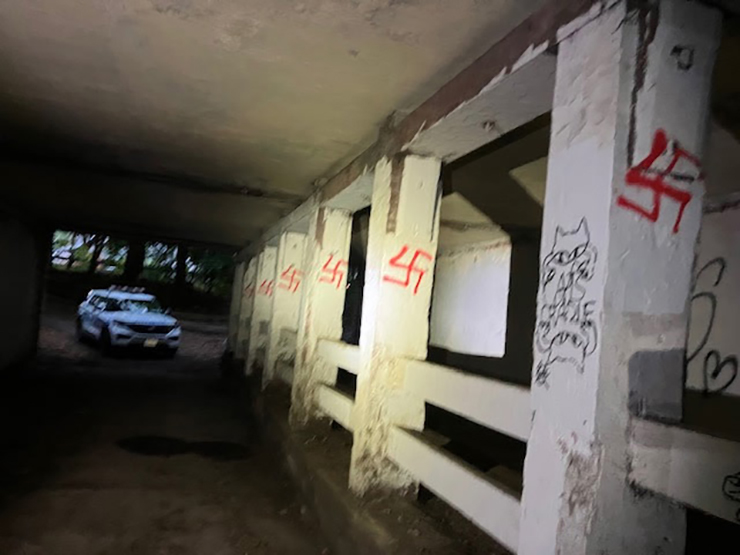
Days after Forest Hills and Rego Park were shaken by images of multiple swastikas sprayed at Jewish institutions, private residences, and a vehicle, Queens was confronted with another disturbing discovery: 11 swastikas spray-painted across Highland Park and Forest Park.
The incidents were reported on Sunday, May 10, when the NYPD responded to graffiti in the two public spaces. Five red swastikas were found near the Ridgewood Reservoir in Highland Park, close to Highland Boulevard and Vermont Place. Six additional swastikas were discovered in Forest Park, near the Bridle Path and the playground area at 72nd Road and Union Turnpike.
While the earlier incidents directly struck Jewish institutions and private property, the park vandalism carries its own painful message. Highland Park and Forest Park are shared public spaces used by families, seniors, and joggers across the borough. The appearance of Nazi symbols in these areas sends a chilling signal well beyond the walls of any single building.
According to ABC7, a bird watcher at the Ridgewood Reservoir noticed the graffiti on a fence and immediately called 911. “I was disgusted. It’s not something I’ve ever really seen around here,” he told the station.
Queens Shmira has been in direct contact with the NYPD Hate Crime Task Force and the 102nd Precinct’s commanding officer, Captain Pratima Maldonado. This communication ensures that community concerns are relayed directly to investigators as police review the incidents. The NYPD Hate Crime Task Force is currently investigating the park graffiti. As of the latest reports, no arrests have been announced, and police have not publicly established a definitive link between the park vandalism and the earlier spree in Forest Hills and Rego Park.
Still, the timing is difficult to ignore. These 11 swastikas appeared just one week after similar graffiti targeted two synagogues, two private homes, and a car. City Council Speaker Julie Menin, along with Councilmembers Lynn Schulman and Joann Ariola, issued a joint condemnation. The New York City Parks Department confirmed that the graffiti was removed immediately.
The original Forest Hills and Rego Park case also remains under investigation. To date, the most significant development has been the NYPD’s release of surveillance images and video of four individuals wanted in connection with multiple hate crime incidents. Despite the release of these images, no arrests have been made. The targeting of these locations remains particularly egregious; in one instance at Congregation Machane Chodosh, the vandalism was placed near Holocaust memorial imagery, transforming a simple act of criminal mischief into a direct attack on Jewish memory and identity.
For many in Queens—a borough home to Holocaust survivors and diverse Jewish communities including those from the former Soviet Union, the Bukharian community, and across the Diaspora—the swastika is a direct reminder of the atrocities their families endured.
The response, therefore, cannot end with cleanup. While graffiti removal is necessary, accountability is essential. These incidents require thorough investigation, visible police follow-up, and heightened security around shuls, schools, and parks. Residents are encouraged to remain alert, preserve surveillance footage, and report suspicious activity immediately. However, the burden of safety cannot fall on the Jewish community alone. Public officials and law enforcement must make it clear that swastikas in Queens will not be dismissed as minor mischief.
The question is no longer just who spray-painted these symbols. It is whether the city will respond strongly enough to ensure that Jewish New Yorkers can walk to shul, return home, and bring their children to local parks without facing the symbols of history’s darkest hatred.
By Shabsie Saphirstein