
A carton of milk can spoil before the date on its label or stay fresh for days afterward. For Rambam Mesivta juniors David Rabinow and Effie Neuman, that familiar kitchen dilemma became the starting point for BioCap, a reusable cap designed to detect signs of milk spoilage.
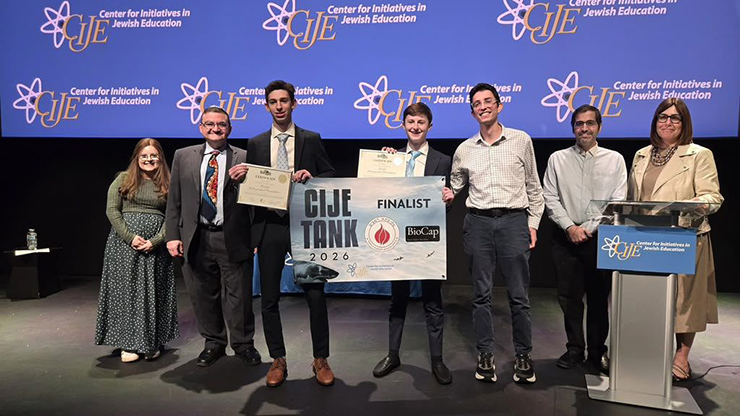
The pair presented BioCap in the final round of CIJE Tank, a national competition run by the Center for Initiatives in Jewish Education. They took third place and earned the Distinguished Presentation Award at the November 15 event, held at the Museum of the Moving Image in Queens.
Their road to the finals began in May, when BioCap took first place for Best Pitch in its judging room at CIJE Innovation Day. Neuman led the marketing effort, helping the team’s social media videos reach more than 225,000 views. Rabinow worked with Wharton alumni and startup founders who had raised funding from Sequoia Capital and Y Combinator to refine BioCap’s pitch and plan how to bring it to market.
Judges evaluated more than 500 projects from high school students nationwide. Only the top 11 advanced to the national finals, fewer than 2.2 percent of the projects judged. At the finals, a panel of entrepreneurs evaluated how well each invention worked and whether its creators could turn it into a product people would buy.
BioCap measures a change that begins when bacteria break down lactose, the natural sugar in milk, and produce lactic acid. As the milk becomes more acidic, some of the calcium phosphate held in tiny clusters of milk protein dissolves, changing how easily an electrical current passes through the milk. BioCap’s sensor looks for that shift by comparing readings over time with an initial reading from the same carton.
Rabinow spent roughly a year researching how to measure those changes. He traveled to Chicago to discuss testing methods with a University of Chicago professor and led the work on BioCap’s pending patent application.
Mazal tov to David and Effie on their achievement!