

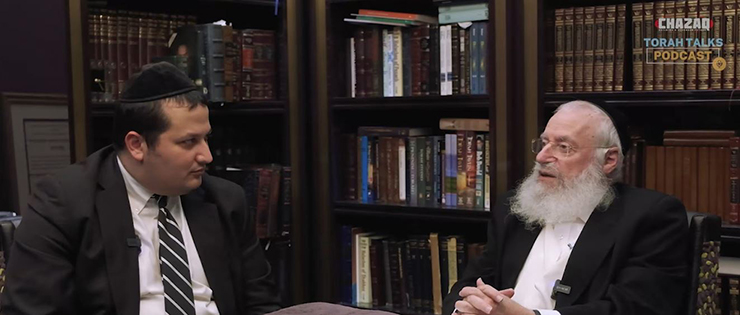
On Tuesday night, November 17, Chazaq Torah Talks featured HaGaon HaRav Asher Weiss. Robbie Aboff, Director of Operations of Chazaq, interviewed the Rav.
He first asked him about people’s concerns regarding the election results and how we should think about them.
Rav Asher Weiss responded that we are HaKadosh Baruch Hu’s chosen people. We have been through so much. We were here before other peoples and will be here after them. Our story is one of tests, challenges, and triumphs. Avraham, the first person to discover Hashem, lived a life of tests. Hashem tested him again and again, and he passed those tests, which were for all the coming generations of klal Yisrael. The ten tests covered the entire spectrum of the human condition, and we’ve been through all these challenges.
He pointed out that we can draw chizuk from looking back on all the generations. “I am a son of survivors.” We’ve been tested before. We do our hishtadlus and trust Hashem. We are His children, and things will work out. Have bitachon! Our existence is a miracle. The fact that we’re still around is a bigger miracle than coming out of Egypt and all the miracles in Israel. We’ve had so many tests in spirituality and gashmiyus, and so many movements have tested us. We came through victorious, and we’ll make it again. “Emunah and bitachon are the most important virtues.” The Gemara says you do your hishtadlus and trust Hashem, and He’ll do all the rest.
Robbie then noted that people sometimes focus too much on differences and asked how we can practically take steps to achieve a higher degree of achdus.
Rav Asher Weiss responded that we must appreciate how important achdus is, especially in times of strife. We’ve had three years of war now in Israel. Chazal say no power in the world can overcome us when we stick together. Ach’av was an evil king, but in his days there was no machlokes. They went to war and were victorious. In the generation of David HaMelech, there was machlokes, and they were beaten in war. Achdus is the greatest s’gulah.
Hashem loves when we are together and when we love each other. We need to see beauty in every different k’hilah.
In Parshas Noach, Hashem said that He would not destroy the world again because of the fallacies of mankind.
Whenever Hashem’s wrath is provoked, Hashem gives the rainbow. Chazal teach that there were 12 tribes, each with its own banner, color, and gem in the bigdei k’hunah. The beauty of a rainbow is in the different colors next to each other. The contrasts enhance the beauty of the rainbow. When we stand together, one next to the other, that is the beauty of klal Yisrael. We are composed of different communities, including different types of chasidic communities, Ashkenazic communities, and Sephardic communities. We enhance each other. You never know what is in the heart of another person, and we need to learn to appreciate and love each other. The Baal Shem Tov taught us to see the beauty in every Jew.
You can never know the tests or challenges of another person. Achdus is the most important asset that we have.
We have the esrog, which has a beautiful smell and taste. We have the lulav, which has fruit but no fragrance. We have the hadas, which has a great fragrance but no fruit, and we have the aravah, which has nothing to offer. They symbolize all the different types of Jews, and we put them all together. We are all Hashem’s children, and a father loves them all. No father will be happy when his children don’t love each other.
Next, Robbie asked how we can reach each child today in the proper way to convey the sweetness of Torah.
Rav Weiss answered that it was never as easy as it is today to be a talmid chacham. There’s an abundance of Torah literature in every language, with beautiful presentations. Hundreds of thousands of people who couldn’t learn Gemara 30 or 40 years ago are now able to learn it. There is so much beautiful literature.
Walk into an English-language frum bookstore, and you will find every classic translated with beautiful elucidations. There are so many shiurim online. People learn Daf Yomi on the way to work and on the way home.
At the same time, it was never as difficult to want to be a talmid chacham. Our children are exposed to so much today. Even in the best cases, children see different people and how much respect wealthy people receive. It’s difficult to inspire your children to want to grow in Torah and become a talmid chacham.
We need to show our utmost love and respect for talmidei chachamim. In America, we’ve come a long way with this, but we still have a long way to go. He added that the most important factor is simchah.
A flower turns to the sun because of its warmth and light. Children need warmth and happiness, and the most important factor in chinuch is warmth from parents. Children should see that there is no greater simchah than performing mitzvos and learning Torah. Children see their parents’ joy in mitzvos and Torah, and that is the most important factor in chinuch.
When a young couple is getting married, they hope their home will be a small “Beis HaMikdash.” How do you bring the Shechinah into your home? Every Jewish home could be a small Beis HaMikdash.
He taught that the Menorah in the Beis HaMikdash symbolized Torah. The Mizbei’ach symbolized avodah, and the Shulchan is like the Mizbei’ach. It symbolized g’milas chasadim. The Leviim were the gatekeepers, standing guard at every entrance of the Har HaBayis. Every Jewish home needs shomrim. It’s important what comes into our Jewish homes and what stays outside. The Leviim brought song, music, and joy into the Temple. They transformed avodah into a happy avodah. Our children need to grow up in an atmosphere of simchah. The greatest gift we can give our children is the simchah of being Hashem’s children. We need to feel grateful every moment of our lives that we are Hashem’s chosen ones.
We are the ones He chose, and that is reason enough to be happy. We hope our children will follow in our footsteps. Share simchas haTorah and ahavas Hashem. His late mother was a little girl in Auschwitz with 30 family members. They were all killed, but she survived. She ran to be with her mother, but a Nazi slapped her and threw her to the ground. When she got up, she no longer saw anyone and walked back to where she had been sent. She passed away at age 93 and left over 500 descendants who are all shomrei mitzvos. She used to say that before we recite Sh’ma, we say Hashem chose us with love. When we feel how much Hashem loves us, it’s easy to reciprocate and love Him. We emphasize that He loves us and chose us, and then we say Sh’ma. He chose us to be His family.
Robbie then posed a final question: What one message would you want to share with klal Yisrael to give us chizuk?
The Rav responded, “I talk to my beloved fellow Jews. Life is a struggle and a nisayon. We are here to serve. Whatever difficulties you face, always believe that Hashem loves you and He is with us. The most important message when people struggle with health or parnasah is that life is a journey. Real life is Olam HaBa. We’re here to get a ticket. We are entitled to enjoy the trip, but don’t lose focus. We are here to cling to Hashem. Put your trust in Hashem. Learn Torah, daven, do your mitzvos. Never forget that Hashem loves you, and He will always look after you!”
Thank you to Chazaq and Robbie for this beautiful, inspiring interview!