
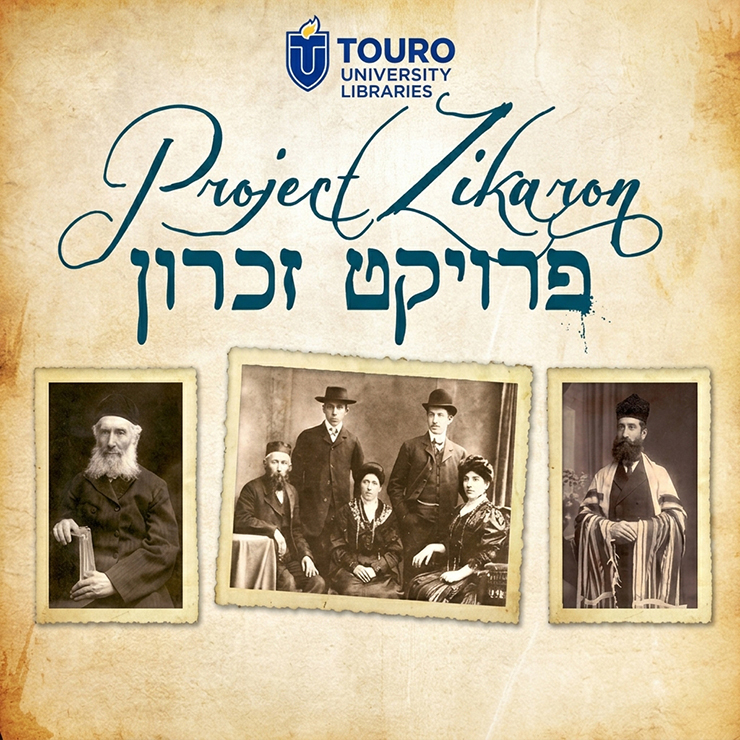
Touro University unveiled Project Zikaron, a digital archive containing more than 1.2 million pages of historical materials documenting over 16,000 Jewish communities worldwide, including thousands destroyed during the Holocaust.
Developed over more than a decade under the direction of Michoel Rotenfeld, associate director of Touro University Libraries, the archive brings together rare manuscripts, autobiographies, communal records, and other materials, many previously unavailable online, to preserve the history and cultural heritage of Jewish communities.
“We invite researchers, descendants, and historians to discover not just where their ancestors died, but the rich, complex world in which they lived,” Rotenfeld said.
Available at www.zikaron.tourolib.org, Project Zikaron, whose name means “memory” in Hebrew, contains materials in more than 30 languages, including Hebrew, Yiddish, English, and Ladino. Its collection ranges from local histories and memoirs to music, cookbooks, and cemetery records, offering glimpses of daily life across generations.
Although the archive extensively documents European communities devastated by the Holocaust, its reach is global, encompassing Sephardic, Mizrachi, and other Jewish communities worldwide. Resources cover Jewish cemeteries in Manaus, Brazil, communities in Argentina’s Pampas, and Jewish life in Uzbekistan, Afghanistan, Iran, and Philadelphia. Other materials document Jewish military cemeteries in northern France and execution sites of Nazi mobile killing units in Eastern Europe. The goal is to make this heritage accessible even to those unable to visit these places.
Users can search for a city, town, or village by its current, former, or Yiddish name, then follow links to relevant documents and, often, the exact page mentioning the location. An interactive map allows users to explore neighboring communities, while full-text search provides another way to find information.
Noted historian and Professor Marc B. Shapiro said the site helps researchers overcome information scattered across thousands of sources, often difficult to find through conventional search engines, and inconsistent spellings of place names.
“I spent a considerable amount of time exploring the various features of the website and was surprised to discover that even in areas where I considered myself an expert, new information was available at the touch of a button,” Shapiro said. “This website is an indispensable resource for anyone researching prewar Jewish communities.”
Among the archive’s holdings are more than 1,250 yizkor books, memorial volumes documenting communities destroyed during the Holocaust, digitized, made fully searchable, and indexed by the more than 4,000 locations they reference. The collection also contains over 1,200 Jewish autobiographies and memoirs and centuries-old pinkasim, or communal registers. A rare 1931 book about the Jewish cemetery in Kielce, Poland, identifies 1,422 men buried there between the 1870s and 1920s; almost all their tombstones were subsequently destroyed.
Rotenfeld said the project grew out of his lifelong fascination with firsthand accounts of Jewish communities. “I always wanted to make this wealth of information available to those for whom it would be meaningful and relevant,” he said. Building the archive required years of tracking down rare publications, borrowing materials from private collections, digitizing documents, and indexing place names. The project has received funding support from the Claims Conference.
Project Zikaron is working through diplomatic channels with governments, nongovernmental organizations, foundations, and religious groups to obtain more materials, particularly from the former Soviet Union and Muslim world. Its leaders have also conducted academic research visits and plan to continue them. New content is added regularly, an artificial intelligence-powered name index is in development, and organizers welcome information about Jewish communities not yet represented.
“Project Zikaron is not just archiving the past,” Rotenfeld said. “We are reviving the memory, the voices, and the actual stories of the people who shaped it.”