
“We will always protect you.”
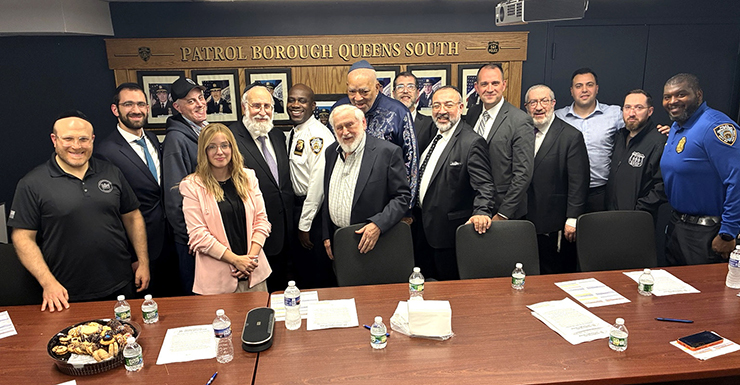
NYPD Assistant Chief Christopher McIntosh delivered that assurance to Jewish community leaders during a two-hour meeting at Patrol Borough Queens South Headquarters in Kew Gardens Hills on Thursday evening, November 5.
The discussion went well beyond promises of protection. Participants raised questions about threatening encounters, the difficulty of reporting incidents, security at shuls and schools, and what can be done to prevent young people from developing hateful attitudes toward others.
Queens Shmira joined rabbanim, community leaders, and representatives of the 101st, 102nd, 107th, and 113th Precincts. McIntosh was joined by Captain Bekim Becaj, Commanding Officer of the NYPD Hate Crime Task Force, and Hassan King, the department’s Queens South Community Ambassador.
Among those attending were Rabbi Daniel Pollack, clergy liaison to the 102nd Precinct; Rabbi Shlomo Nisanov, clergy liaison to the 107th Precinct; Menashe Friedman, representing Hatzolah of Queens and Great Neck; and Allison Deal, executive director of the Jewish Community Council of the Rockaway Peninsula. Also present were Rabbi Alex Wiener, executive director and administrator of Yeshiva Shaar HaTorah Grodno in Kew Gardens; Rabbi Lawrence Teitelman, rav of Young Israel of New Hyde Park and an officer of the Vaad Harabonim of Queens; and Rabbi Hayim Schwartz, executive director of the Rabbinical Seminary of America, among others.
McIntosh began by speaking about the special relationship between the NYPD and the Jewish community. The chief described how police deployments increase around Jewish neighborhoods, synagogues, and community gatherings during holidays and periods of heightened concern. Such deployments are intended to deter potential threats while helping residents feel secure.
McIntosh also made clear that community leaders should contact the department whenever concerns arise. If officers are overlooking something, the chief wants to know about it.
The reassurance was especially meaningful in light of the figures presented by Captain Becaj.
According to the Queens statistics discussed during the meeting, approximately 62 percent of hate crimes were anti-Jewish. Becaj described a substantial local increase, with the 107th Precinct, covering Kew Gardens Hills and neighboring communities, contributing significantly to the borough’s numbers.
The captain also reported that roughly two-thirds of the local anti-Jewish offenses involved swastikas. Approximately 23 percent of hate crimes in the borough figures presented occurred in schools, raising concerns about antisemitism among younger students.
Newly released citywide figures offer additional perspective. On November 9, the NYPD reported 279 confirmed anti-Jewish hate crimes through October 2026, compared with 268 during the same period last year. These offenses accounted for nearly 53 percent of all confirmed hate crimes across New York City.
In October alone, 26 of the city’s 45 confirmed hate crimes targeted Jews. While the numbers are disturbing, Becaj explained that many incidents involve vandalism rather than physical attacks.
Becaj explained that offensive language, even when openly antisemitic, does not automatically constitute a criminal offense. Threats, assaults, vandalism, and other unlawful conduct motivated by religious hatred may qualify as hate crimes, depending on the evidence.
Investigators also consider the circumstances surrounding an attack. A victim does not necessarily have to hear an antisemitic remark for police to determine that religious bias may have played a role.
But what happens when someone shouts a hateful remark from a passing car and disappears? Is there any value in reporting an encounter when no photograph, license plate number, or identifying information is available?
McIntosh’s answer was emphatic: Report it.
The chief would rather have officers document an incident that ultimately requires no further action than discover later that an unreported encounter could have helped investigators identify a suspect.
Becaj explained why this matters, describing an Upper West Side investigation involving an individual who repeatedly harassed Jewish residents. Early complaints initially appeared to involve offensive speech that did not meet the threshold for prosecution. However, photographs, police body-camera footage, and subsequent reports helped investigators connect several encounters involving the same person. Eventually, conduct that crossed the legal threshold allowed investigators to pursue criminal charges. The earlier complaints helped establish the broader pattern.
For someone subjected to threatening behavior, particularly when a suspect immediately disappears, filing a report may feel pointless. The discussion demonstrated why it is not.
McIntosh also addressed the reluctance some residents feel about approaching the police. Anyone encountering difficulty filing a complaint was encouraged to request a supervisor, while the chief emphasized that precinct doors remain open around the clock.
Becaj also offered a closer look at the Hate Crime Task Force, which includes approximately 20 investigators, three sergeants, Lieutenant Robert Delaney, and legal support. Two New York State Police detectives work alongside the unit to improve coordination and information sharing.
The task force also works with federal authorities and district attorneys while providing training to NYPD officers and supervisors on recognizing, documenting, and investigating possible hate crimes.
One investigation illustrated how much work can go into identifying a suspect.
Becaj discussed the repeated vandalism at Bagels & Co., a Jewish-owned kosher establishment on Union Turnpike in Fresh Meadows that prominently displayed Israeli flags.
According to Queens District Attorney Melinda Katz, Dawood Faisal allegedly damaged plant stands outside the business on two occasions in May, throwing dirt and debris toward the storefront.
Detective Patrick Lynaugh of the NYPD Hate Crime Task Force helped investigate the incidents, which resulted in Faisal’s October indictment on hate-crime charges. Investigators also examined connections to a separate fatal traffic collision involving the same defendant that claimed the life of 71-year-old Cara Trager.
Becaj praised the cooperation of the Queens DA’s Office, including Hate Crimes Bureau Chief Michael Brovner, whose team prosecutes bias-motivated offenses.
The meeting also highlighted an important security resource that many community institutions may not realize is available.
NYPD precinct crime prevention officers provide free security surveys, including assessments of synagogues, schools, and other facilities. Officers examine entrances, locks, lighting, surveillance systems, and potential vulnerabilities, then recommend improvements.
These assessments may also help institutions identify improvements for which they can seek state or federal security funding. Schools and shuls were encouraged to contact their local precinct crime prevention officers rather than wait until something happens.
The conversation then moved from investigating antisemitism to preventing it.
Becaj expressed particular concern about young people encountering hateful material through social media without understanding its meaning or history. The captain described incidents involving students who displayed swastikas but appeared to have little understanding of what the symbol represented.
Participants discussed bringing Holocaust education directly into schools and finding ways to reach students who might otherwise have limited exposure to Jewish history.
Among the programs mentioned was The Blue Card’s interactive Holocaust education presentation featuring survivor Sonia Warshawski. Using recorded survivor testimony and hologram technology, students can ask questions and receive responses drawn from her experiences. The program is available to schools and community organizations at no cost.
The Simon Wiesenthal Center’s Mobile Museum of Tolerance, which brings educational presentations to schools through a traveling classroom, was another initiative discussed.
Several participants also emphasized the importance of relationships between Jewish and Muslim communities.
One rabbi described educational exchanges between neighboring Jewish and Muslim schools, where students learn about one another’s traditions while school security personnel cooperate on everyday safety concerns.
Hassan King was recognized for his efforts to maintain relationships across religious and ethnic communities throughout Queens South.
The discussion also returned to the importance of visible police protection. Community representatives expressed appreciation for the additional officers deployed during Jewish holidays and periods of heightened concern, particularly when demonstrations or threats raise anxiety near local institutions.
The meeting gave Jewish community leaders an opportunity to speak openly about their concerns and hear the NYPD’s response firsthand.
By Shabsie Saphirstein