
From a real Parker family to the Jewish roots of a comic-book legend, Queens honors its most famous fictional resident
For more than six decades, Spider-Man has swung between Manhattan skyscrapers, battled villains, and captured imaginations worldwide. Yet through countless comics and films, the superhero has maintained one constant: his roots in Forest Hills.
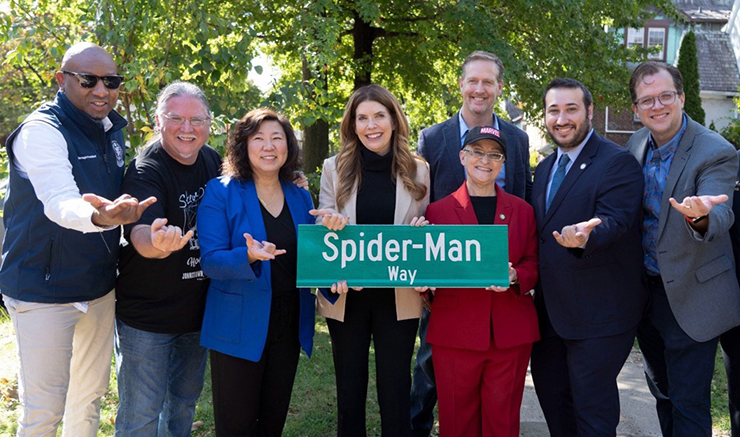
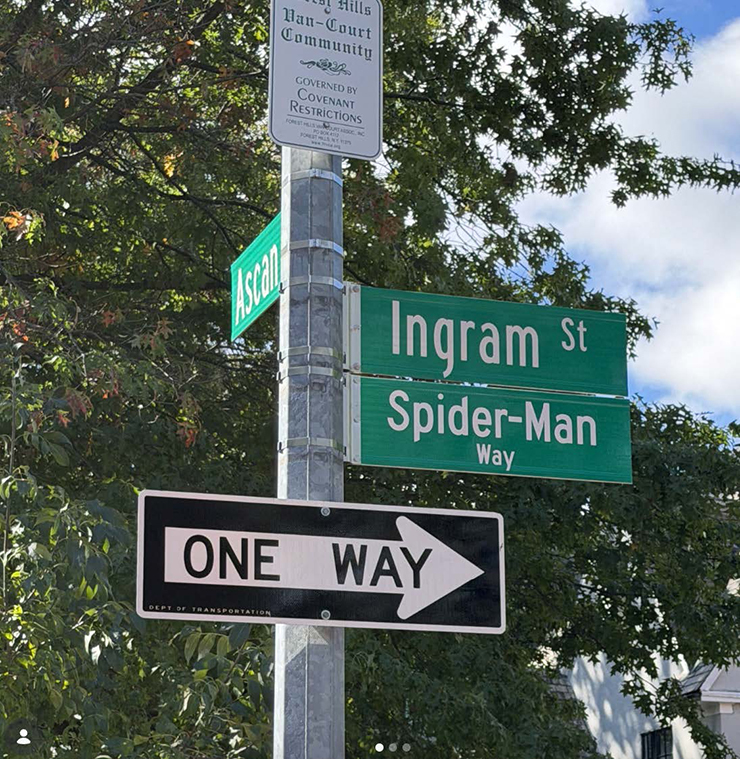
On Monday, October 12, elected officials, Marvel representatives, relatives of Spider-Man co-creator Steve Ditko, and neighborhood residents gathered for the unveiling of Spider-Man Way at Ingram Street and Ascan Avenue.
The ceremony, hosted by City Council Member Lynn Schulman and Assembly Member Sam Berger, included Congresswoman Grace Meng, City Council Speaker Julie Menin, Queens Borough President Donovan Richards, Queens District Attorney Melinda Katz, Assembly Member Andrew Hevesi, and State Senator Leroy Comrie. Marvel’s Spider-Man executive editor Nick Lowe and Steve Ditko’s nephew, Mark “Zen” Ditko, also attended.
The location was particularly fitting. Just steps away stands 20 Ingram Street, identified in a 1989 comic book as Peter Parker’s home. Remarkably, the real house was already occupied by a family named Parker, who eventually began receiving letters addressed to Spider-Man from children around the world.
The honorary designation followed legislation introduced by Schulman at Berger’s suggestion. Approved by the City Council on June 30, it became law on July 30, with the public unveiling taking place October 12.
Schulman described Spider-Man as a reminder that ordinary people can accomplish extraordinary things through service to others.
For Berger, the occasion held personal meaning. He recalled purchasing his first Spider-Man comic in 2013 at Royal Collectibles on Metropolitan Avenue.
Berger emphasized that Spider-Man’s greatness lies not in his extraordinary abilities but in choosing to help others. Reflecting on the principle that great power brings great responsibility, he explained that doing what is right matters even when there is no recognition or reward.
He connected that lesson to his father, grandparents, and generations of families who built Forest Hills through hard work and commitment to their neighbors.
Mark “Zen” Ditko shared memories of his uncle’s creative vision, explaining that Steve Ditko carefully designed Spider-Man’s appearance, movements, and surroundings to make Peter Parker believable and relatable.
Richards brought humor to the celebration, observing that Philadelphia has Rocky and London has Sherlock Holmes, while Queens has Spider-Man. “Before he belonged to Spider-Man fans around the world, Peter Parker belonged to us first in Forest Hills, Queens,” Richards declared.
Katz recalled growing up near the real Parker family on Ingram Street and the neighborhood’s amusement at the coincidence. Menin highlighted Spider-Man’s courage and willingness to help others, while Meng reminded attendees that Queens itself is filled with everyday superheroes.
As the covering came off the green Spider-Man Way sign, families cheered and posed for photographs beside reproductions of classic comic-book artwork.
Spider-Man debuted in August 1962 in Amazing Fantasy No. 15, created by writer Stan Lee and artist Steve Ditko. Unlike many superheroes, Peter Parker was an awkward teenager struggling with school, finances, and family responsibilities.
His Forest Hills roots appeared early in the comics, while the specific 20 Ingram Street address was introduced in 1989.
The real-life Parker family had moved there in 1974. Over the years, children mailed letters, drawings, and requests for autographs to Spider-Man at the address. The family preserved many of these letters, which were featured in the City Reliquary’s 2023 exhibition, Dear Spider-Man, Letters to Peter Parker.
Spider-Man’s history also carries a meaningful connection to Jewish New York.
Co-creator Stan Lee, born Stanley Martin Lieber in Manhattan in 1922, was the son of Romanian Jewish immigrants. Growing up during the Great Depression, Lee understood financial hardship and the struggles of ordinary families.
Peter Parker’s self-deprecating humor, anxieties, and strong sense of responsibility have led many readers to recognize elements of Jewish New York culture in the character, although Spider-Man was not explicitly created as Jewish.
The 2018 animated film Spider-Man: Into the Spider-Verse included a Jewish wedding custom, showing an alternate Peter Parker breaking a glass. Co-director Rodney Rothman, who grew up Jewish in Forest Hills, helped bring that cultural connection into Spider-Man’s screen history.
More significantly, Spider-Man’s guiding principle recalls the Jewish values of areivus, mutual responsibility, and gemilus chasadim, acts of kindness. His willingness to help others despite personal sacrifice reflects the importance of doing what is right, even when doing so is difficult.
That message echoed throughout the dedication, as speakers emphasized moral responsibility, community service, and the extraordinary impact of ordinary people.
Forest Hills has long celebrated its cultural legacy, including Paul Simon, Art Garfunkel, and the Ramones. Spider-Man Way now honors another famous figure whose connection to the neighborhood has endured for generations.