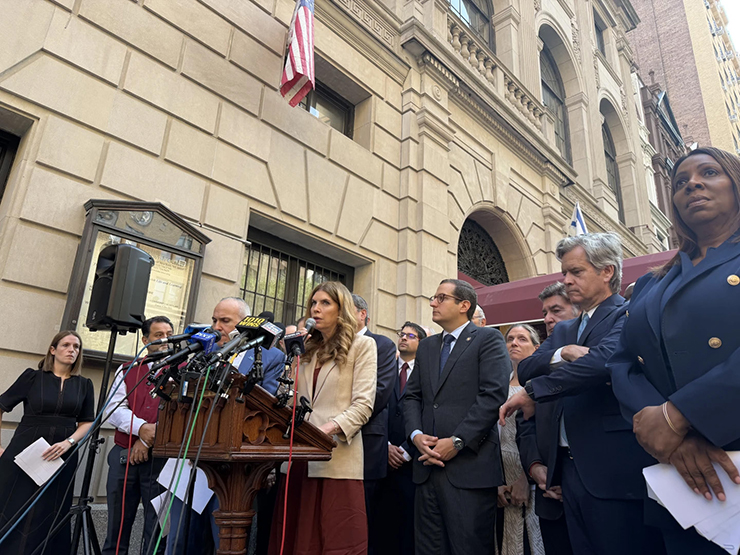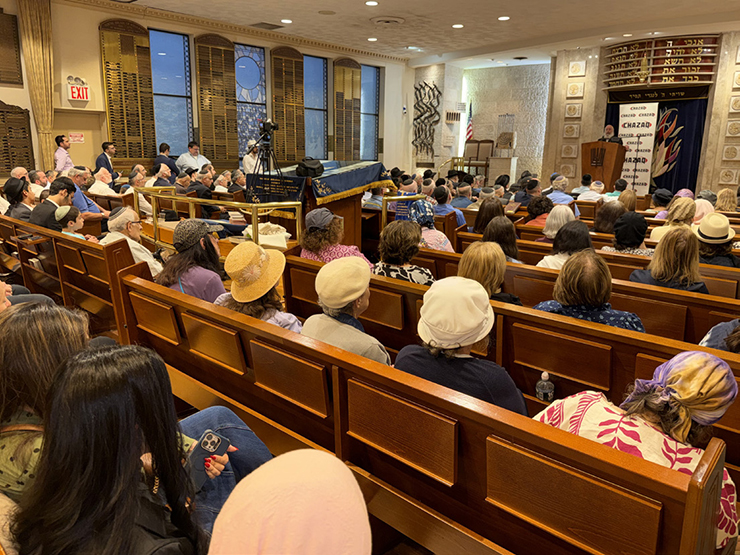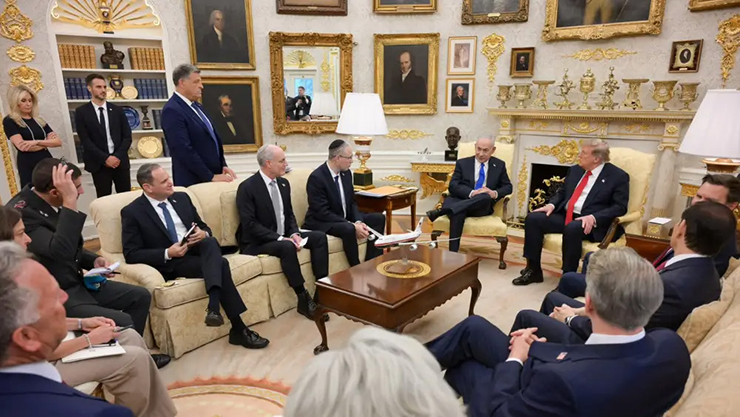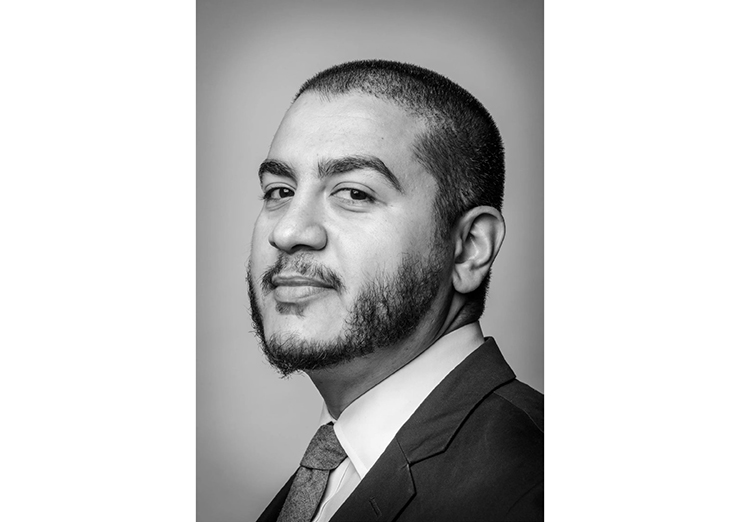
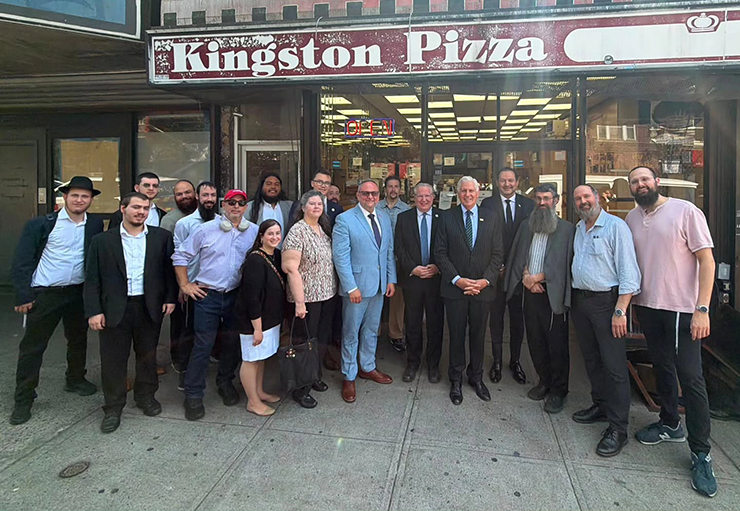

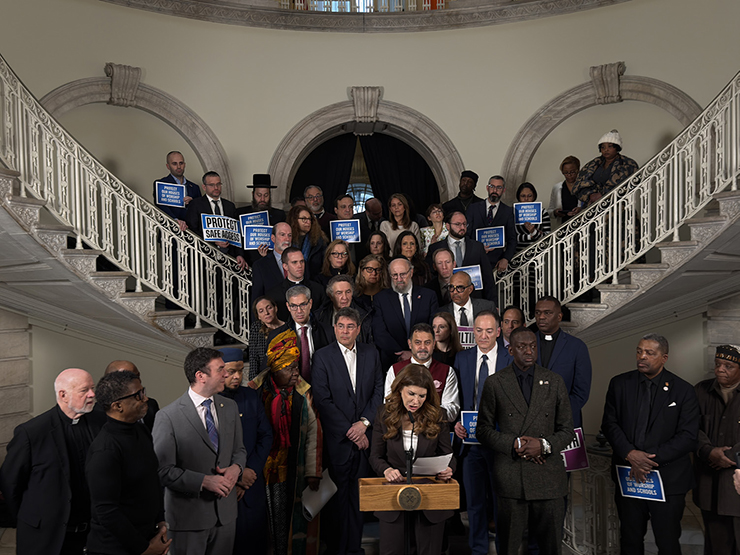
On February 25, community leaders from Queens gathered at City Hall for a lengthy hearing of the New York City Council’s Committee to Combat Hate, bringing the experiences of Jewish neighborhoods directly into the debate over how the city should protect houses of worship during protests. For those of us who traveled from Queens that morning, the issue was not an abstract policy discussion; it reflected events that have already unfolded on the streets of our own communities.
The day began with a press conference inside the City Hall Rotunda. Among those present was District Leader Shimi Pelman, who had come from Queens to attend before addressing the Council during the hearing itself. Outside, however, the atmosphere was markedly different. On the front steps of City Hall, protesters gathered in opposition to the legislation. Many were the same activists who had previously demonstrated outside Park East Synagogue and in Kew Gardens Hills. Although their presence was lawful, the moment was deeply unsettling. These were familiar voices – individuals who had already confronted Jewish gatherings in our neighborhoods. Seeing them again, just beyond the doors of City Hall, was a stark reminder of why so many Queens residents had come to testify.
The hearing focused on Intro. 1-A, legislation introduced by Council Speaker Julie Menin requiring the NYPD to formalize procedures for establishing security perimeters – often referred to as “buffer zones” – outside houses of worship and schools when protests occur nearby. The goal is to ensure that congregants can safely enter and exit religious institutions while preserving the constitutional right to protest.
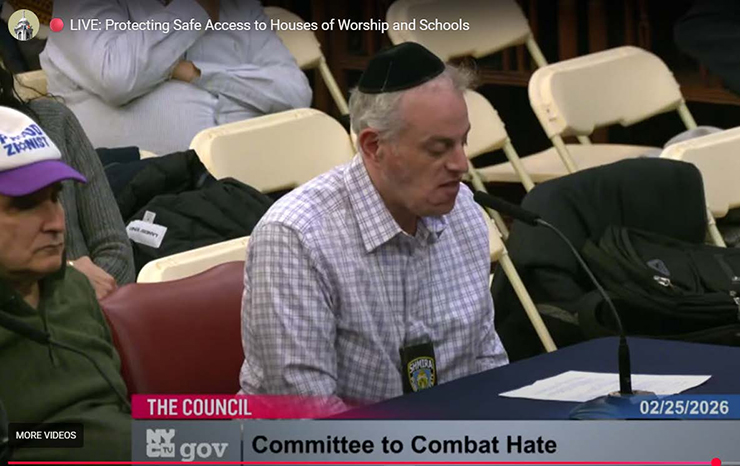
Queens voices played a prominent role throughout the proceedings. Barry Grodenchik, president of the Queens Jewish Community Council, spoke about the impact demonstrations outside synagogues can have on the sense of security within Jewish neighborhoods. District Leader Pelman described the concerns he hears regularly from families throughout central Queens who have watched protests unfold outside Jewish institutions in the months since October 7.
Community advocate Alan Sherman offered a legal perspective, explaining that protecting houses of worship and protecting free speech are not mutually exclusive principles. Sorolle Idels, chairperson of the Queens Jewish Alliance, testified about the emotional toll these confrontations have taken. Having come directly from a family simchah that morning, she described how unsettling it has been for Jewish residents to encounter aggressive demonstrations outside events. Idels stressed that the issue is about ensuring that demonstrations do not turn into intimidation directed at people entering houses of worship.
Several speakers joined the hearing remotely. Chazaq’s Israel Peskowitz testified via Zoom from the location in Kew Gardens Hills where a protest had taken place. Chaskel Bennett, a leader with Agudath Israel of America, described the fear and anxiety many Jewish communities have experienced since the Hamas massacre in Israel. Leaders of major Jewish organizations added their perspectives, including Mark Treyger of the JCRC, Scott Richman of the ADL, and Hindy Poupko of UJA-Federation. Rabbi Yeruchim Silber, director of New York government relations for Agudah, stressed that Jewish communities only ask for the ability to practice their faith without intimidation.
One of the most powerful moments of the hearing came when Devorah Halberstam addressed the Council. Her son, Ari, was murdered in a terrorist attack on the Brooklyn Bridge in 1994. During her testimony, she asked that the blinds in the chamber be opened, revealing the bridge itself in the distance. For me personally, it was especially moving. When the window shades rose and the bridge came into view, a quiet solemnity filled the chamber. It was a reminder that the issues being discussed were not theoretical; they are rooted in real loss.
State legislators also participated remotely from Albany. Assembly Member Sam Berger and Assembly Member David Weprin joined the hearing via Zoom along with Assembly Member Jeffrey Dinowitz of the Bronx.
Later in the hearing, I addressed the committee as a resident of Kew Gardens Hills and as the Community Outreach Coordinator for Queens Shmira. Drawing on firsthand experience, I described the pro-Hamas protest that took place in Central Queens outside an educational event. Because of safety concerns, the NYPD’s 107th Precinct deployed a significant police presence, while Shmira volunteers assisted with communication.
What many residents heard that evening was chilling. Demonstrators chanted, “We are Hamas and we’re here to stay.” For Jewish residents still grappling with the trauma of October 7, those words did not sound like political slogans; they sounded like threats. At the same time, the events in Kew Gardens Hills demonstrated how the right balance can be achieved when law enforcement manages protests responsibly. During that demonstration, the NYPD established the protest area diagonally across from the Young Israel of Kew Gardens Hills. The arrangement allowed demonstrators to express their views while ensuring that the shul and school themselves were not placed at risk.
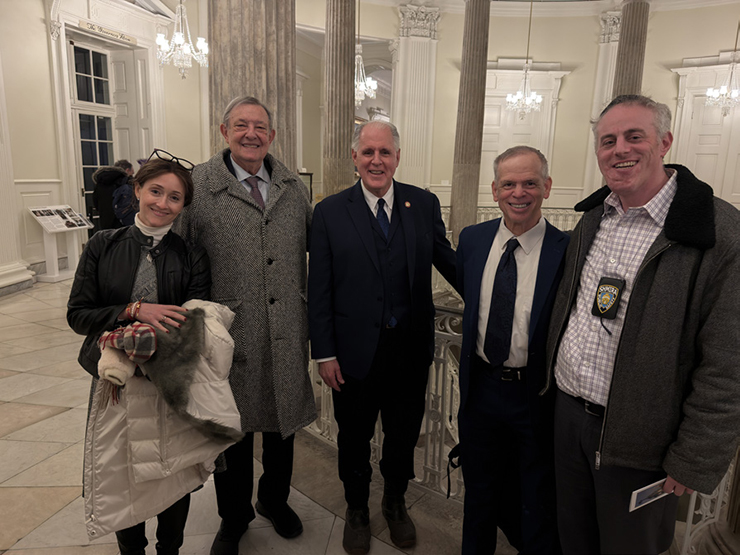
Following Sherman’s and my testimony, Council Member James Gennaro, whose district includes Kew Gardens Hills, addressed the chamber and acknowledged the work of community volunteers. Despite the intense opposition voiced by protesters throughout the hearing, many members of the City Council expressed strong support for protecting access to houses of worship. Members of the Council’s Jewish Caucus – including Council Member Lynn Schulman of Forest Hills – have also been active in addressing anti-Semitism and supporting measures aimed at protecting Jewish institutions.
By the time the hearing concluded late in the evening, it had been a long and emotionally charged day. Shortly afterward, I traveled with my friend Yosef Noy to the Ohel of the Lubavitcher Rebbe in Queens. While there, I visited Ari Halberstam’s kever, thinking about his mother’s decades of advocacy and the solemn moment she created in the hearing chamber. Standing there, I davened that Ari should continue to be a meilitz yosher for the Jewish people.
The message brought to City Hall by Queens residents was clear. In our neighborhoods, shuls are not political symbols. They are where families pray, celebrate, and mourn together. Ensuring that people can enter those buildings without intimidation is a matter of dignity, safety, and the simple freedom to live openly as Jews in New York City.
By Shabsie Saphirstein