
The sukkah refused to fall. For two years in a quiet backyard in Alfei Menashe, it stood through wind and rain—the temporary shelter that Ilan Dalal and his son Guy had built together for Sukkos, left untouched as a silent tefillah. Before driving off to the Nova music festival in October 2023, Guy had told his father, “Wait for me, Abba. We’ll take it down together when I get back.” This week, that promise echoes thousands of miles away in South Florida, where Miami Beach and its leaders are opening their arms to Guy and his childhood friend, fellow former hostage Evyatar David, turning their arrival into a moment of kavod, chizuk, and remembrance for all the hostages.
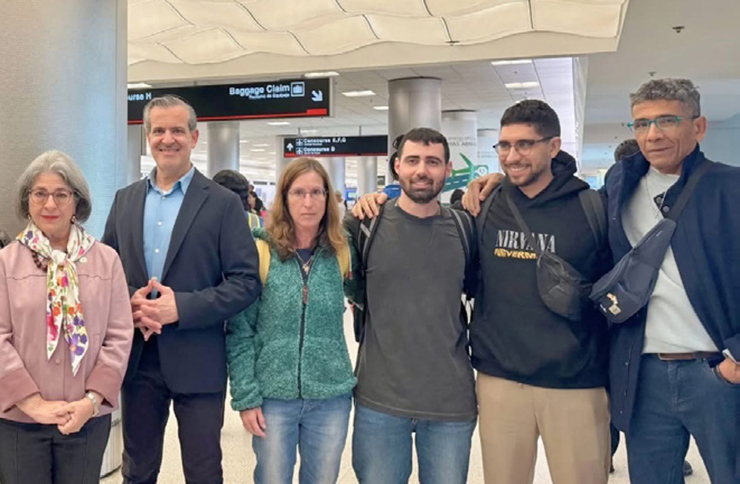
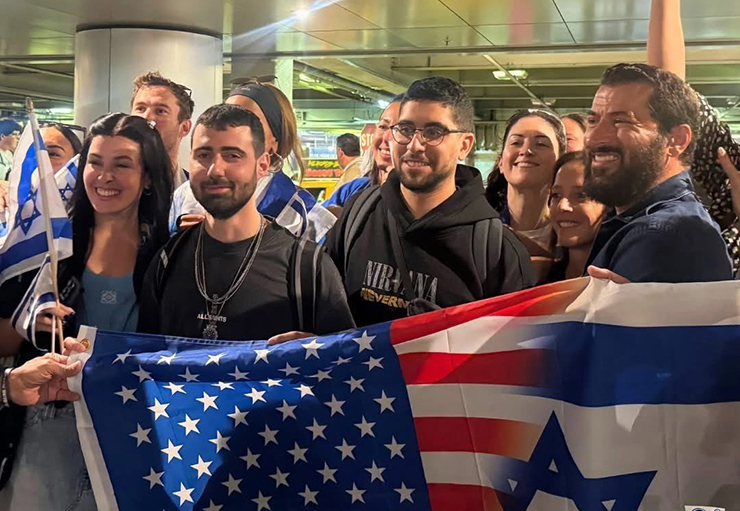
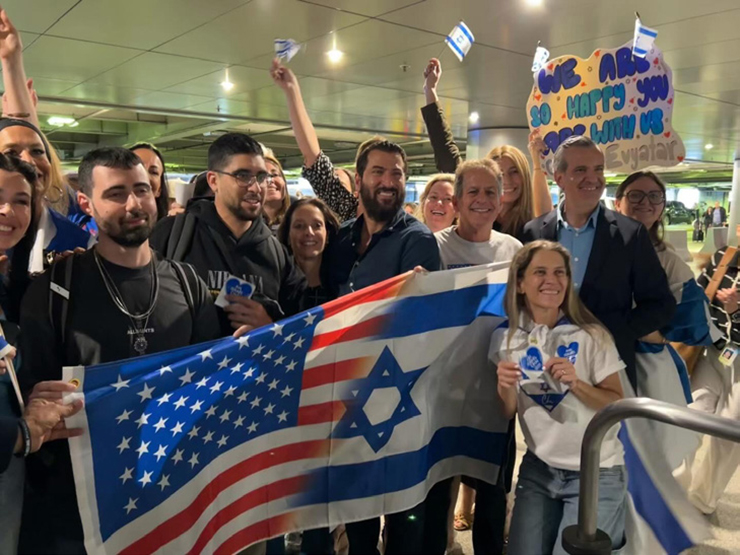
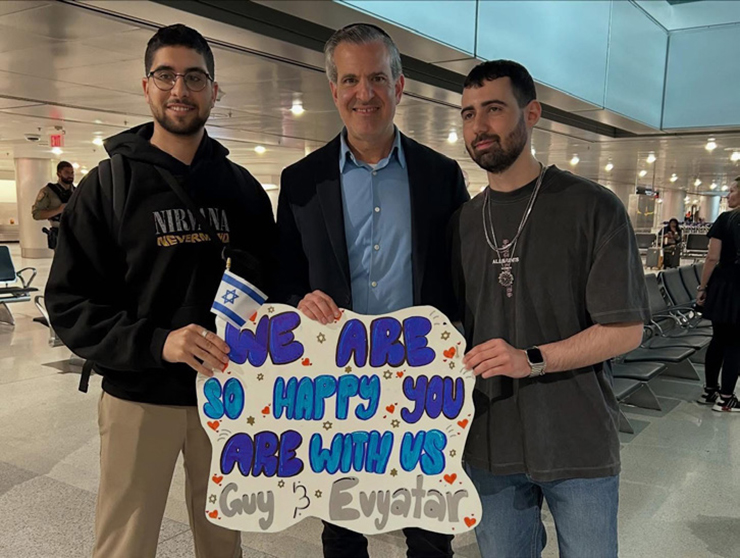
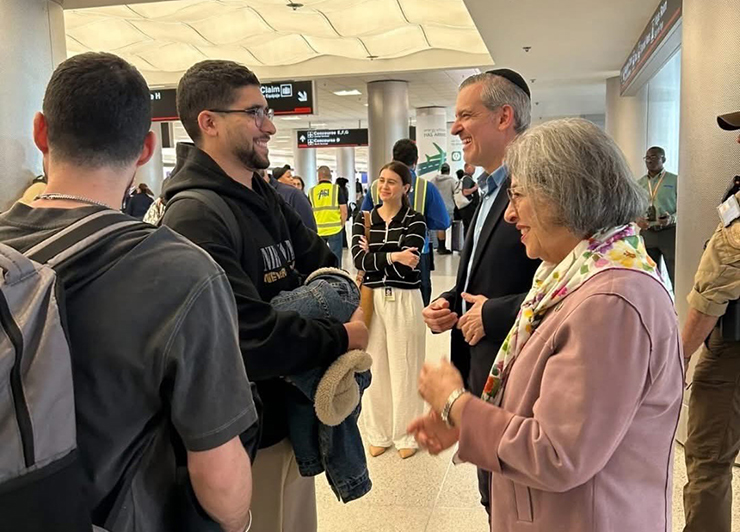
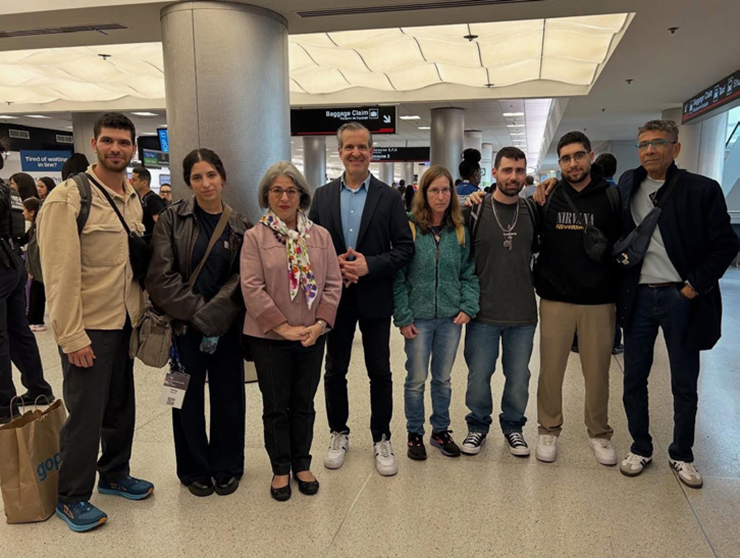
On Friday morning, November 21, 2025, Miami International Airport became the latest scene in their story. Miami Beach Mayor Steven Meiner, freshly re-elected, stood alongside Miami‑Dade County Mayor Daniella Levine Cava to greet the two young men. The mayors spoke not only as officials but as parents and as members of a community that cares—expressing relief that Guy and Evyatar were finally free, admiration for their strength, and a clear message that Miami Beach stands with Israel and with the families of those still in captivity. The emotion in the terminal was visible: some waved small Israeli flags, others wiped away tears, and many simply watched in silence as two survivors who had spent 738 days in darkness walked into the light of an American airport.
To understand what that moment in Miami means, one has to go back to the desert near Kibbutz Re’im. On October 7, 2023, as dawn broke, thousands of young Israelis were still dancing at Nova, a night of pure simcha. Among them were two friends from Kfar Saba: 23‑year‑old Guy, who loved anime and dreamed of visiting Japan, and 24‑year‑old musician Evyatar, who played guitar and piano and hoped to go into music production. The music pounded, the sky lightened—and then the rockets came. “They are bombarding the party,” Evyatar texted his family, as chaos spread. Young people ran to their cars, trying desperately to escape, unaware that Hamas terrorists lay in wait on the roads out. Guy, Evyatar, and their friends Bar Kuperstein and Omer Wenkert were seized, thrown into a truck, and driven across the border. Behind them, hundreds of their fellow festival‑goers were left dead in the sand; Guy’s younger brother Gal, also at Nova, survived by hiding for hours until rescue forces arrived. He went home. Guy did not.
In Gaza City, the nightmare deepened. When the truck doors opened, a mob awaited them. “Yahud aseer! Khinzeer!,” came the shouts—Jewish prisoners, pigs. The hostages were paraded through the streets like trophies, dragged from one intersection to the next. At every stop, civilians swarmed them with punches, kicks, and spitting, until shots fired in the air forced the crowd back and the truck lurched onward to repeat the spectacle. Guy would later speak about this “parade” in a flat, distant tone, as if describing someone else’s life. It was no random brutality; it was a carefully staged humiliation, designed to begin breaking them even before they vanished underground.
Beneath Gaza, the four young men found themselves in a cramped tunnel about 1.8 meters high. There, Guy, Evyatar, Tal Shoham, and Omer Wenkert learned to fold their bodies and their lives into ever‑smaller spaces. Their captors ate well; the hostages could smell hot food and hear the sounds of satisfied men. For them, there was only calculated hunger: a single piece of pita each day, sometimes with the barest accompaniment. Guy described the system they devised to stay alive: they would put aside the day’s portion, waiting until they saw the next day’s food arrive before eating the previous one, even though it was already spoiled. In that way, they tried never to be completely without food, hovering in a limbo between true starvation and a life that barely qualified as living.
The halachic principle of pikuach nefesh—preserving life above almost all other mitzvos—took on a raw, literal reality. They ate in darkness, hands and feet often bound, bags over their heads, unable to see what they were putting into their mouths. Once a month, they were allowed a “shower”—a bucket of water. On the first day of captivity, Evyatar’s glasses were taken from him, and for the next 738 days the world remained a blur. A camera watched them almost constantly, stripping away privacy. Yet even there, Guy found a quiet form of resistance. When the lens focused his way, he imagined that somewhere his family and his future children were watching. In his mind, he became a father giving a lesson: this is how you survive; this is how you stay strong. What was meant to dehumanize him became, in his imagination, a hidden act of chizuk to those he loved and to generations not yet born.
In August 2025, the world caught a glimpse of what had been done to them. Hamas released a video of Evyatar that shocked even seasoned observers. Gone was the healthy young man who had once danced at festivals; before the camera stood a figure that might have stepped out of black‑and‑white photos from the camps. His family used the haunting word muselmann, the Yiddish‑German term once used for prisoners so starved they hovered between life and death. Seventy‑five years after the Holocaust, a Jewish boy was again being deliberately starved, this time on video. In the footage, Evyatar is forced to dig what is clearly meant to be his own grave. “I have not eaten in days,” he says numbly, as a well‑fed Hamas arm reaches into the frame, offering a can of food—a cruel performance of “mercy” that deepened the horror.
What the camera did not show was that Guy sat just behind the curtain, in the same skeletal state. His muscle mass had wasted away to the point that his shoulders would no longer obey him. He later described how even going to the bathroom had become a joint effort. “When I went to the bathroom, he would cover me against the cold,” Guy recalled. “He’d use wet wipes on areas I couldn’t reach—around the armpit—because I lacked the energy to lift my shoulder.” Two childhood friends who had once dreamed together of trips and careers were reduced to this: one literally keeping the other clean because that was what survival now required. In Alfei Menashe, Ilan and Merav Dalal woke each day, as Ilan put it, with “a big hole in our heart.” Yet they drew strength from the knowledge that Guy was counting on them to be his voice. “We are his voice,” Ilan told a crowd in Yerushalayim, his own voice breaking. And so the sukkah stayed standing, season after season, a silent protest and a stubborn tefillah that their son would come home to finish what he had begun.
There was another layer of suffering that most would never have spoken about. In our siddur, the moment of vidui teaches us that there is kedushah in naming hard truths. Days after he was freed, Guy chose to do just that. He revealed that one of his guards had repeatedly isolated him, tied his hands to a chair, covered his eyes, made degrading remarks about women and improper images, and then behaved toward him in a deeply inappropriate and invasive way. When Guy froze in terror, the guard pressed a rifle to his head and a knife to his throat, warning that if he ever told anyone—fellow hostages or other guards—he would be killed. A second episode came after a rare shower, when Guy was dragged, still undressed, into the captors’ room and subjected to another act of intimate violence. After that, he lived with a constant additional fear: if he were ever left alone, such abuse might become regular, or far worse. The same guard later forced Omer Wenkert onto all fours “like a dog,” threw Guy on top of him, and beat them both. These incidents were not just physical attacks; they were calculated attempts to shatter neshamos as well as bodies. When Guy finally spoke, Israeli President Yitzchak Herzog publicly praised his courage in exposing what he had endured and in giving testimony so soon after his release.
Through all of this, one phrase keeps returning on Guy’s lips: “We were each other’s anchor.” He and Evyatar, friends from Kfar Saba who had served together and driven to Nova together, became each other’s lifeline underground. For more than two years, that bond stood between them and despair. On day 505 of their captivity, in February 2025, another video was released. This time, it showed three other hostages—Omer Shem‑Tov, Eliya Cohen, and Omer Wenkert—being freed. In the background, thin and hollow‑eyed, stood Guy and Evyatar, watching their friends walk toward the tunnel entrance and disappear into the light. The door closed. They remained behind. Later, Omer would describe how emunah had sustained him, how each morning he thanked Hashem for air in his lungs and something to eat, and how every Friday he made Kiddush in the tunnels. For Guy and Evyatar, especially after they were separated for the final stretch of their captivity, emunah became woven with memory—of each other, of their families, of that sukkah still standing in a backyard.
On October 13, 2025, as part of President Donald J. Trump’s Gaza peace plan, the tunnel doors finally opened for them. After 738 days beneath the earth, Guy Gilboa‑Dalal and Evyatar David emerged into daylight. At Rabin Medical Center in Petach Tikvah, the childhood friends were reunited, frail and thin but alive, clinging to one another. One photograph, now etched into the hearts of many, shows Evyatar collapsing into his parents’ arms, his mother Galia’s face an indescribable blend of agony and joy. Two weeks later, both young men were discharged from the hospital. Guy went home to Alfei Menashe, where Ilan waited by the sukkah that had stood in silent testimony for two full years. Father and son, at last together again, took it down plank by plank. It was two years late, but the promise had been kept.
From that backyard in Israel to the terminal in Miami, their journey has become a bridge between communities. In Miami Beach, Mayor Meiner and Mayor Levine Cava have made it clear that their welcome is not a one‑day photo op but part of an ongoing commitment: to give these young men space to heal, to give the Jewish community a way to stand with them, and to keep the plight of those still in Gaza front and center. For local families who have been davening for the hostages for two years, seeing Guy and Evyatar in person transforms distant headlines into living, breathing reality.
Today, Guy still loves anime and still dreams of Japan. Evyatar still loves music and still hopes to produce albums and travel. But they are no longer the same boys who left for a festival on a Thursday night. You do not endure 738 days of hunger, terror, and degradation and emerge unchanged. You do not watch your best friend help you with the most basic tasks because your body has forgotten how to obey you, without learning forever what real vulnerability—and real friendship—means. Guy has said that things he once took for granted now feel like treasures: every Shabbos meal with family, every ordinary moment that once looked so small.
The Dalal family’s sukkah is finally down, but its message lingers. A sukkah is, by design, temporary. It reminds us that all shelters are fragile, that we are always, on some level, exposed, and that our true protection comes from Above. In their backyard in Alfei Menashe, that fragile structure stood for two extra years as a living tefillah and an act of hope. Guy and Evyatar are home, but dozens of hostages still remain in Gaza. Their families keep their own vigils, building, in heart and deed, their own sukkos of hope.
In Miami Beach, two mayors welcomed two survivors walking through an airport concourse. It was not a grand diplomatic summit. It was two young Jewish men, alive, taking step after step after 738 days in darkness. For them, for their families, for the Jews of Miami Beach and for klal Yisrael watching from afar, that in itself is everything. And in the tunnels of Gaza, in that long night when their bodies failed and hope seemed impossibly distant, the anchor they were for each other held fast. It still does.
By Shabsie Saphirstein