Before He Was Prime Minister: Philadelphia Magazine Revisits Bibi’s Teen Years
Israeli Prime Minister Benjamin “Bibi” Netanyahu grew up in West Jerusalem but spent his high...
 Queens Jewish Link
Connecting the Queens Jewish Community
Israeli Prime Minister Benjamin “Bibi” Netanyahu grew up in West Jerusalem but spent his high...

The posuk refers to one who “slaughters outside the camp.” Homiletically, if a person speaks negatively of others, destroying his character and “slaughtering” the reputation and honor of another person, he will have to answer for this misdeed.
R’ Matisyahu Salomon, shlit’a, says that one cannot be a believer (ma’amin) unless he is first faithful (ne’eman). One cannot believe in the Torah and the word of Hashem unless he himself is a person who values a word. If it means nothing when I say something, then when Hashem says something, why should I believe it? The more trustworthy a person is and the more meticulous he is about his own words, the more he will be faithful to the word of the Almighty.
It is well known that when people visited R’ Chaim Kanievsky, zt”l, to receive a berachah or ask a shailah, he would often tell them to either cut their hair short or grow their beard. He also instructed people to wear their payos out, rather than tucked behind their ears.
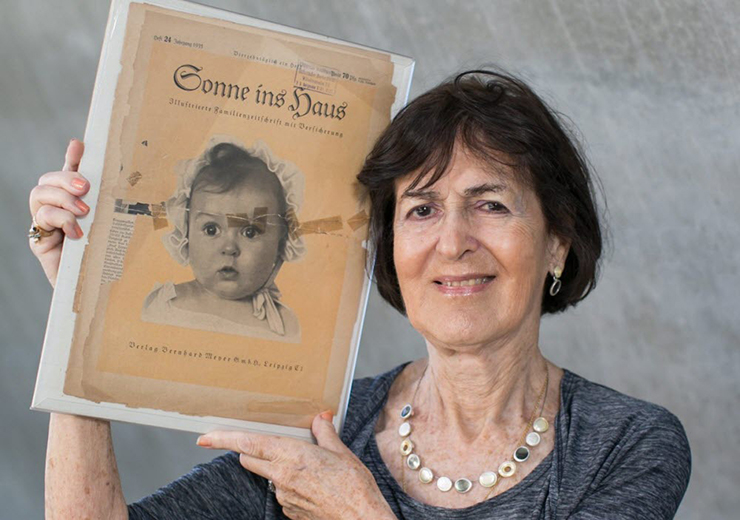
In 1935, the Nazi drive to isolate and demonize the Jewish people was soaring to new heights. A series of decrees known as the Nuremberg Laws made brutal distinctions between Aryans and non-Aryans: Jews, Roma, and Black people. Overnight, German Jews were stripped of their citizenship, forbidden from holding government jobs, and restricted from public spaces lest they “infect” Aryans. A key driver of this pseudo-racial propaganda was a magazine called Sonne ins Haus, or “Sunshine in the Home,” which promoted the Nazi myth of Aryan perfection and non-Aryan pollution. In 1935, the magazine ran a contest across Germany to find the perfect Aryan baby. Ten famous portrait photographers were asked to submit ten portraits of beautiful German babies. Joseph Goebbels, chief propagandist of the Nazi party, would judge the winner himself.
It was the winter of 5716 (1956), immediately following the Sinai Campaign, when Israel took control of the Sinai Peninsula from imperialistic Egyptian advances. Poland and the Soviet Union had just signed a treaty allowing all Polish citizens who had fled to Russia during World War II to return to Poland. Jewish or not, they had the right to return, as long as they were Polish citizens on September 1, 1939, the day the Second World War broke out. As a result of this treaty, thousands of Jews throughout Russia returned to Poland, and the majority of them subsequently immigrated to Israel.
The yeshivos in Europe were unlike the yeshivos in our days. Today, the yeshivos take full care of all the needs of the bachurim, but it wasn’t so in Europe. The yeshivos didn’t have dormitories; most bachurim were far from home, and so boys would sleep on the benches in the local shul. Even then, the benches weren’t enough for all the boys; often only the older bachurim had the privilege of sleeping on a bench! The younger bachurim had to sleep on the floor.