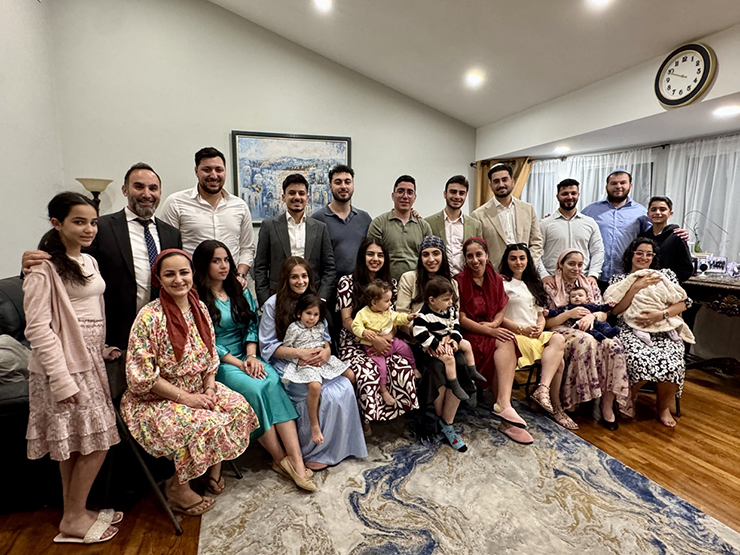

I am blessed to have three wonderful brothers-in-law, each of whom I enjoy spending time with, though they are very different from each other.
One of the attributes of my brother-in-law Baruch is that he is a doer. He doesn’t have patience for wasting time, and when there’s something that needs to get done, it’s as good as done. This is true even in how he performs mundane household tasks.
Our families spent a wonderful Shabbos together a couple of weeks ago to mark the yahrzeit of our father-in-law. These days, sourdough challah has become a basic staple in many homes, and we had one as well. Baruch cut the sourdough challah with precision and intense alacrity, the likes of which I have never seen before.
This past Shabbos in my home, we also had a sourdough challah. I began to cut it with the image of Baruch cutting the sourdough challah a week prior in the back of my mind. In my subconscious, I was singing a redacted version of the new TYH song “I Wanna Be Like Zusha” to the words, “I wanna be like Baruch cutting the sourdough.” I was doing pretty well until I cut my finger. At that point, I became so annoyed that I announced that there will be no sourdough challah next week (or any other challah for that matter).
In the Haggadah, we quote the pasuk from the prophet Yechezkel: “And I said of you, in your blood you shall live! And I said of you, in your blood you shall live.” Chazal say that the double mention of blood refers to the merit of the two mitzvos involving blood that our ancestors performed just prior to the Exodus: the blood of circumcision and the blood of the Korban Pesach.
Why were these two difficult mitzvos commanded at that juncture?
There was once an impoverished man who entered a convenience store and used his last dollar to purchase a lottery ticket. The next day, he found out that he was the sole winner of the $10-million jackpot. The only problem was that he had to pick up his winnings from an office in the city. He had an old jalopy but didn’t have enough gas to get all the way to the city. He went to a neighbor and asked if he could borrow $30 to fill up his car with gas. The neighbor looked at him incredulously: “Why would I lend you that money? You’ll never be able to pay it back!” The man replied, “Actually, I’ll pay you back triple the amount. That won’t be an issue when I get there. The only problem is that I need the means to get there to claim the jackpot waiting for me.”
At the time of the Exodus, klal Yisrael hit the jackpot. They were destined to receive the Torah at Sinai and become the heartbeat of the world. There was one problem: They were mired in the 49th level of impurity and lacked merit to get out of the spiritual Egyptian morass in order to come to Sinai to collect their spiritual jackpot. The mitzvos of circumcision and offering the Korban Pesach were the spiritual fuel they needed to propel them out of Egypt and to Sinai.
Circumcising oneself is the absolute last thing one would conceivably do right before emigrating from a country where he and his ancestors had lived for over two centuries. Separating a lamb or goat to offer as a Korban Pesach, in full view of the Egyptians who worshipped those animals, also required incredible courage and faith. It was through the merit of these two “bloods” that the nation was worthy of redemption.
In his Haggadah, Yachel Yisrael, Rav Yisrael Meir Lau, former Chief Rabbi of Israel, relates:
“The most difficult Seder of my life was, ironically, the most tranquil Seder I ever attended. It was held in the Beit HaChayil hall in Tel Aviv, organized at the initiative of the Ministry of Defense for bereaved families who had lost a child in the IDF. Six hundred people participated in this Seder. For many of the attendees, it was their first time leaving their homes at night since they were informed of the death of their child. There were parents whose children were killed during the recent Yom Kippur War, with parents whose sons had fallen during the Six-Day War and the War of Independence.
“On that night of the Seder, I saw the pain of the words we state in the Haggadah, ‘Through your blood you shall live.’ I thought of the Gemara, which relates the tragic story of Rabbi Chanina ben Tradyon. Rabbi Chanina was captured by the Romans for teaching Torah in public. The murderers wrapped his body with the parchment of a sefer Torah and then set it on fire. As the fire began to consume him, his disciples asked him, ‘Rebbi, what do you see?’ He replied, ‘I see that the parchment is burning, but the letters are floating in the air.’ (Avodah Zarah 18a)
“I thought to myself that perhaps the expression osiyos porchos (the letters are floating in the air) is also an expression of ‘blooming’ (porei’ach also means to bloom), as in growth and regeneration. Not only will the letters not be consumed and destroyed, but they will be the source of our national resilience and rebirth.
“During the Holocaust, the decree of ‘burning parchment’ was fulfilled to the maximum. At the same time, however, the letters of the Jewish faith, the Torah, and the souls of the people of Israel emerged, as the pasuk says, ‘will flourish in the courts of our G-d’ (T’hilim 244).
“This is the depth of the words of the prophet: ‘And I said to you, in your blood you shall live.’ The very blood that our enemies try to shed in their ceaseless efforts to destroy us becomes the catalyst of our fortitude.”
At the time of this writing, Eretz Yisrael is engulfed in war against an implacable enemy who seeks its eradication. Hardly a night goes by without sirens and missiles flying overhead, often several sirens a night. Each time, families have to gather their young children and rush down to their protected areas, awaiting the all-clear signal. The nearby booms are frightening and anxiety-provoking.
Every day, numerous miracles occur, and it is clear that Hashem is protecting His nation. However, there have also been many casualties and injuries and tremendous financial loss, aside from constant anxiety. Schools are shut, and children are home every day. At times, the news sources report that there were light injuries. Many of us probably perceive a light injury as something that just requires a Band-Aid. On Shabbos, as I held a napkin tightly around my cut finger, I thought about those “lightly wounded” in Eretz Yisrael. I was quite concerned about the cut on my finger and worried that it might need stitches. It was on my mind for the next few hours. It sometimes consumed me despite the fact that there was no fear of an enemy (though I did refuse to eat from that sourdough).
Hearing that people were “only” lightly injured may allow us to feel better about the situation, but the reality is that an injury is only called light to contrast it to more severe and traumatic injuries, chas v’shalom.
With all our tragic losses, pain, and fear of the future, we take comfort in knowing, “In your blood you shall live.” They can hurt us, and they can make our lives miserable, but they will never defeat us. My sourdough cut may not symbolize anything beyond my not being able to cut as well as Baruch. But the blood of our people is symbolic of our eternity.
As we sing at the Seder, “For in every generation they stood against us to destroy us. And the Holy One, blessed is He, saves us from their hands.”
Rabbi Dani Staum is a popular speaker, columnist, and author. He is a rebbi in Heichal HaTorah in Teaneck, New Jersey, principal of Mesivta Orchos Yosher in Spring Valley, New York, and a member of the administration of Camp Dora Golding. His writings can be found at strivinghigher.com. Looking for an inspirational speaker or scholar-in-residence? Contact Rabbi Staum at 845-641-5094 or at This email address is being protected from spambots. You need JavaScript enabled to view it..