
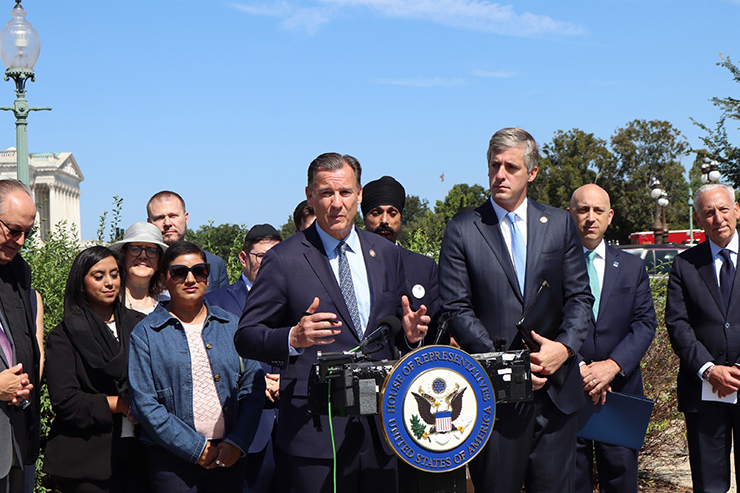
Congressman Tom Suozzi had introduced legislation protecting access to houses of worship when he learned that Republican Congressman Brad Knott of North Carolina was pursuing a similar measure. The Long Island and Queens Democrat agreed to combine their efforts, helping develop the bipartisan Right to Worship Act.
“He put down his bill, he joined this one, he contributed unbelievably productively to this bill’s formation,” Knott said in an interview. He also credited Suozzi with helping enlist Democratic Senator Elissa Slotkin of Michigan and Republican Senator Ted Cruz of Texas.
The proposal would impose civil penalties for interference with religious services or access to them. Sponsors say it protects congregants while preserving peaceful protest; critics question whether its language adequately safeguards lawful demonstrations.
“Exercising your right to worship should not require you to exhibit particular courage as you enter your synagogue, church, mosque, temple, mandir, or gurdwara,” Suozzi said at a September gathering in Glen Cove.
Suozzi became involved through Abraham Hamra, a constituent whose family came from Syria seeking religious freedom. After a demonstration at Manhattan’s Park East Synagogue, Hamra circulated a petition seeking federal protections outside houses of worship. It attracted approximately 10,000 signatures and reached Suozzi through the Holocaust Memorial and Tolerance Center in Glen Cove.
In April, Suozzi and Republican Congressman Max Miller introduced the SACRED Act, proposing restrictions on intimidation, obstruction, and harassment within 100 feet of a house of worship, including criminal penalties. Constitutional questions prompted Suozzi to consult legal scholars, including Berkeley Law Dean Erwin Chemerinsky.
Meanwhile, Moshe C. Davis and Sander R. Gerber were building support for legislation. Davis, formerly Mayor Eric Adams’ Jewish liaison and the first executive director of the Mayor’s Office to Combat Antisemitism, founded the Leonine Project after leaving City Hall. Through the Protecting Worship coalition, he helped recruit religious organizations and congressional offices.
Gerber, CEO of Hudson Bay Capital and a member of President Trump’s Intelligence Advisory Board, had a personal connection. His father, Marvin Gerber, attended Beth Israel Congregation in Ann Arbor, Michigan, where protesters have gathered during Shabbos services since 2003, displaying signs including “Jewish Power Corrupts.”
Marvin Gerber and fellow congregant Miriam Brysk sued for relief. In 2021, the Sixth Circuit recognized their concrete harm but found the nonviolent demonstrations constitutionally protected: Protesters had not blocked entry, trespassed, or interrupted services. The Supreme Court declined their appeal in May 2022 without ruling on its merits.
The case drove Sander Gerber’s pursuit of new remedies while demonstrating the constitutional hurdles. He and Davis worked with religious organizations as lawmakers negotiated revisions.
Introduced August 6, the Right to Worship Act named Knott as lead House sponsor, joined by Suozzi and Congressmen Mike Lawler and Josh Gottheimer. Cruz and Slotkin introduced the Senate companion.
The compromise replaced criminal penalties with civil fines and narrowed the conduct covered. It applies within 100 feet of an entrance from one hour before a scheduled service until one hour afterward. Fines begin at $2,500, increase to $5,000 for a second violation, and reach $10,000 for subsequent violations.
Individuals could seek damages or injunctions, while federal and state attorneys general could enforce the measure. An interstate-commerce requirement addresses federal jurisdiction; disruption is assessed through volume, duration, frequency, and effect.
The bill would not ban every nearby demonstration, instead targeting meaningful disruption or unreasonable interference with participation. Nevertheless, the Muslim Public Affairs Council and Bend the Arc: Jewish Action warn that its provisions and potential lawsuits could discourage lawful protest.
Agudath Israel supports the bill, citing Ann Arbor, Manhattan, and West Orange, New Jersey. Its congressional affairs director, Rabbi Yossie Charner, joined Orthodox Union, ADL, AJC, Jewish Federations, Hadassah, and other representatives outside the Capitol September 16. Christian, Muslim, Hindu, and Sikh organizations also supported the campaign.
Suozzi’s involvement follows years of support for Israel despite Democratic disagreements. Reflecting on his unsuccessful gubernatorial campaign and 2024 congressional return, he said, “I’m a little bit more fearless than I was last time around.” He has also credited President Trump’s Israel-related accomplishments.
Communal leaders, including the Orthodox Union’s Nathan Diament, have praised Suozzi’s record and collaboration with Knott. His positions have earned Jewish constituents’ support, while setting aside his own bill helped advance the joint proposal.
As of October 26, H.R. 10052 remains before the House Judiciary Committee, and Senate companion S. 5289 had not passed. Congressional action and the legislation’s ability to withstand constitutional challenges remain uncertain.
By Shabsie Saphirstein