
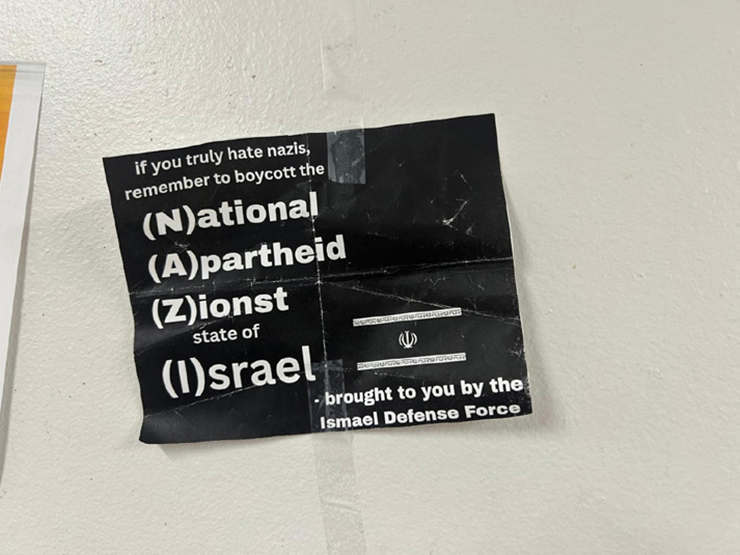
A flyer taped to a wall at Flushing High School is among 68 antisemitic and anti-Israel incidents documented in Queens public schools by United Jewish Teachers (UJT). As this newspaper prepared to go to press, UJT President Moshe Spern shared a photograph of the flyer and spoke about the continued harassment of Jewish students and employees.
Spern, a member of the West Hempstead Torah community, called on the Department of Education to protect Jewish students and staff and ensure that every school is a safe place for them to learn and work.
Released in August, UJT’s report documented 250 incidents across New York City public schools between October 2023 and July 2026. Queens accounted for 68 cases, approximately 27 percent of the total, second only to Brooklyn’s 91. Manhattan recorded 62, the Bronx 22, and Staten Island seven. The findings were sent to Mayor Zohran Mamdani and Schools Chancellor Kamar Samuels.
The photograph shows a flyer taped to a wall at Flushing High School, located at 35-01 Union Street. Its message begins, “if you truly hate nazis, remember to boycott the,” followed by the words “National Apartheid Zionst state of Israel,” with the initial letters arranged to spell NAZI. It also features imagery resembling the Iranian flag and the words “brought to you by the Ismael Defense Force,” an apparent play on the name of the Israel Defense Forces.
The May 28 incident was included in UJT’s Queens cases. The photograph documents the flyer’s appearance, but publicly available information does not establish who posted it or whether disciplinary action followed.
At Townsend Harris High School in Flushing, UJT reported that a student was harassed on May 1 over plans to join the Israel Defense Forces after graduation. The outcome of that complaint has not been publicly established.
A complete school-by-school breakdown of the 68 Queens cases has not been publicly released, leaving the outcomes of many complaints unknown.
According to UJT, 64.8 percent of the citywide cases involved direct acts against people or property, including harassment, threats, assaults, vandalism, and hate symbols. Another 23.2 percent concerned classroom instruction or educational materials the organization considered biased, particularly regarding Israel. Protests, walkouts, and related incidents accounted for 9.6 percent, with the remaining 2.4 percent classified as other incidents.
These figures represent cases collected and classified by UJT, not independently verified hate crimes. The report includes both antisemitic and anti-Israel incidents, and inclusion does not mean every allegation was substantiated by school authorities.
Townsend Harris has attracted additional attention following the release of internal Department of Education records obtained through a Freedom of Information Law request by Spern. Journalist Kevin Deutsch reported on the school’s involvement with the New York chapter of the Council on American-Islamic Relations (CAIR-NY), including its participation in a February 2026 session addressing hate crimes and bystander intervention.
UJT objected to CAIR-NY’s involvement, citing its positions concerning Israel, Zionism, and the International Holocaust Remembrance Alliance’s working definition of antisemitism. The records confirm CAIR-NY’s participation but do not establish that its programming was discriminatory or connected to the student’s subsequent harassment allegation.
UJT has also received complaints from Jewish teachers, paraprofessionals, and other public-school employees concerning workplace harassment and discrimination. Spern has criticized schools for allegedly removing swastikas and other antisemitic graffiti without adequately documenting the incidents or preserving evidence.
In a separate Brooklyn case, the Department of Education determined in September that social studies teacher George Trim violated Chancellor’s Regulation A-830, its nondiscrimination policy, following complaints about antisemitic conspiracy theories promoted in his public online videos. The material included allegations that the World Trade Center’s Jewish owner had advance knowledge of the September 11 attacks.
The department said it would work with the school’s principal on corrective action, although specific personnel consequences were not disclosed. Spern welcomed the finding, according to reporting by the New York Post.
Separately, on April 23, the U.S. Department of Education’s Office for Civil Rights opened a Title VI investigation into NYC Public Schools following complaints concerning educational seminars allegedly organized by employees associated with NYC Educators for Palestine.
Federal officials said the complaints involved materials concerning Palestine, Zionism, and resistance that could contribute to a hostile environment for Jewish students. NYCPS said the educators’ group was not officially affiliated with the school system. The investigation does not establish that discrimination occurred.
UJT has called on NYCPS to adopt the IHRA working definition of antisemitism, provide additional training, preserve evidence, review instructional materials concerning Israel, and establish centralized tracking of incidents and their outcomes. The proposed use of IHRA remains contested, particularly over its application to political criticism of Israel. Criticism of Israel is not inherently antisemitic; harassment based on Jewish identity, threats, and antisemitic conspiracy theories raise separate concerns.
NYC Public Schools maintains reporting procedures through its Respect for All program and separate channels for complaints involving employees. Its Anti-Hate Hotline, 718-935-2889, operates Monday through Friday from 8 a.m. to 6 p.m., and reports may be made anonymously. Complaints may also be emailed to This email address is being protected from spambots. You need JavaScript enabled to view it..
While the Flushing High School photograph and Townsend Harris records provide details of two Queens incidents, the outcomes of most of the 68 reported cases remain publicly unknown. A school-by-school accounting, with students’ privacy protected, would help parents and educators determine which complaints were substantiated, what action followed, and whether schools took steps to prevent further incidents.
By Shabsie Saphirstein