
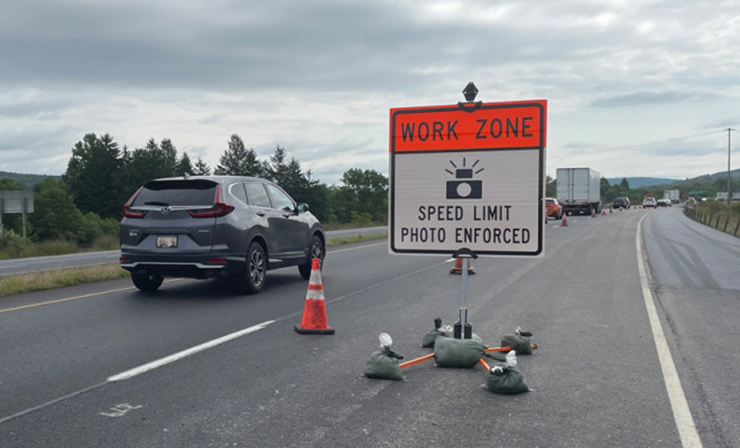
Drivers using MTA bridges and tunnels can now receive fines through a new automated work-zone speed enforcement program. Mobile cameras may photograph vehicles traveling more than 10 miles per hour above the posted limit while construction or maintenance crews are present.
The program applies at all nine crossings operated by MTA Bridges and Tunnels. Five are frequently used by Queens motorists: the Bronx-Whitestone, Throgs Neck, Cross Bay Veterans Memorial and Marine Parkway-Gil Hodges Memorial bridges and the Queens-Midtown Tunnel. The remaining locations are the Henry Hudson, Robert F. Kennedy and Verrazzano-Narrows bridges and the Hugh L. Carey Tunnel.
Unlike permanently installed school-zone cameras, the MTA’s equipment is mobile and can be moved among work sites. Drivers will see signs displaying the work-zone speed limit and warning that photo enforcement is in use. Electronic message boards may also alert motorists to slow down. The cameras may operate only while work is underway and crews are present.
The system records the vehicle’s speed, license plate, location, lane and direction of travel and captures images as it passes the camera. A certified MTA Bridges and Tunnels technician must review the evidence before a Notice of Liability is issued.
A violation is issued only when a vehicle is recorded traveling more than 10 miles per hour above the posted limit. A motorist traveling 41 miles per hour in a 30-mile-per-hour zone, for example, may receive a notice. If no separate work-zone limit is displayed, the regular posted limit remains in effect.
The cameras began operating June 30 during a warning phase, with monetary enforcement taking effect September 22. A first violation carries a $50 fine. A second violation within 18 months carries a $75 fine, while a third and each subsequent violation during that period carries a $100 fine. Additional penalties may be imposed when a notice is not answered on time.
As we go to press, the MTA has not released the number of warnings issued at each crossing or a breakdown between New York residents and nonresidents. Because monetary enforcement has only now begun, ticket totals for the individual bridges and tunnels are not yet available.
The MTA initiative expands a statewide program that has operated on New York State Department of Transportation and Thruway Authority roads since April 2023. Through December 2025, that earlier program issued more than 600,000 Notices of Liability during 9,163 deployments. Those figures do not include tickets from the new MTA bridge-and-tunnel enforcement phase.
A Notice of Liability is mailed to the vehicle’s registered owner, who remains responsible even if someone else was driving. Notices must generally be mailed within 14 business days when the owner is a New York resident and within 45 business days when the owner is a nonresident.
The violations are civil and do not carry license points or get reported to insurance providers. Motorists can review the photographic evidence using the notice number and PIN printed on the document. Instructions for paying the fine or requesting a hearing are also included.
The MTA program is separate from New York City’s school-zone cameras and the cameras mounted on buses to enforce bus-lane, bus-stop and double-parking restrictions. Each program operates under different rules and penalties. Drivers approaching an active work zone should follow the posted limit until they have left the marked area.
By Shabsie Saphirstein