


Major regional programming contest brings students from leading universities to Times Square as Touro teams put their skills to the test
More than 200 students from 22 colleges and universities, including Princeton, Cornell, Columbia, Yale, and New York University, gathered at Touro University’s Times Square campus last week for the International Collegiate Programming Contest (ICPC) Greater New York Regional Contest.
The event brought 66 teams to Touro, a New York-based international university with 18 campuses around the country and overseas, for five hours of intensive problem-solving, filling three rooms with students competing in one of the world’s best-known collegiate programming competitions.
Joe Terlizzi, director of the ICPC Greater New York Region, praised the university’s efforts.
“I want to thank Touro University and all the staff and volunteers who worked this weekend. It’s not easy to host this contest; lots of demands and stress,” Terlizzi said during the closing ceremony. “I think we can all agree that Touro put on a top-notch regional contest, and it’ll be hard for the next school to top.”
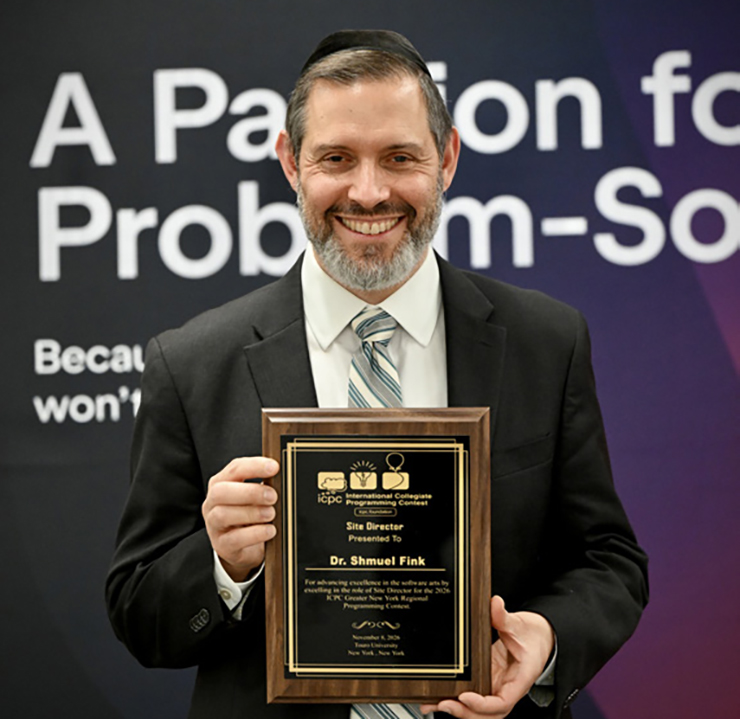
Organizers also presented a plaque to Dr. Shmuel Fink, associate chair of Touro’s Department of Computer Science, in recognition of his work organizing the event.
Touro Students Join the Competition
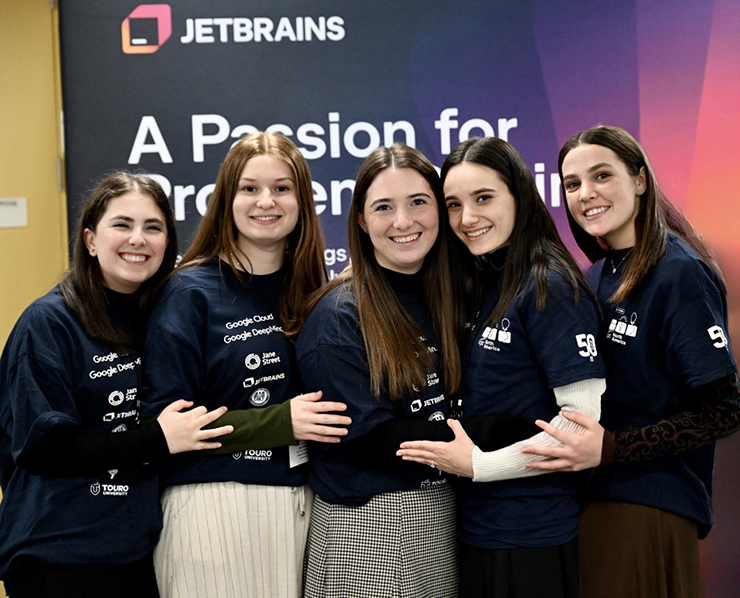
In addition to hosting the contest, Touro fielded three teams of its own. Five of the students participated in previous years, and two of Touro’s three teams were composed entirely of women. For Tehilla Sebrow, a senior computer science student at Touro’s Lander College of Arts & Sciences competing for the second consecutive year, the experience was especially meaningful, because women were relatively scarce among the hundreds of competitors.
“Women in STEM is not so common, and that was especially true at this contest,” Sebrow said. “So being able to represent Touro University as a woman was definitely very impactful.”
Unlike a hackathon, where participants typically develop a project, the ICPC challenges teams to solve a series of individual programming problems under time pressure. Success requires mathematical reasoning, programming knowledge, and creative thinking.
“They just bring a lot of really hard coding problems,” said Zecharia Davidson, a third-year computer science student at Touro’s Lander College in Flatbush, who was competing for the second consecutive year. “You have to figure out how to code it properly and solve what they give you.”
Putting Classroom Skills to Work
For Dr. Yitzchak Novick, a computer science professor who coached Touro’s three teams and has helped prepare students for the competition for more than a decade, the contest provides valuable experience beyond traditional coursework.
“When they participate, they are challenging themselves to take very theoretical skills and apply them to problem solving,” Novick said.
The Lander Colleges’ computer science curriculum emphasizes the same combination of theory and practical problem-solving on display at ICPC, including data structures, complexity theory, algorithms, programming languages, and software development, as well as AI. Students interested in continuing in the field can move into graduate study at Touro, including Touro’s Graduate School of Technology programs in artificial intelligence, cybersecurity and other computing disciplines.
To prepare for the competition, students draw on concepts learned in their classes, supplemented by practice sessions designed to familiarize them with the contest format.
Davidson said the preparation pushed him to explore material beyond his regular coursework.
“It forces you to practice things you don’t get to do in class,” he said. “I went online and looked at previous competitions, and I had to learn different things that classes don’t teach you so much.”
Sebrow said the contest requires students to collaborate closely, particularly because each team is allowed only one computer.
“You really have to coordinate with your teammates, which is one reason why it’s a lot of fun,” she said.
Competing With the Best
The opportunity to compete alongside students from some of the region’s leading universities was another benefit for Touro’s participants.
“They get exposure to some of the students from the top schools in the region, which is also, I think, very enlightening,” Novick said.
For Davidson, being surrounded by students who shared his interests was just as rewarding as the competition itself.
“It’s just really cool to be part of all this,” he said. “Everyone likes doing the same thing.”
Novick said the experience consistently leaves students with a sense of accomplishment, regardless of how their teams perform.
“I’ve never seen a student leave without a smiling face,” he said. “They have fun and they really love it.”