

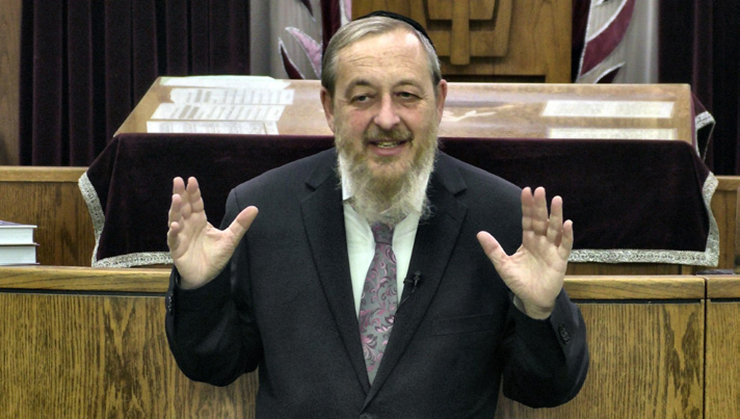
On Motza’ei Shabbos, October 24, the community gathered at the Young Israel of Queens Valley for an inspiring shiur given by renowned speaker, educator, and author Rabbi Menachem Nissel. Sponsored by Chazaq, JAspire, the Young Israel of Queens Valley, Eshel Avraham, and Milanas, the shiur opened with Rabbi Avraham Nissanian welcoming everyone and introducing Rabbi Nissel.
Rabbi Nissel shared that everyone is talking about Mashiach, noting that Chazal teach that before Mashiach comes, there is the Galus of Yishmael, who will commit ten crimes in the Land of Israel. So many of these have already occurred, and the terror throughout the world is bringing klal Yisrael to new levels of t’filah. All of this is unfolding before our eyes, at a time when the two main places where Jews live are Israel and the United States.
A question that bothered him personally was why great people he had seen in his lifetime, such as Rav Shlomo Zalman Auerbach zt”l, Rav Chaim Kanievsky zt”l, Rav Moshe Shapira zt”l, and Rav Elyashiv zt”l, all wanted to see Mashiach, yet they did not. The Chofetz Chaim kept a suitcase packed because he knew Mashiach could come at any moment. They were all holy people who lived such holy lives, and yet Mashiach comes for us while they are in a higher realm. The question is: Why us?
He shared the analogy of a marathon race: During the last five minutes, you see a runner who is sweaty and unkempt, yet everyone stands up for him. If you didn’t know he was in a marathon, you would wonder why everyone was cheering him on, but the answer is that he outran everyone else and made it into the stadium first. His job is to cross the finish line with all his sweatiness because all the hard work has already been accomplished.
The nimshal is that earlier generations have already accomplished all the hard work. Every generation has its leaders and challenges, and our generation has unique challenges of its own. Since we are closer to crossing the finish line, we must possess special forces to deal with these challenges.
Rabbi Nissel shared the famous midrash about Hashem saying to the angels, “Let us create man.” Emes and shalom were against it, while tzedakah and chesed were for creating man. He explained that with tzedakah and chesed, you can have one percent, but with emes and shalom, one percent doesn’t work because there is still sheker and fighting. Hashem said that, at the end of days, emes will come out and succeed.
The Maharal of Prague taught that emes is like a seed planted in the ground: It appears to disintegrate completely beneath the surface, but in reality, tiny pieces are coming together to form a new creation. Think of an apple seed versus an apple tree, and how we say in our davening that salvation comes like a seed.
Today, we live in a world of sheker, and you and I are the tiny, invisible dots left to help Mashiach come. When we come together, we will unleash an explosion like morning sunshine.
He said, “Yaakov will explode like the morning sun,” explaining that thick darkness precedes the dawn, which is where we are in history. We’ve replaced the G-dly world with concrete and machines, while Yishmael is sowing all the sheker in the world. An average person spends eight hours a day viewing sheker, and the worlds of sports and fashion are all sheker.
He described Hamas and the pro-Palestinian movement as based on sheker, noting that politics today consists of layers of sheker, as do the worlds of social media and business. We are raising our children and grandchildren in a scary world.
So, what does Hashem want from us? There are hidden sparks of emes, and “those are the people in this room.” Rav Hutner said that, after the Holocaust, Hashem changed how He runs the world: Instead of the pain of the rabbim, it is now the pain of the individual. Everyone is dealing with some sort of pain or challenge, confronting his own darkness, and it is extraordinary to see how people deal with it while holding onto emunah.
He pointed out that mental health challenges have become a tsunami, and the number one test we have is emunah. Holding onto emunah is one of our special forces today, and it is extraordinary to see heroes in our midst who deal with overwhelming personal challenges and come out with exquisite dignity.
There are three stresses today: social, monetary, and health. There are also three places that sheker can’t enter: the ohel of the Jewish home, the beis midrash, and the beis k’neses. These are places of emes, and the mezuzah contains Sh’ma, which is emes, all of which helps us connect to Hashem.
As Jews, we don’t belong to this world, for we are living on a higher plane. Hashem should bring Mashiach very, very soon.
Thank you to the sponsors and to Rabbi Nissel for this inspiring shiur.