During my teenage years, I often accompanied my father to a local Friday night Chumash shiur. Given by Rabbi Baruch Twerski, who had been my seventh-grade rebbi, the shiur was based on the thoughts of the Ohr HaChaim HaKadosh. Rabbi Twerski would have a pile of s’farim open, one on top of the other, and he would weave many different ideas together during the shiur. When the shiur ended, piping hot kugel and cold seltzer would be served. Back then, I did not appreciate seltzer much, preferring a cup of soda any day. But after that shiur, along with the hot kugel, that seltzer tasted divine.
Although it may seem otherwise, seltzer is not a Jewish invention. During the 1700s in Germany, wealthy patrons frequented hotels and spas in towns where there were natural springs. One of those towns was Niederseltzer. Seltzer seems to have derived its name from that town. The idea of adding carbon dioxide to water to make it bubbly originated in 1740 in Germany.
In the early 1900s, Eastern European Jewish immigrants in New York popularized the seltzer bottle home delivery service. The delivery man would affectionately be known as the “Seltzer Man.” Since then, seltzer has often been associated with the Jewish people, often referred to as “Jewish Champagne,” even though the drink had little to do with Jews beyond their delivery routes.
Those familiar with Rabbi Shmuel Kunda’s When Zaidy Was Young know that the children claimed: “Shabbos without seltzer is like Chanukah without latkes, Pesach without charoses, and Purim without sneakers.” To which Momma replied: “Seltzer is just water with some explosions going on inside the glass, and I do not have to pay good money to have my water exploding in a glass.”
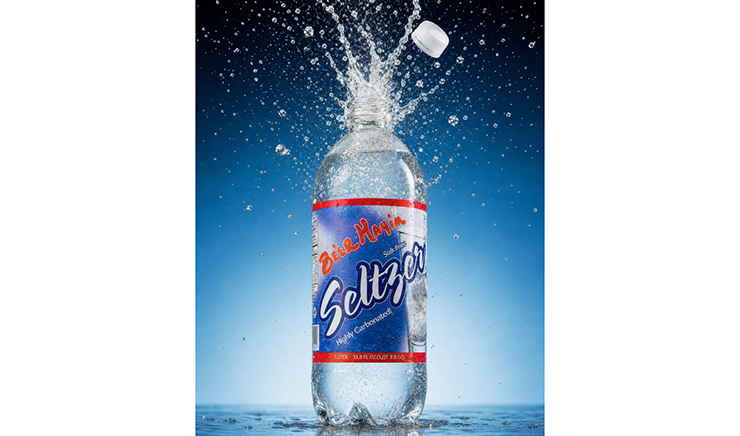
The reality is that Jewish seltzers are far more carbonated than their non-Jewish counterparts. There is nothing quite like the explosion within a cup of freshly poured Be’er Mayim or Mayim Chayim seltzer. Trying to open a bottle of kosher seltzer requires adroitness: Every trick is needed, including tilting the bottle 45 degrees, opening it very slowly, and closing it again repeatedly. Even then, chances are there will be a miniature explosion.
Non-Jewish companies produce many flavored seltzers; but personally, I do not think they taste anywhere near as intense and delicious as the Jewish brands. I have often wondered jokingly if it is even legal to have so much carbonation in a drink. I called the Be’er Mayim company and asked the representative why their seltzer is so much more intense than non-Jewish brands. The representative replied that it has to do with the water used: While other companies use regular sink water to produce their seltzer, Be’er Mayim uses well water, which allows the gas to be better absorbed.
The Yerushalmi (Sh’kalim 1:1) states: “Rabbi Ba bar Acha said: You cannot comprehend the contradictory behavior of this nation. On the one hand, they were solicited to donate gold for the Golden Calf and they gave: On the other hand, they were solicited to donate for the Mishkan and they also gave!”
This source in the Yerushalmi touches on the core of the Jewish soul. By nature, a Jew wants to give and wants to be involved. He has an explosive soul that pines to accomplish big things. If he channels that passionate drive correctly, he can light up the world with his ingenuity, resourcefulness, sagacity, and divinity. However, if he allows his passion to get the better of him, he can become a force of destruction, enabling and creating all forms of societal degeneration and corrosiveness.
My rebbi, Rabbi Berel Wein zt”l, quipped that Jews are a funny people: If you try to stop them from observing Torah u’mitzvos, they will fight you, literally to the death. But if you give them space, they often throw it all away. Is that not the story of much of American Jewry today?
The Jewish people are like a seltzer bottle: The energy and passion are always there, though sometimes they need their cap twisted off. Maybe that is the real reason why Jewish seltzer is so much sharper and bubblier than its goyishe counterparts.
Pesach Sheini provided a second chance for those exempted from offering Korban Pesach on the 14th of Nisan to offer it one month later on the 14th of Iyar. The opportunity was granted as the result of the complaints of those who were dissatisfied with an exemption. They pined for the opportunity to offer the unique Korban, so it was granted to them.
Tiferes Shlomo of Radomsk writes: “If only we were so bothered by missing out on the opportunity to offer Korban Pesach, which we have been unable to offer since the Beis HaMikdash was destroyed almost 2,000 years ago! Those men in that first year after the Exodus were enthusiastic about performing the avodah and were so deeply bothered by the missed opportunity.”
Lag BaOmer is also the celebration of the inner, hidden fire within the core of the Jew bursting forth from within. Rabbi Shimon bar Yochai recognized that inner fire within every Jew.
As we begin the homestretch toward Kabbalas HaTorah, these two minor holidays spur us on. They slowly help awaken our inner passion and help us build excitement for the great holiday of Shavuos. The collective Jewish seltzer cap is being opened, allowing our internal fizz to rush forth.
Rabbi Dani Staum is a popular speaker, columnist, and author. He is a rebbi in Heichal HaTorah in Teaneck, New Jersey, principal of Mesivta Orchos Yosher in Spring Valley, New York, and a member of the administration of Camp Dora Golding. His writings can be found at strivinghigher.com. Looking for an inspirational speaker or scholar-in-residence? Contact Rabbi Staum at 845-641-5094 or at This email address is being protected from spambots. You need JavaScript enabled to view it..