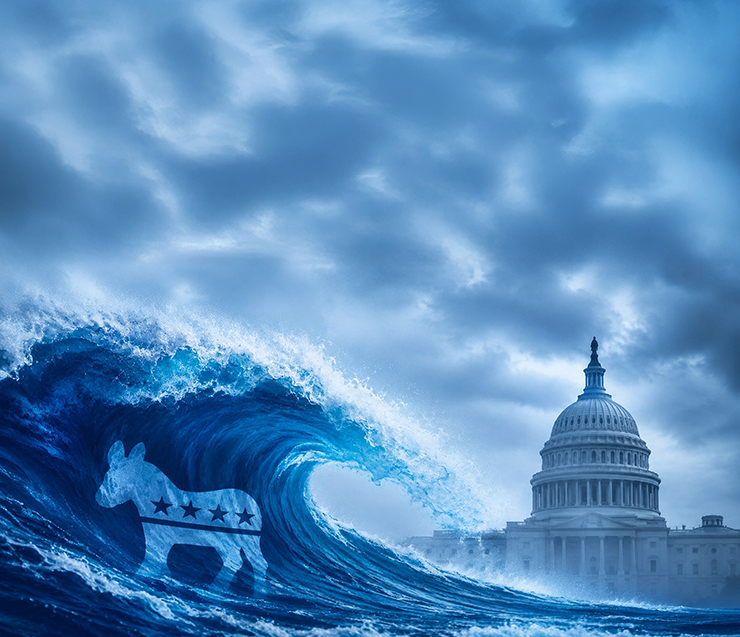
It turns out that the polls were right, and the midterm elections have delivered control of both the House and the Senate to the Democrats. This sets up two years of divided government with President Trump still in the White House. This was obviously a devastating result for many in the Jewish community, as several antisemites are entering the House of Representatives and the Senate in January. However, it is worth sorting through which of our legitimate concerns will come to fruition and what is mostly noise from political commentary.
The first issue we should be nervous about is refunding USAID and restoring the foreign aid apparatus that the Trump administration dismantled. USAID started as an anti-Soviet measure but evolved into a way to waste taxpayer money on leftist ideology and was a slush fund for liberal causes. The same people who find a problem with foreign spending when Israel is involved happily flush billions down the proverbial toilet every year. The same is true of the United Nations, especially UNRWA, and other international organizations that take American dollars and then spit in our faces.
Democrats will also likely move to defund or restrict the military and law enforcement, particularly ICE. To Democrats, security is not an issue because they are beholden to college campus activists who have been taught that America is the nefarious force in the world. So anyone attacking us is correct, and anyone who comes here should stay. This is a return to the disastrous Biden era that caused more war, chaos, and destruction, not less. Regardless of what you think of Trump and his actions, both domestically and abroad, it is undeniable that we need security, and Democrats will move to remove that.
These policies could easily be part of any government funding deal coming out of this Congress, which can pass a budget with only a simple majority. While Trump could, in theory, veto the budget, Democrats could easily add provisions that would make it incredibly unpopular for Trump to veto. It would not be surprising if Democrats put in minimal funding for border security and a lot of funding for immigration judges (similar to the Border Act in 2024) in preparation for a return to an open border and blanket amnesty, with the media framing the budget as a “comprehensive immigration control” budget that pressures Trump into signing. This is merely one example of how a Democratic Congress could still harm the country, even with Trump as a check on its power.
Of course, the true concern is 2028. Democrats are poised for a big victory there as well. If they nominate someone palatable to the American people, they will win. The only shot Republicans have is if Democrats get too confident and nominate someone like Alexandria Ocasio-Cortez and Republicans have a true professional like Ron DeSantis or Marco Rubio.
Vice President JD Vance is currently the favorite for the GOP nomination in 2028 and has already begun that process by blaming the Iran war for the Republican losses and calling for a change in the relationship with Israel. His post-election comments place him closer to the Tucker Carlson and Thomas Massie wing of the party, who spend far too much time listening to podcast bros and social media, than to the more conventional conservative approach that treats military readiness and strategic partnerships as non-negotiable. Vance as the nominee could mean President AOC.
While Democrats in control of the presidency and Congress will have disastrous effects on the country and the world, that is two years away from fruition. Outside of the budget, Democrats in the Senate will require 60 votes (for now) to pass any legislation. Trump has a unique ability to work with anyone, even people who are seen as enemies, like Zohran Mamdani. Trump brought in Nancy Pelosi and Chuck Schumer in 2017 to try to set a legislative agenda, even though they were both in the minority at the time. It is unlikely that Hakeem Jeffries and Schumer, should they remain in leadership positions, will work with Trump.
Israel is the area where the next two years will be difficult rhetorically but not legislatively. We now have multiple members of Congress who are more comfortable with a keffiyeh draped around their shoulders than an American flag. However, the Jewish state has demonstrated repeatedly that it can defend itself when necessary, with or without American military assistance. President Trump has already said that the military aid will expire at some point soon, something that Benjamin Netanyahu wants as well. The issue going forward is not that half of the Democrats want to halt or condition aid; it’s that they want a full arms embargo, even for defensive weapons, on Israel. That is the extremist position, and Israel has two years to prepare for a world where America cannot legally sell it arms.
So President Trump will be using the veto pen. Most of what Democrats pass will die on his desk unless they can assemble the supermajorities required to override, which they cannot. So they will likely try to pass popular yet bad policies, knowing they will have election talking points but no real-world repercussions. We will mostly spend the next two years in gridlock.
What is deeply worrying is the longer-term institutional strategy Democrats have demonstrated whenever they gain power. They do not simply govern for a term and then face the voters again. They change the rules to make future losses less likely. California provides the clearest example. The state adopted a top-two primary system that frequently produces general elections between two Democrats, effectively locking Republicans out of November ballots in many cities, congressional districts, and even statewide races. At the same time, sanctuary policies and expansive benefits for noncitizens have made it so no Republican could possibly win in California.
New York followed a similar path. After Democrats regained the State Senate in 2018, they redrew the map to cement their advantage. They also passed legislation moving local elections to even-numbered years, aligning them with high-turnout federal contests. That change means that people no longer consider local issues; they lump them in with statewide and national issues. Local government should not be an afterthought, because that’s how you get the problems of an overreaching federal government that we have today. Democrats took power and changed the rules to keep and expand that power.
This is the biggest fear going into 2028. If Democrats win the presidency, they can nuke the Senate filibuster, which means they only need 51 votes. They can change the voting rules, making it illegal to show ID at the polls and making it automatic that every household gets ballots that can be picked up by anyone. These are measures that Democrats have taken in California. They can even try to get noncitizens to vote, which is what they have done in some districts in Vermont, Maryland, and elsewhere.
The Senate is likely lost to Republicans until 2032, given the map for the next two elections. This means that even if Republicans can squeak out a victory in 2028, the next president will be dealing with a divided Congress the entire time. This was a devastating loss for Republicans and America, and it’s something the country will be reckoning with for a long time. That’s the bad news. The good news is that there are other elections (despite what Democrats say every time they lose). It is incumbent upon the Republican Party to show the American people that voting for the socialists to take over will lead to our own demise.
nist. His work can be found at www.aHillwithaView.com and on X at @HillWithView.